
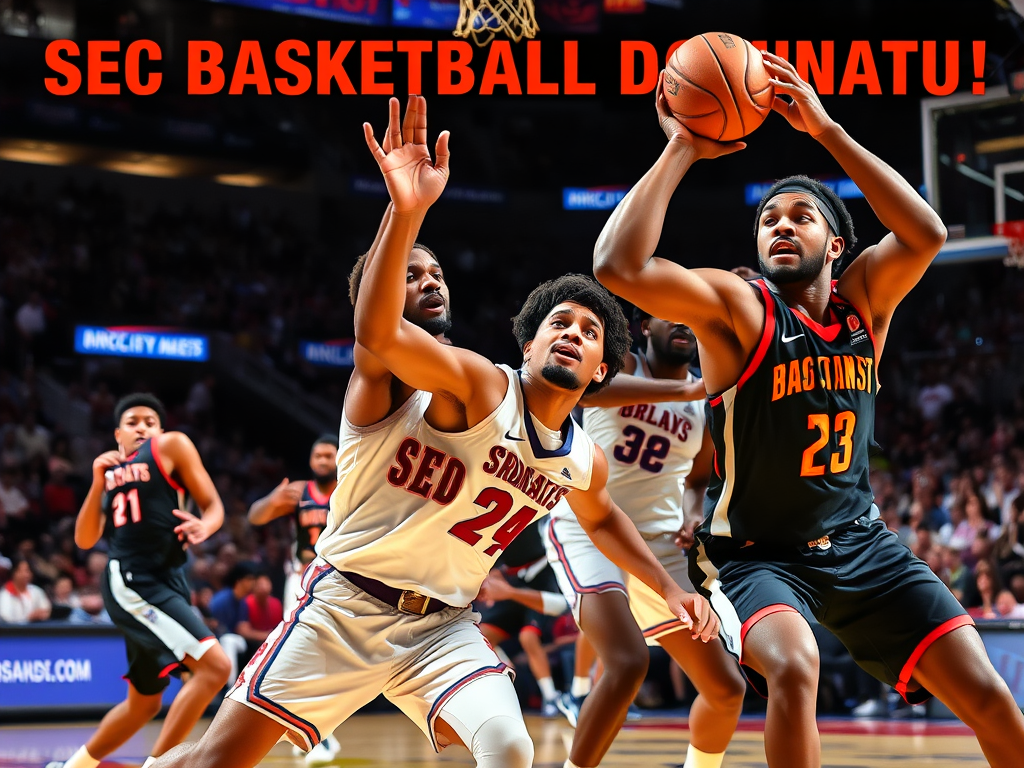

SEC Breaks NCAA Tournament Records with 14 Teams

In the SEC, success now translates to an unprecedented number of NCAA Tournament teams—more than any other conference has ever achieved.
On Selection Sunday, Auburn, Duke, Houston, and Florida earned No. 1 seeds in the NCAA men’s basketball tournament, marking the first time in 45 years that the SEC secured multiple top seeds. Additionally, the conference shattered records by sending 14 teams to the tournament.
“I felt confident that all 14 teams deserved a spot, but you can never be certain until it’s official. So, I wasn’t overconfident—just relieved and pleased when it was confirmed,” SEC Commissioner Greg Sankey told The Athletic on Sunday night.
Two-time defending national champion UConn (23-10) will attempt to win a third consecutive title as a No. 8 seed in the West Region. They open against Oklahoma, with a potential second-round matchup against Florida.
For only the second time in program history, Auburn has secured a No. 1 seed, the first since 1999. This year, they are the tournament’s top overall seed. Led by national player of the year contender Johni Broome, coach Bruce Pearl’s Tigers will begin their championship quest on Thursday in Lexington, the home of SEC rival Kentucky. They will face the winner of the First Four game between No. 16 seeds Alabama State and Saint Francis (Pa.), hoping to claim the program’s first-ever national championship.
Despite winning the SEC regular-season title, Auburn (28-5) heads into the tournament on a challenging note, having dropped three of their last four games—all against ranked conference opponents. The SEC, now arguably the strongest and deepest league in college basketball history, has solidified its reputation. While SEC football dominance has been challenged by back-to-back Big Ten titles, basketball in the Deep South has never been stronger. The SEC posted an impressive 59-19 record against teams from the ACC, Big Ten, Big 12, and Big East.
With its recent expansion to 16 teams, the SEC surpassed the previous record of 11 bids set by the 2011 Big East, earning three additional tournament spots.
The sheer number of SEC teams in the field created a logistical challenge for the NCAA selection committee, which aimed to minimize early-round intra-conference matchups.
“We didn’t alter any team’s seed line, but we had to shuffle teams around to limit early conflicts,” committee chairman and North Carolina athletic director Bubba Cunningham explained on CBS’ bracket reveal show. “We ensured no more than four SEC teams landed in the same region to spread them out as evenly as possible.”
Nine years ago, the SEC sent only three teams to the tournament for the third time in four seasons. Determined to elevate the conference’s basketball standing, Sankey enlisted former Big East Commissioner Mike Tranghese as an advisor. Since then, the league has made significant investments in basketball, leading to its resurgence.
“We’ve seen new arenas at Auburn and Ole Miss, as well as major renovations at Kentucky, Florida, and Georgia. Practice facilities have improved across the board. Every one of our 16 coaches has NCAA Tournament experience, and six have reached the Final Four—that’s a testament to our athletic directors,” Sankey noted. “It all comes down to our universities striving for excellence in men’s basketball, just as they have in women’s basketball, football, baseball, and softball.”
Duke (31-3) secured a No. 1 seed for the 15th time, tying Kansas for the second-most in history behind North Carolina. Meanwhile, North Carolina’s tournament worthiness was debated throughout the season, but coach Hubert Davis’ team squeezed in as a No. 11 seed. They will face San Diego State in the First Four in Dayton, Ohio, on Wednesday.
Due to selection committee protocol, Cunningham recused himself from discussions regarding North Carolina (22-13), which played one of the nation’s toughest nonconference schedules but secured only one Quad 1 win.
Sun Belt Commissioner and committee vice chairman Keith Gill addressed North Carolina’s inclusion during the selection show.
Gill explained that when the committee finalized its at-large selections on Saturday night, North Carolina was the last team in—contingent on Sunday’s American Athletic Conference championship between UAB and Memphis.
“If UAB had won, Memphis would have claimed an at-large bid, UAB would have received the automatic bid, and North Carolina would have been the first team left out,” Gill said.
Ultimately, West Virginia of the Big 12 became the first team out, followed by Indiana and Ohio State from the Big Ten, and Boise State, which lost the Mountain West title game to Colorado State. The Rams were the tournament’s lone bid-stealer, effectively taking Boise State’s spot.
The expanded 18-team ACC secured only four bids—its lowest total since 2013.
For Duke, this marks its first No. 1 seed since 2019 and its first under coach Jon Scheyer, who succeeded five-time national champion Mike Krzyzewski three years ago.
Duke will open play in Raleigh, N.C., on Friday in the East Region. However, the status of star freshman Cooper Flagg remains uncertain after he sprained his left ankle in the ACC tournament. The Blue Devils still claimed the ACC title without him, and he is expected to be available for the NCAA Tournament.
Houston (30-4), the Big 12 champions under coach Kelvin Sampson, earned a No. 1 seed for the third straight season. They will start their tournament run in the Midwest Region on Thursday in Wichita, Kansas, facing SIU Edwardsville. The Cougars are seeking their first Final Four appearance since 2021 and their first-ever national championship.
Florida (30-4) secured the No. 1 seed in the West Region by defeating Tennessee in the SEC tournament final. The Gators are a top seed for the third time, their first since 2014 under coach Billy Donovan, who led Florida to back-to-back NCAA titles in 2006 and 2007. The last time the SEC had multiple No. 1 seeds was in 1980 when LSU and Kentucky accomplished the feat. The conference’s most recent national championship came in 2012, courtesy of Kentucky.
Donovan’s former mentor, Rick Pitino, is back in the NCAA Tournament, this time leading St. John’s (30-4). The Big East champions are the No. 2 seed in the West and will face Omaha from the Summit League in Providence, R.I. A potential second-round matchup against the winner of Kansas vs. Arkansas could set up a showdown between Pitino and longtime rival John Calipari.

At 72, Pitino has become the first coach in history to lead six different programs to the NCAA Tournament: Boston University, Providence, Kentucky, Louisville, Iona, and now St. John’s.
The SEC also placed two teams on the No. 2 line, with Alabama joining Duke in the East Region and Tennessee slotting in behind Houston in the Midwest.
New SEC member Texas narrowly made the field despite a 6-12 conference record. The Longhorns will play Xavier in a First Four game on Wednesday.
Oklahoma, also sporting a 6-12 SEC record, earned a bid thanks to marquee nonconference victories over Michigan, Arizona, and Louisville.
The newly expanded 18-team Big Ten secured the second-most bids with eight.
In a sign of the growing dominance of super conferences, only seven leagues received multiple bids. Notably, the SEC and Big Ten combined for 20 at-large berths, while the rest of the country claimed just 17.
The Big 12 landed seven teams in the tournament, while the Big East earned five. The Mountain West placed four teams, and the West Coast Conference secured two bids with Gonzaga and St. Mary’s.
Gonzaga extended its NCAA Tournament streak to 26 consecutive appearances, the second-longest active streak behind Michigan State’s 27. The Spartans are the No. 2 seed in the South Region behind Auburn. Meanwhile, Gonzaga, the No. 9 seed in the Midwest, faces Georgia in the first round, with top-seeded Houston likely awaiting the winner.


Leave a Reply