
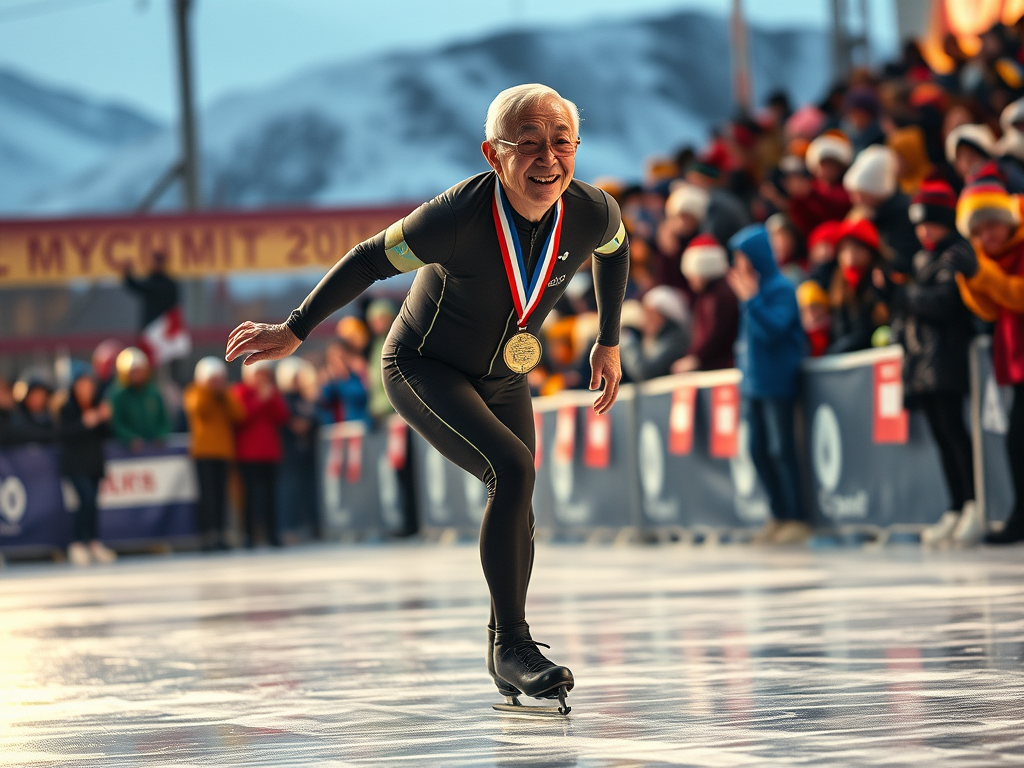

When Iichi Marumo took part in his first international speedskating competition seven years ago in Moscow, his pace on the ice resembled a brisk jog. Compared to the other skaters that day, he took three times as long to reach the finish line.
At 95, He’s the World’s Oldest Speedskater. He’s Gunning for 100.

But that didn’t matter—because Mr. Marumo was also three times their age. At 88, his time was still fast enough to secure a silver medal in the 85-and-over category.
Since then, he has won nothing but gold. Now 95, he competed in his most recent race—a national event in Japan this past January—in a category created specifically for him: 95 and over.
So far, he’s the sole participant.
“Every time I show up, I win gold,” Mr. Marumo said in an interview at his home in Chino, a small city nestled in the rugged mountains of central Honshu, Japan’s main island. To prove his point, he pulled out a plastic shopping bag brimming with more than 20 gold medals, including ones from competitions in the Netherlands and Canada.

A small man with slightly bowed legs and a mischievous smile, Mr. Marumo has been skating his entire life. However, he only began competing at an age when most people consider themselves lucky just to be alive. A collection of Guinness plaques on his wall confirms his title as the world’s oldest male competitive speedskater. His closest competitor, a Norwegian skater, is a full five years younger. (Meanwhile, the oldest active female speedskater is an 80-year-old Dutch athlete.)
His achievements are just the latest chapter in an extraordinary life. A World War II survivor who once volunteered for a kamikaze mission, he later earned recognition from Japan’s emperor for helping farmers profit from growing celery. He also publishes a monthly magazine dedicated to traditional Japanese poetry.
At his age, speedskating is less about speed and more about perseverance. Dressed in compression pants and a skintight racing suit, he carefully glides across the ice, mindful of his balance. The crowd greets him with enthusiastic cheers, and he waves back with a smile.

Interestingly, racing wasn’t even his idea. A friend initially challenged him to compete as a dare. But what started as a playful challenge has turned into a joyful way to spend his later years.
“I never imagined I’d become an international racer,” Mr. Marumo admitted.
In Japan—one of the world’s fastest-aging societies—he has become something of a celebrity, inspiring a surge of interest in senior sports. The country has produced some of the oldest winter sports competitors, including two Japanese women holding Guinness World Records for being the oldest downhill and cross-country skiers. Yet even they are at least five years younger than Mr. Marumo.
“He’s the face of senior winter sports in Japan, possibly even the world,” said Kenji Takai, director of the Japan Association for Winter Masters Sports. “He’s inspiring people to follow in his footsteps.”
Mr. Marumo and other senior athletes are redefining the boundaries of aging in sports. In speedskating, the Masters category typically starts at age 30, meaning Mr. Marumo is more than three times older than the youngest competitors.


Masters-level speedskating is divided into five-year age brackets so that skaters compete against others of similar physical ability. Since Mr. Marumo’s debut race in 2016—when he was 86—Japan’s skating federation has created three new age divisions just for him, including the current 95-and-over category.
“I hope he keeps going until we have to introduce a 100-and-over category,” said Mr. Takai.

Mr. Marumo himself hopes to skate at 100, though he knows it won’t be easy. He has had a few falls, the worst occurring in his most recent race in January. A blizzard rolled in just as the starting pistol fired, and he fell early in the race. Unable to stand back up, he crawled across the ice to the finish line.
It took him 17 minutes to complete the 500-meter race.
“My left leg went numb from the pain,” he recalled, “but I had to finish.”
Afterward, he announced his retirement to undergo hernia surgery. Yet, as time passed, he reconsidered. Now, he says he might return to racing next year if he feels strong enough.
Mr. Marumo first stepped onto the ice around 1940, when he was about 10. In those days, he tied handmade metal blades to wooden sandals and raced against his elementary school classmates across frozen rice paddies. But his childhood ended at 15 when he volunteered for Japan’s kamikaze missions during the final stages of World War II. Trained as a radioman for a two-seat bomber meant to crash into enemy warships, he was spared only because the war ended before his mission took place.

That second chance, he said, taught him to make the most of life. After returning to his family farm, he noticed a few stalks of celery growing. At the time, celery was rare in Japan, but he figured out how to cultivate it in the local soil, turning it into a profitable crop. In 1970, Emperor Hirohito honored him with an award for his contributions to agriculture.
Alongside farming, he developed a passion for tanka, a form of traditional Japanese poetry. The rhythmic structure of tanka, he noted, reminded him of the military songs that once convinced him to volunteer for war. But now, he writes poems that celebrate peace. In 2002, he took over the publication of a tanka magazine, which he has been editing and publishing ever since.
Even after the war, he continued ice skating, primarily for exercise. As a city council member in the late 1980s, he successfully lobbied for the construction of a local speedskating rink—never imagining he himself would one day compete on it.
It wasn’t until he was 86 that a friend urged him to enter a race. “There’s no one else your age competing,” his friend told him. “You’ll get a medal just for showing up.”

Despite his success, Mr. Marumo’s lifestyle has remained largely unchanged. Speedskating serves as his main form of exercise, and he does little additional training. “I believe in not overdoing it,” he said.
Traveling to competitions can be exhausting, especially overseas, but he finds his forgetfulness to be the bigger challenge. Once, he arrived at the airport without his passport, causing him to miss his flight—and nearly the entire competition.
Still, speedskating has become more than just a sport for him. It’s a way to celebrate a life that was almost cut short by war—a life he’s not ready to leave behind just yet.
“I retired once,” Mr. Marumo said. “I don’t want to do that again.”


Leave a Reply