

An Unexpected Trump Bump for the World’s Centrists

In Britain, a struggling prime minister has unexpectedly been elevated to the status of a statesman, while his rising populist opponent finds himself on the defensive. In Canada, the ruling Liberal Party, once considered unlikely to win another election, now sees a viable path to victory. Meanwhile, in Germany, the incoming center-right chancellor is setting the political agenda, defying predictions that the far right would make a major breakthrough.
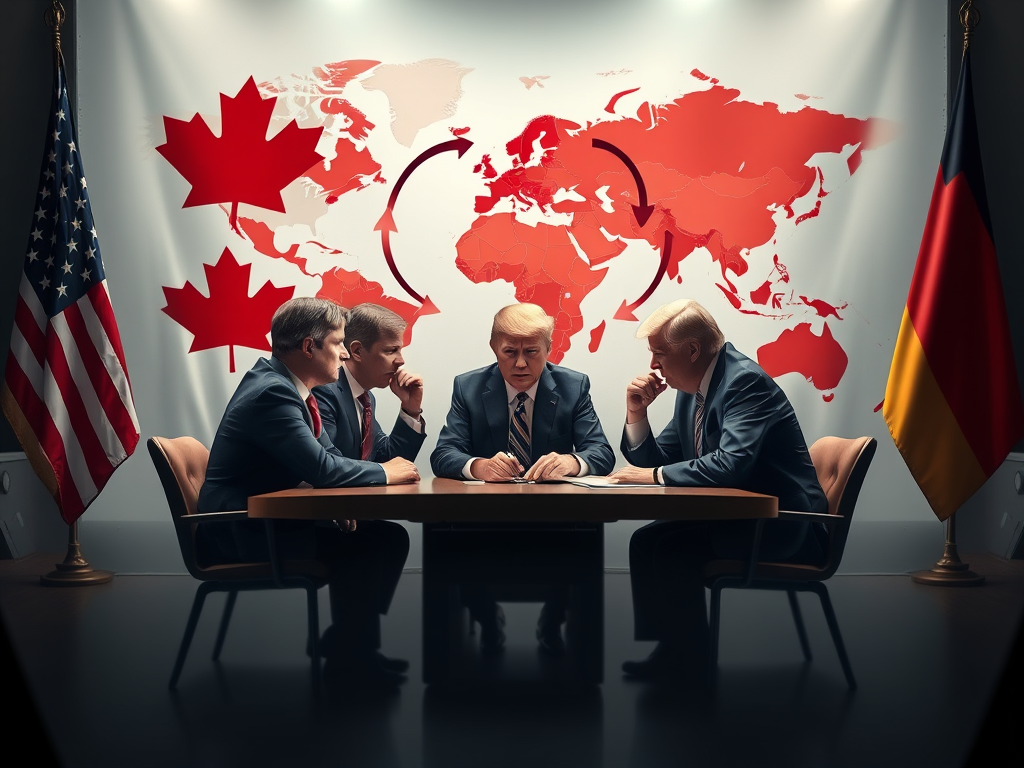
As President Trump’s aggressive policies send shockwaves across the globe, they are reshaping international politics in unexpected ways.
Trump’s sweeping tariffs and open challenges to the transatlantic alliance have revitalized centrist leaders, boosting their popularity as they push back against the American president. His confrontational stance on Ukraine and his alignment with Russia have left right-wing populists in countries like Britain and Germany off balance, stalling their momentum despite Trump’s return to the White House.
“Perhaps one of the greatest ironies of Trump’s presidency is that he has become a unifying force for Europe,” noted Constanze Stelzenmüller, a transatlantic relations expert at the Brookings Institution in Washington. “The level of shock among Europeans is difficult to overstate.”
The impact of Trump’s influence extends beyond Europe. In Mexico, President Claudia Sheinbaum has earned widespread approval for her composed response to Trump’s tariffs, leading to soaring poll numbers. In Canada, Mark Carney, a former central banker, has risen to the leadership of the Liberal Party with an overwhelming 86 percent of the vote, largely due to his perceived ability to navigate a trade war with the United States.
Under Justin Trudeau, the Liberals trailed the Conservatives by double digits, but Carney’s leadership has significantly narrowed the gap. With an election on the horizon, the party now stands within reach of victory. Meanwhile, Conservative leader Pierre Poilievre has struggled to regain traction, as Liberals capitalize on the opportunity to brand him as Canada’s version of Trump.

In Europe, where many feared a populist wave similar to the one that carried Trump back into office, the president’s policies have had an unintended effect—reinforcing the position of mainstream leaders. Faced with U.S. tariffs and the challenge of an increasingly adversarial ally, centrist politicians have found political strength in standing together.
Prime Minister Keir Starmer’s flurry of diplomatic activity—seeking to organize a European peacekeeping force for Ukraine while working to mend relations with Washington—has earned him praise across Britain’s political spectrum. His approval ratings, which had plummeted in his first six months in office, have shown signs of recovery, though he remains underwater in net favorability.
“He needed something to turn things around, and this appears to be it,” said Tim Bale, a politics professor at Queen Mary University of London. “A prime minister performing well on the global stage is not insignificant.”
At the same time, Nigel Farage, leader of the anti-immigration Reform U.K. party, has hit his first major stumbling block since his election to Parliament last July.
Farage, a longtime Trump ally, has faced backlash over perceived sympathies toward Russian President Vladimir Putin. His criticism of Ukrainian President Volodymyr Zelensky for not wearing a suit during his White House meeting with Trump backfired, as the British public overwhelmingly sided with Zelensky.

Further turmoil struck Farage’s party last week when Reform U.K. reported one of its own lawmakers, Rupert Lowe, to the police for allegedly threatening a senior colleague—an accusation Lowe denies.
According to analysts, Farage’s position may be further weakened by the loss of support from Elon Musk, Trump’s close ally. Musk had previously endorsed Farage but withdrew his backing in January, instead praising Lowe, saying Farage “does not have what it takes.” In a recent interview, Lowe criticized Farage’s leadership, claiming Reform had become “a protest party led by the Messiah.”
“To some extent, Farage has made himself quite vulnerable,” said Professor Bale.
Last week in Parliament, Starmer received thunderous applause from both Labour and Conservative MPs when he rebuked Farage for his history of pro-Putin remarks and reaffirmed Britain’s unwavering support for Ukraine.
“Zelensky is a wartime leader whose country has been invaded,” Starmer declared as Farage looked on, visibly subdued. “We should be standing with him, not pandering to Putin.”
Analysts suggest that linking Farage to Putin is a more effective political strategy than portraying him as an enemy of the establishment, as populist leaders often thrive on opposition from mainstream institutions.

“The mistake is to simply label populists as the enemy,” said Ben Ansell, a professor of comparative democratic institutions at the University of Oxford. “It’s far more effective to tie them to a larger external threat.”
Farage’s ties to Trump have also become a liability. Trump’s unpopularity in Britain, coupled with his erratic leadership style, offers little in the way of policy successes that Farage or other right-wing figures can champion.
Even with recent electoral gains for the far right in Germany, the Netherlands, Poland, and Austria, Professor Ansell believes Europe may have already seen the peak of its populist surge. In Austria, for example, the far-right Freedom Party secured the most votes but was ultimately shut out of government, as three mainstream parties united to form a coalition instead.
In Germany, the hard-right Alternative for Germany (AfD) emerged as the second-largest party in recent elections, trailing only the Christian Democrats under Friedrich Merz, the likely next chancellor. Despite endorsements from Musk and U.S. Vice President JD Vance, AfD’s performance fell short of some expectations.
“It’s alarming enough that 20 percent of voters backed an anti-establishment, pro-Russia party,” said Stelzenmüller. “But it’s clear that Musk’s and Vance’s attempts to boost AfD didn’t yield the results they hoped for.”

Since the election, AfD has played a limited role in shaping Germany’s political landscape. Merz has instead taken center stage, pushing for a historic relaxation of Germany’s debt restrictions to finance a massive military buildup. He has positioned himself as the leader of a Europe that must take responsibility for its own security in light of Russia’s aggression and the growing unreliability of the United States.
However, Merz is moving quickly because AfD’s presence in the next Parliament could complicate his efforts to pass such measures. With AfD opposing the military spending increase, their numbers could be enough to block the proposal.
Merz still faces significant hurdles, needing substantial backing from the Green Party to meet the two-thirds majority required in Parliament. Behind closed doors, his aides argue that Trump’s foreign policy stance provides their best justification for pushing the measure through—after all, he is the first American president to so explicitly threaten to withdraw U.S. support.
Both in Britain and Germany, political dynamics remain fluid. Starmer’s pledge to increase defense spending is likely to spark difficult debates over taxes and government expenditures within the Labour Party. His recent diplomatic victories may prove short-lived if he fails to revive the economy and improve public services.
In that sense, Starmer’s leadership shares an unexpected parallel with Trump’s: both have seen their political fortunes fluctuate dramatically. However, while Trump’s turbulent presidency has so far benefited centrist leaders, whether this advantage will last remains an open question.
“The initial luster of Trump’s return has faded, and his foreign policy and economic decisions have taken a dark turn,” said Professor Ansell.



Leave a Reply