

After Nearly 125 Years, a Lost Jewel by Ravel Gets Its Premiere

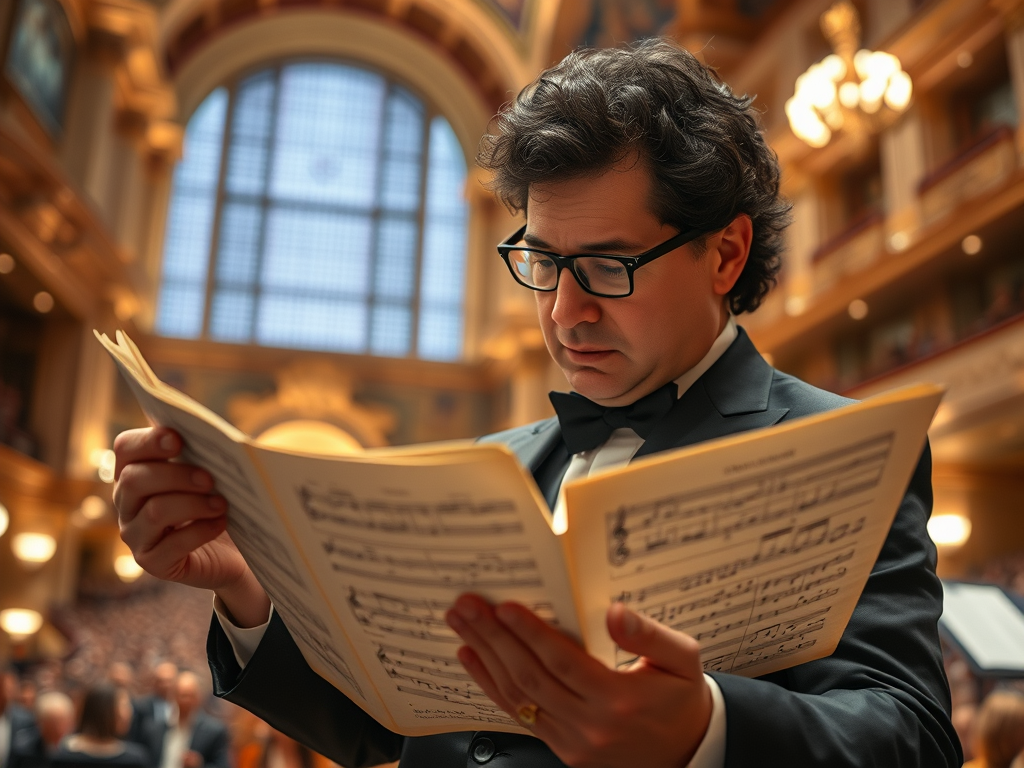
Gustavo Dudamel has introduced numerous works throughout his career, but the score he was eagerly examining one recent afternoon at Lincoln Center was something quite different—an almost 125-year-old composition by Maurice Ravel that had only recently emerged from obscurity in a Parisian library.
“Imagine discovering a small, exquisite gem more than a century later,” said Dudamel, the incoming music and artistic director of the New York Philharmonic, in an interview at David Geffen Hall. “It’s truly precious.”
On Thursday, Dudamel and the Philharmonic will present the world premiere of this five-minute piece as part of a program honoring the 150th anniversary of Ravel’s birth. Ravel, one of the most influential composers of the 20th century, is best known for works like Boléro, Le Tombeau de Couperin, and La Valse.
The newly uncovered work, Sémiramis: Prélude et Danse, was composed sometime between 1900 and 1902, during Ravel’s late twenties—a period marked by his clashes with administrators at the Paris Conservatory, where he studied piano and composition.

Drawn from an unfinished cantata about the Babylonian queen Semiramis, the piece offers a glimpse into the young composer’s developing artistic voice. It also reveals his admiration for other composers, such as the Russian master Rimsky-Korsakov. While Sémiramis lacks the rich harmonies and layered textures that later defined Ravel’s style—a fusion of French impressionism, Spanish melodies, baroque elements, jazz, and more—it still hints at his unconventional approach.
The manuscript, spanning more than 40 pages, includes an aria for tenor and orchestra that will not be performed in this premiere. That section will debut in December in Paris, conducted by Alain Altinoglu with the Orchestre de Paris.

For the New York Philharmonic, Sémiramis is a remarkable find, arriving just as the orchestra prepares for Dudamel’s tenure, set to begin in fall 2026. It is rare to discover unpublished works by major composers, particularly one as selective as Ravel, who, despite his influence, wrote fewer than 80 pieces in his lifetime.
Dudamel emphasized the challenge of interpreting Ravel’s intentions, as the manuscript lacks a tempo marking at the beginning and contains some missing notes, particularly in the harp part.
“This adds extra pressure,” he admitted. “All I can hope for is that Ravel somehow sends me a message in my dreams.”
The discovery has sparked excitement among the Philharmonic musicians, who, lacking recordings or detailed scholarly analysis, have been collaborating closely to determine the phrasing and dynamics.
“It’s a rare, vulnerable moment for Ravel,” noted Julian Gonzalez, the Philharmonic’s associate principal bassoon. “He won’t be at rehearsals. He can’t revise anything. It’s up to us to bring his music to life.”

The manuscript had actually been in the archives of the Bibliothèque Nationale de France since 2000, after the library acquired it in an auction of Ravel-related materials. However, it only came to light recently, as researchers searched for new pieces to feature in celebrations of Ravel’s 150th birthday.
François Dru, editorial director of the Ravel Edition publishing house, first stumbled upon an image of the score while browsing the library’s digital archives several years ago. He recognized the title from a catalog of Ravel’s works, where it had been listed as “not traced.”
“It was incredibly easy to find,” Dru said. “There was no grand adventure or mystery—no Indiana Jones-style excavation. I’m surprised no one had noticed it before.”
Dru later mentioned the discovery to Gabryel Smith, director of the New York Philharmonic’s archives, when they met at an exhibition about the Ballets Russes at the Morgan Library & Museum last year. However, before presenting it to Dudamel, the Philharmonic needed to verify its authenticity. Since the manuscript was unsigned and lacked references to public performances, there was a small chance—however unlikely—that Ravel had simply copied someone else’s work as a student exercise.
The key to confirming its authenticity came from the diary of Spanish pianist Ricardo Viñes, a close friend and collaborator of Ravel’s.
Viñes had meticulously documented events at the Paris Conservatory, including his interactions with figures like flutist Paul Taffanel and composer Gabriel Fauré, Ravel’s mentor and teacher. His notes referenced an initial reading of Sémiramis on April 7, 1902, during an orchestra class at the conservatory.
The manuscript itself bears clear hallmarks of Ravel’s style. The precise notation matches his handwriting, right down to his distinct way of writing the letter “a” in Danse, resembling the Greek alpha. Stylistically, the piece aligns with Ravel’s other early compositions, particularly his Shéhérazade pieces, which were inspired by The Arabian Nights and heavily influenced by Russian composers.

By the early 1900s, Ravel was already making a name for himself, having composed the beloved Pavane pour une Infante Défunte (1899). Just two days before the Sémiramis reading, Viñes had premiered Jeux d’eau, one of Ravel’s most celebrated piano pieces.
Yet, despite his talent, Ravel struggled at the Paris Conservatory, frequently clashing with its conservative faculty. He repeatedly failed to secure the prestigious prizes necessary for advancement, leading to his dismissal multiple times. However, he continued to audit Fauré’s classes and found solace among friends in Les Apaches, an informal collective of artists, writers, and musicians who met regularly to exchange ideas. Their signature greeting was a whistle of the opening theme from Alexander Borodin’s Symphony No. 2.
Ravel may have intended Sémiramis to win him one of these elusive awards, as its orchestration is notably more traditional than his later works. However, he seems to have abandoned the idea of completing it as a grand cantata, leaving behind only the prelude, dance, and aria.
Musicologist Arbie Orenstein first came across references to Sémiramis in the 1970s while conducting research for his biography Ravel: Man and Musician (1975). Though he had located other unpublished Ravel works—six of which premiered during Ravel’s centenary in 1975—Sémiramis had remained elusive.
Orenstein noted that the work demonstrated Ravel’s early command of orchestration.
“He had already produced masterpieces, but he was still shaping his voice as a student,” Orenstein explained. “In many ways, he was already there.”
As the Philharmonic prepares for the world premiere, Dudamel and his musicians have been meticulously studying the score, searching for connections to Ravel’s later compositions and clues about its phrasing and tone. Dudamel believes the piece contains early glimpses of Ravel’s signature style, foreshadowing works like the Ma Mère l’Oye (Mother Goose) suite.
“Ravel paints with sound,” Dudamel said. “He is a true colorist, creating a rich, sensual atmosphere in his music. Few composers achieve that level of nuance.”
Though unveiling Sémiramis to the world is a daunting task, Dudamel sees it as a rare opportunity to shape Ravel’s music in an intimate and personal way.
“The piece is still a mystery,” he reflected. “It’s like an open book, waiting for the imagination to fill its pages.”





Leave a Reply