
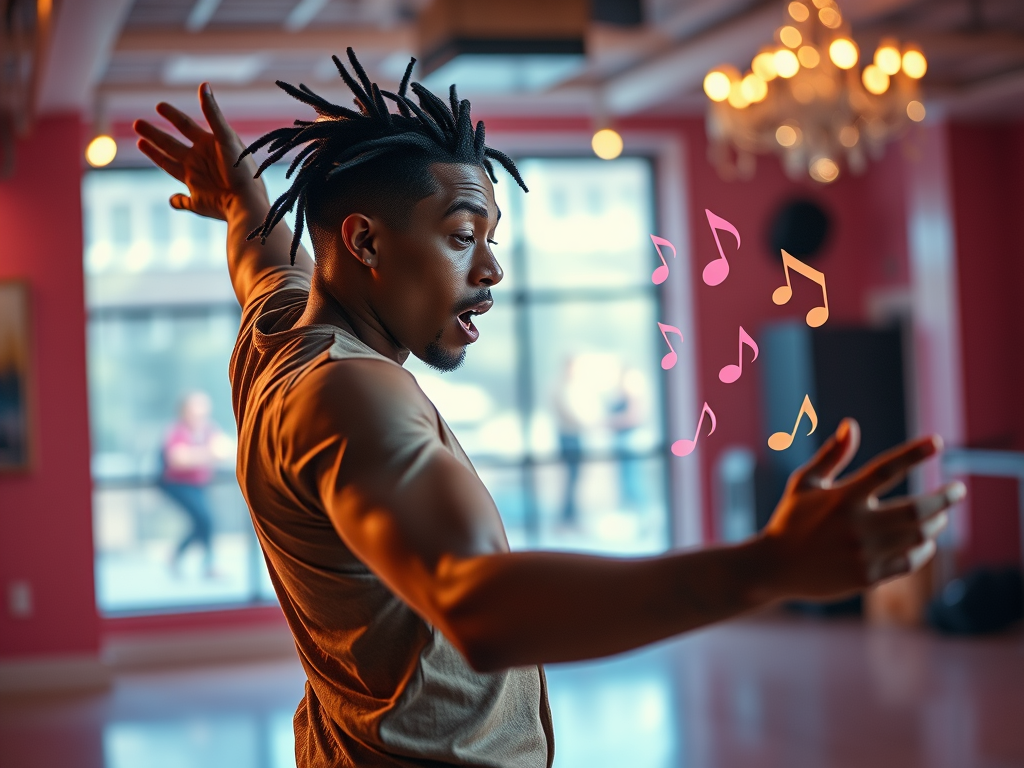

… been both surprising and affirming. “I never expected my voice to go viral, let alone become a soundtrack for so many people,” he said with a laugh. “But it makes sense—dance is all about feeling, and these sounds bring that feeling to life.”
Those Sounds (Brrr-ah Bah Bah-BAH) You Hear? Choreographers at Work.

TikTok is a platform brimming with talented vocalists, and one of its most celebrated figures is actually a choreographer.
In a now-viral TikTok video with over 5 million views, dance artist Sean Bankhead conducts a tutorial for his choreography to Cardi B’s song “Up.” But he doesn’t just demonstrate the moves—he sings them, too. “Ooo, ooo, a-bock-a-bock-a BOCK!” he exclaims, his voice punctuating and perhaps even summoning the rhythmic rolls and digs of his movement. “Ooo-crack, a-bookie bookie BOO!”
Bankhead’s dynamic vocalizations captivated viewers, propelling the audio from his clip into its own viral phenomenon. The track has since been used in more than 17,000 TikTok videos, featuring everything from dance recreations to music lessons and even hair tutorials.
Originally posted in 2021, Bankhead’s signature “bookie bookie boo” sound has cemented itself in TikTok history. (It still resurfaces from time to time.) More than just a passing trend, it helped ignite a wave of choreography-driven sound effect videos, introducing mainstream audiences to the distinctive and irresistibly expressive language of dancers.
Within the dance world, using sounds to mark rhythms and movements is a long-standing practice. In an art form that lacks a universal written notation, dancers often rely on vocalized cues—poetic, onomatopoeic bursts of sound—to convey both the structure and the energy of a routine. This spontaneous, intuitive language captures not just the steps themselves but also their texture, pacing, and feel.
Tap dancer Ayodele Casel describes this vocalization as essential to the essence of dance. “I do it when I teach, in rehearsals, even in interviews,” she said. “When someone says, ‘OK, it’s a shuffle, hop, step, heel, toe, heel’—that doesn’t express the soul of the rhythm. But ‘dah-dah OON dah-sicka un’—now you feel the groove. Now you hear the tone.”

This phenomenon isn’t limited to styles like hip-hop, jazz, and tap—genres that emphasize rhythm and innovation. Even in ballet, which has a highly structured vocabulary, vocalization plays a role. Choreographer Wayne McGregor enhances traditional ballet terminology with sounds like “fwhoops” and “jee-AMBs.” Archival footage of ballet legend Léonide Massine captures him calling out beats during a 1917 rehearsal of Parade: “ta-da-tee ta-da-tee tum.”
However, vocal cues are particularly prominent in dance styles that prize rhythm and individuality. Hip-hop choreographer Laurieann Gibson, who has trained in multiple dance disciplines, has experienced this contrast firsthand.
“In ballet, if you say ‘glissade,’ everyone knows exactly what that means and how it fits into the music,” she explained in a video interview. “But in hip-hop, you want to break boundaries, create new rhythms, invent new moves. So if I want a shoulder movement that goes ‘zhush-zhush’” — she paused to demonstrate a hybrid roll-pop motion — “how else am I supposed to communicate that?”
Many of the dance forms that emphasize vocal expression are rooted in Black traditions. Cultural historian Brenda Dixon Gottschild, author of The Black Dancing Body, recognizes these viral TikTok clips as part of a larger legacy. “That connection between dance and sound is deeply ingrained in Africanist traditions,” she explained. It’s a form of call and response: “Dancers aren’t counting ‘1, 2, 3, 4’—they’re responding to the syllables of the drum, or the voice.”

Tap dancers, whose bodies both create and react to intricate jazz rhythms, are often particularly adept at vocalizing. Their mouths, like their feet, become instruments of percussion. “Every sound they make is precise, deliberate,” Casel said.
When I attempted to mimic a viral dance sound effect, Casel chuckled. She explained that tap dancers would interpret the same rhythm with far greater speed and complexity. “You were doing quarter notes—one beat per count—which works for most dancers,” she noted. “But tap dancers explore the spaces between those beats.”
Like jazz scat singing, dance vocalizations are largely spontaneous. Bankhead, who has a musical background in drumming and keyboard, often surprises himself. “I never know what’s going to come out of my mouth,” he admitted, laughing. Fellow dancer and instructor Brandon O’Neal, whose own classroom sounds recently went viral, likens the experience to freestyle rapping: “It just flows—it’s right off the top of my head.”
Gibson only realized how vocal she was in rehearsals after appearing on Making the Band in the mid-2000s. The show’s editors amplified her enthusiastic sounds—“a boom-boom KACK”—with dramatic overdubbed crashes and beats.
“I’d be walking down the street, and people would just yell, ‘Hey, boom-kack!’” she recalled. The phrase became her signature, so much so that she eventually trademarked “BoomKack” and founded BoomKack Worldwide.
Despite their spontaneous nature, these sounds aren’t random. There’s a certain logic behind which noises correspond to which movements. Dancer Matthew Deloch, currently performing in Wicked on Broadway, even created a video explaining some of the most common vocal cues and their meanings.
“For instance, ‘gee-gee’ is often used to indicate a sharp, staccato movement,” Deloch explained. “Whereas ‘skoom’—that’s a scoop, something elongated.”
These rhythmic phrases also serve as mnemonic devices, helping dancers internalize complex choreography. Deloch’s own TikTok videos feature him narrating his thought process while practicing routines, seamlessly weaving in onomatopoeic cues.

Singer and dancer Tate McRae, a frequent collaborator of Bankhead, recently posted a TikTok clip of herself and her team rehearsing, captioned: “What we hear in our heads.” In the video, they echo Bankhead’s vocalized choreography cues as they move: “YAH! Brrr-ah bah bah-BAH!” Fans have since used the audio to synchronize with McRae’s live performances, turning Bankhead’s sounds into a shared rhythm for their own experiences.
Reading “brrr-ah bah bah-BAH” might even make you feel like moving. That’s the point—these sounds don’t just communicate steps; they transmit energy, pushing dancers to perform at their highest level. “Even when everyone knows the choreography, I’m still making noise because it’s motivational,” Bankhead said.
During a music video shoot for Normani, Bankhead noticed a makeup artist recording his enthusiastic vocalizations. When he asked why, she grinned. “Sean, this is going to be my morning alarm now,” she told him. “It just hypes me up.”
That motivational power plays a big role in dance training. O’Neal, a jazz instructor at the Debbie Allen Dance Academy, was already known for his uplifting vocal cues before his phrase “5, 6, believe in yourself” went viral last year. A twist on the traditional “5, 6, 7, 8” count-in, his encouragement sparked a wave of admiration, even catching the attention of Amy Poehler and Jennifer Lopez.
“I’ve always used sounds and bops—it’s about the steps, but also about fostering confidence,” O’Neal explained. With young dancers, he tailors his vocalizations to suit different learning styles, blending counts, noises, and movement cues into a rhythmic coaching system.
His viral moment made him realize something unexpected: “I guess I’m a motivational speaker now!”
Even non-dancers are tuning in for inspiration, which might explain why these clips resonate beyond the dance community. They offer a rare behind-the-scenes glimpse into the art form—a dancer’s perspective, or perhaps, a dancer’s ear.
But O’Neal believes the appeal is simpler than that. “People love dancer sound effects for the same reason they love dance,” he said. “It’s a language beyond words. You may not know what it is—but you feel it.”




Leave a Reply