
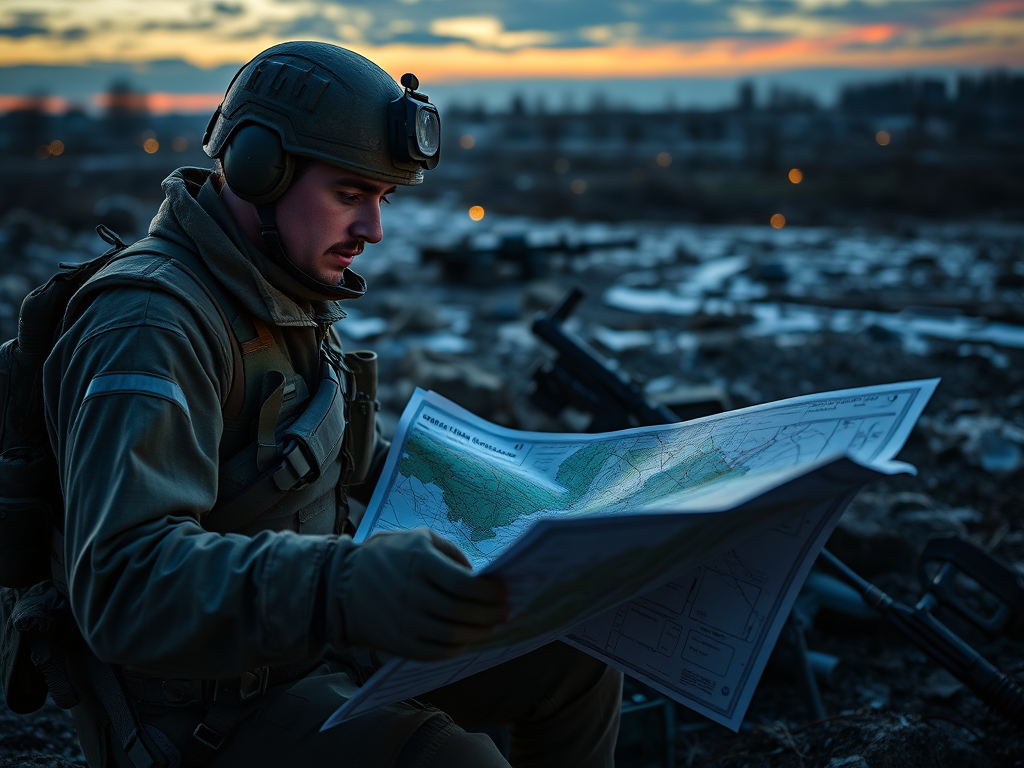

Russian Forces Depleted and Stalling on Eastern Front, Ukraine Says

In recent months, Ukrainian forces have managed to halt Russia’s offensive in the eastern Donetsk region and have gradually reclaimed small sections of territory, according to Ukrainian soldiers and military analysts.
Despite this, Russia maintains the strategic initiative, launching dozens of assaults daily across the eastern front. However, after over 15 months of continuous offensives, Russian brigades have been severely weakened, and Moscow is struggling to replace lost equipment. This situation has created limited openings that Ukrainian forces are actively working to exploit.
“The Russian offensive in Donetsk has stalled in recent months due to unfavorable weather conditions, exhaustion among Russian troops, and Ukraine’s effective adaptation to Russian tactics,” said Michael Kofman, a senior fellow at the Carnegie Endowment for International Peace in Washington.
Although it is too soon to say the front in Donetsk has fully stabilized, he noted that Ukraine has made progress by employing innovative strategies to counter its troop shortages.
Ukrainian soldiers warned that they expect Russian forces to regroup and escalate their attacks, aiming to take advantage of the temporary suspension of U.S. military assistance and intelligence sharing—an interruption that poses a serious risk to Ukraine’s war effort.
The intelligence-sharing pause is expected to be a key topic in upcoming discussions between Ukrainian and American officials at their first high-level in-person meeting since a dispute between President Trump and President Volodymyr Zelensky at the White House on February 28. Zelensky confirmed that the meeting will take place on Tuesday in Saudi Arabia, with U.S. Secretary of State Marco Rubio participating in the talks. (On Monday, Zelensky met with Crown Prince Mohammed bin Salman, the de facto ruler of Saudi Arabia, in Jeddah.)

Western military analysts and U.S. officials believe that while withholding military equipment could take months to have a significant effect on the battlefield, the absence of intelligence is already impairing Ukraine’s ability to target Russian command centers, logistics hubs, and troop concentrations behind enemy lines.
Ukrainian soldiers reported that this intelligence gap is particularly problematic in Russia’s Kursk region, where Russian and North Korean forces have launched an offensive and advanced rapidly. Ukraine sees retaining control over Kursk as crucial leverage in any potential negotiations to end the war. Soldiers on the front lines, speaking anonymously by phone on Friday and Saturday, described the situation as increasingly challenging.
A senior U.S. military official, also speaking on condition of anonymity, confirmed that the intelligence-sharing suspension has weakened Ukraine’s ability to track and strike Russian forces in Kursk, limiting its ability to target high-value objectives.
Keith Kellogg, a retired Army general and the U.S. special envoy for Ukraine, acknowledged that the decision would have a “significant” impact on Ukraine’s battlefield operations.
Ukraine has proposed an immediate partial ceasefire for air and sea operations and has recognized that some territory will remain under Russian control. However, U.S. officials have stated that the suspension of support will remain in place until Ukraine complies with unspecified White House demands.
The most intense battles of the war continue to take place along the 260-mile front in the Donbas region, which includes Donetsk.
Although Russia made substantial territorial gains in southern Donbas last year, it still faces a long battle to capture the remaining Ukrainian-held cities and towns that form the backbone of the country’s defenses.

Here’s an overview of the situation in three key battlegrounds in the region:
The Defense of Pokrovsk
Russian forces advanced to within roughly three miles of Pokrovsk in December, a city that serves as a critical transportation hub for rail and road networks in Donbas.
Unable to break through Ukraine’s well-fortified defenses in a direct assault, Russian troops have been attempting to encircle the city from the south.
As Russia’s advance slowed and eventually stalled, Ukrainian forces launched a series of localized counterattacks to regain tactical advantages.
Maj. Taras, a deputy battalion commander in the 68th Jaeger Brigade, described a recent operation aimed at retaking part of Dachenske, a village south of Pokrovsk.

“We stockpiled ammunition, carried out a brief artillery preparation, identified enemy positions in the village, and launched a concentrated strike,” Major Taras said. Following this, two infantry assault teams moved in to engage the enemy.
The battle lasted around 90 minutes, after which Ukrainian forces had secured roughly half of the village—an achievement backed by combat footage verified by military analysts.
However, Major Taras emphasized that fully reclaiming the village would require additional troops and resources.
This engagement reflects a broader pattern in the conflict—Ukraine capitalizing on Russian weaknesses but facing constraints due to its own shortages of manpower and firepower.
Col. Oleksii Khilchenko, commander of the Third Operational Brigade of the National Guard, reported that Russian forces significantly reduced their assaults last month after suffering heavy losses. He claimed that, at one point, Russia was sending wounded soldiers on crutches into battle—though this could not be independently verified.

Still, he warned against underestimating the enemy.
“The Russians are constantly regrouping, replenishing their ranks, and redeploying units from other fronts,” he said.
Maj. Taras added that Russian forces conduct daily reconnaissance of Ukrainian positions, supply routes, and rear areas, continuously preparing for either a gradual or a sudden offensive.
Street-by-Street Fighting in Toretsk
For the past eight months, Toretsk has been the scene of intense urban combat.
Capt. Bohdan Ravlikovskyi, from the 12th Special Forces Brigade Azov, described the brutal nature of the fighting, with Ukrainian and Russian troops sometimes occupying different sections of the same street or even the same building.
“There have been cases where Russian soldiers crawl forward with explosives strapped to their backs, attempting to detonate our positions—sneaking under buildings, placing mines, and setting them off,” he said.

Russian assaults in Toretsk follow a familiar pattern: troops attempt to push forward using motorcycles, civilian vehicles, armored transports, or advancing on foot. If they manage to hold a position, reinforcements arrive to continue the offensive.
However, in recent days, Ukrainian forces have launched counterattacks, making gains in parts of Toretsk through intense combat.
The Russian advance into the city in August came at a time when Ukrainian forces were struggling across the eastern front.
Severe shortages of troops and ammunition—worsened by a six-month delay in U.S. assistance and internal logistical issues—allowed Russia to seize approximately 1,600 square miles of Ukrainian territory in 2024.
Despite being outnumbered and outgunned, Ukrainian forces are using a growing network of drones to inflict mounting casualties on Russian troops.
The Destroyed Fortress Town: Chasiv Yar
Lt. Mykola, a 37-year-old commander with Ukraine’s 5th Assault Brigade, has been stationed near Chasiv Yar—a key hilltop town—for two years.

“We are still holding almost the same lines,” he said.
Following the fall of Bakhmut in May 2023, Russian forces took nearly a year to advance eight miles toward Chasiv Yar. They have since installed camouflage netting over roads leading to the town to shield their supply lines from Ukrainian drone strikes.
Like Toretsk, Chasiv Yar serves as a critical buffer, preventing Russian forces from directly attacking Kostiantynivka and other Ukrainian-controlled cities in Donetsk.
Russian troops launched their first direct assaults on Chasiv Yar in April 2024, employing a variety of tactics, including airstrikes, armored offensives, and tunnel infiltrations.
Despite months of grinding advances, large parts of the town remain contested, with neither side in full control.
Lieutenant Mykola noted that while the fighting remains intense, Russian forces are experiencing growing difficulties.
“We can see a decline in both the quality and quantity of their troops, which, fortunately for us, is only getting worse,” he said.



Leave a Reply