

Is Your Garden Safe? Soil Contamination Risks After Wildfires

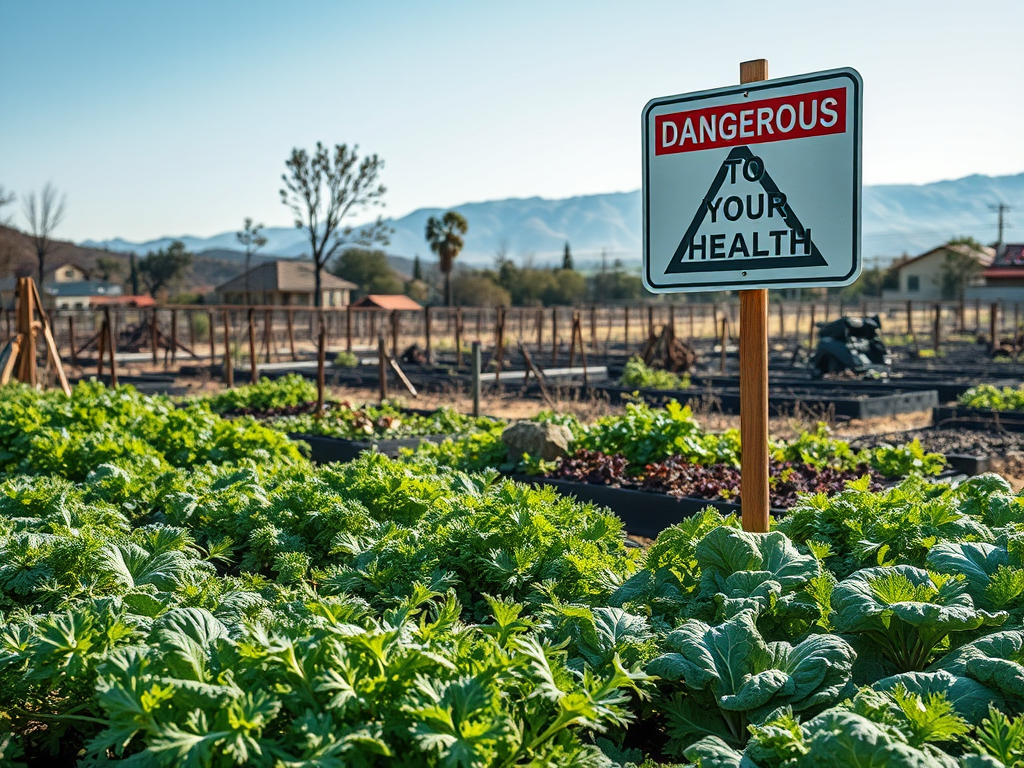
At first glance, the community garden appears abundant, its beds overflowing with parsley, lettuce, and kale—though long overdue for harvesting. Lavender plants line the edges, enhancing the garden’s vibrant greenery.
Yet, a sign on the gate warns visitors away, declaring the area “DANGEROUS TO YOUR HEALTH.”
Nestled in the foothills of the San Gabriel Mountains, the Altadena Community Garden stands next to the more than 14,000 acres that were devastated by January’s Eaton fire. Across the road, the landscape is marked by charred homes, collapsed roofs, and the scorched remains of vehicles.
State and federal officials have emphasized the swift progress of cleanup efforts here and in Pacific Palisades, where a separate fire scorched over 23,000 acres. In January, President Trump made it clear that he believed residents should be able to rebuild without delay, while California Governor Gavin Newsom recently stated that hazardous waste removal had taken place at an “unprecedented pace.”
Still, concerns linger. Even as authorities work to clear an estimated 4.25 million tons of debris—comprising ash, rubble, and soil—questions remain about whether toxic pollutants might persist in the land long after cleanup is complete. What if, despite all efforts, harmful contaminants remain?
Laura Siahaan, a mother of two who lost her home in the fires, voiced her concerns: “We want to plant fruit trees that we can actually eat from. We want our kids to play outside.”
To her, rebuilding is about more than restoring structures—it means ensuring that no toxic remnants from the fire continue to affect families for years to come.

This issue has sparked a new controversy. Federal agencies have stated that they will not be testing the topsoil before removal—nor the soil left behind—a policy that has been in place since 2020.
Curtis Brown, a FEMA official overseeing federal recovery efforts in fire-affected areas, informed California leaders last month that removing the top six inches of soil was considered sufficient. Conducting tests, he said, would have significantly delayed the rebuilding process. Historically, soil testing following wildfires has mostly identified contaminants that were already present before the fires ignited.
However, state leaders argue that testing the remaining soil is critical. Many residents, already uncertain about returning and rebuilding, are anxious to know if the land is truly safe.
Fires in densely populated areas often burn common household and construction materials—PVC pipes, appliances, batteries, and paint—releasing harmful pollutants. These include heavy metals like lead and arsenic, as well as PFAS, a group of chemicals found in carpets and clothing. Older structures may also release asbestos.

These toxins—some linked to cancer, developmental issues, and birth defects—can seep into the soil and water runoff. While some may have existed in the ground beforehand, experts warn that wildfires can elevate their levels to hazardous concentrations.
Three environmental specialists noted that people may be exposed through inhaling dust or consuming food grown in contaminated soil. Children playing outside may unknowingly ingest harmful particles.
With federal agencies declining to conduct soil testing, independent researchers have stepped in, offering to analyze samples from a wider range of locations than those originally identified by state authorities. Their efforts include testing soil from both burned and unburned properties.

Some homeowners have taken matters into their own hands, hiring private contractors to assess their soil. The Los Angeles County Department of Public Health has also engaged a private firm to examine approximately 80 affected properties, though officials say this decision was not directly influenced by FEMA’s stance.
Kristy Brauch, a nature educator who has been coordinating community-led soil sampling, believes these efforts serve as a safeguard. “This data could be crucial,” she said. “If we later discover high levels of contamination, we’ll need proof of what was there.”
She fears inaction could lead to a crisis down the road. “The worst-case scenario is they ignore this, and five years from now, we realize we’re the next Flint, Michigan, with people falling ill.”

Anthony Wexler, director of the Air Quality Research Center at UC Davis, believes that regardless of testing, it’s reasonable to assume some level of contamination. “The question is: Is it harmful to people?” he said. “If the soil remains undisturbed, it’s likely not a major threat.”
Workers involved in cleanup and reconstruction face the greatest risks. Wexler recommends wearing protective gear and spraying down soil before beginning work to reduce dust exposure. Residents should also keep windows shut and use air purifiers during nearby construction.
Despite this, Wexler is skeptical about the value of testing. “I’m not sure what testing would accomplish beyond alarming people,” he said. “Most residents will still want to rebuild.”
The federal decision not to conduct testing surfaced in recent communications between California officials and FEMA, first reported by The Los Angeles Times.
Nancy Ward, director of California’s Office of Emergency Services, highlighted past wildfire data showing that pollutants can extend beyond the six-inch soil depth currently being removed. “Without thorough testing, harmful contaminants could remain undetected, posing risks to residents, workers, and the environment,” she wrote.
FEMA, however, has made its position clear: if California or local governments wish to test the soil, they are free to do so—but they will not be reimbursed. The agency has not funded soil testing for wildfire recovery in several years.
Before 2019, FEMA’s protocol involved removing three inches of soil, testing it, then removing an additional three inches and testing again. But after the devastating 2018 Camp Fire in Northern California, that approach was abandoned in favor of simply removing six inches without testing. “It was slow, inefficient, and hindered recovery,” Brown wrote.

He added that the EPA had determined this method would sufficiently mitigate health risks. The same policy is now being applied to cleanup efforts for both the Eaton and Palisades fires. The city of Los Angeles has not yet announced whether it will conduct its own soil tests.
Following the Camp Fire, which killed 85 people and destroyed over 18,000 buildings, researchers found that residual ash contained heavy metal concentrations “significantly above” pre-fire levels. Yet, wildfire impacts on soil chemistry remain poorly tracked, often overlooked in post-fire recovery plans, according to a 2024 study by Stanford and Colorado State University researchers.
Thomas Borch, a soil chemist at Colorado State University and co-author of the study, explained that wildfire soil testing is complex. Pollutants vary widely, even within a single property.
After Colorado’s 2021 Marshall Fire, Borch’s team examined soil near burned homes. While they found elevated metal levels, they weren’t high enough to pose immediate health risks.
His team is now analyzing soil from properties affected by the Eaton Fire. So far, only a handful of sites have shown concerning levels of contamination. But Borch cautioned that testing isn’t foolproof. “You might miss highly concentrated spots—like where a Tesla battery melted.” Rain and wind can also spread pollutants far beyond burned zones. The only way to know for sure, he said, is to test each site individually.

Brianne Gilbert, a senior lecturer in urban and environmental studies at Loyola Marymount University, is leading a separate study that has drawn interest from more than 1,000 residents affected by the fires. Her team plans to examine soil from both burn zones and adjacent properties.
“In a perfect world, homeowners wouldn’t have to worry about soil contamination,” Gilbert said. “But that’s not our reality.”
Some residents acknowledge that complete certainty about soil safety may never be possible.
Leslie Aiken, who grows olives, oranges, lemons, and guavas in her Pasadena garden—just a block from burned homes—has decided not to eat some of this year’s produce. But the risk of contamination won’t stop her from growing food in the future.
“No soil on Earth in 2025 is completely free from toxins,” Aiken said. “That’s just the reality we live in.”




Leave a Reply