

The Quest for A.I. ‘Scientific Superintelligence’

Experts widely agree that one of the most promising and transformative opportunities in artificial intelligence lies in revolutionizing scientific discovery and development. By leveraging vast datasets, AI has the potential to accelerate breakthroughs in drug development, agriculture, and sustainable energy—accomplishing in months what traditional research might take years to achieve.
Tech giants like Microsoft and Google are already integrating AI into scientific fields, particularly in drug discovery, while last year’s Nobel Prize in Chemistry recognized researchers using AI to predict and design proteins.
Now, Lila Sciences, a Cambridge, Massachusetts-based startup, has entered the scene with ambitions to redefine science through AI. Operating in stealth mode for two years, the company has been dedicated to developing what it calls “scientific superintelligence” to tackle humanity’s greatest challenges.
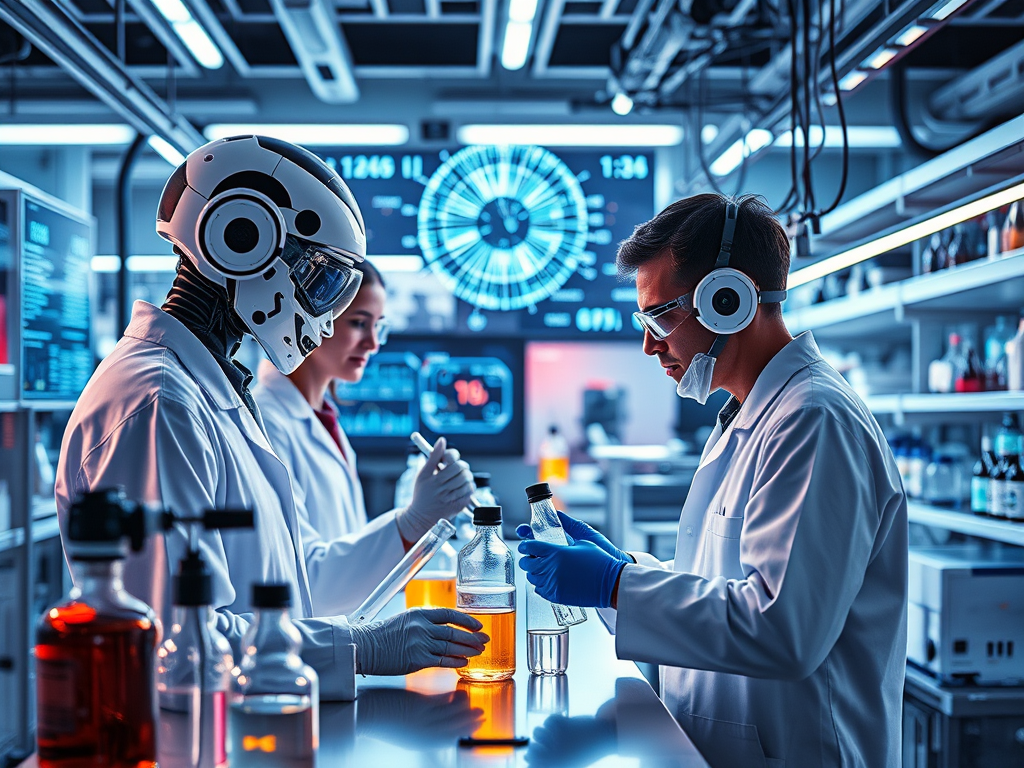
Backed by $200 million in initial funding and a team of seasoned researchers, Lila has been training an AI system on extensive published and experimental data, alongside principles of scientific reasoning. This AI doesn’t just analyze information—it conducts experiments in automated physical labs, with human scientists providing oversight.
Lila’s technology has already demonstrated its capabilities, producing novel antibodies to combat diseases and creating advanced materials for carbon capture. What traditionally would have taken years was achieved within months in Lila’s labs, reinforcing the belief that AI is poised to dramatically accelerate the scientific process.
Many scientists now anticipate AI will soon outpace conventional hypothesis-experiment-test cycles, potentially even surpassing human imagination in generating groundbreaking discoveries.
“AI is set to power the next major revolution in human history—the advancement of the scientific method itself,” said Geoffrey von Maltzahn, Lila’s CEO and a biomedical engineering and medical physics Ph.D. from MIT.

This push to redefine scientific discovery is fueled by the rapid rise of generative AI, which entered mainstream consciousness with the launch of OpenAI’s ChatGPT just over two years ago. The ability of such models to process vast amounts of data and generate human-like responses has triggered a fierce competition among tech giants like OpenAI, Microsoft, and Google, leading to unprecedented investments in AI research.
(Legal disputes have emerged in this space, with The New York Times suing OpenAI and Microsoft for alleged copyright infringement related to AI-generated news content. Both companies have denied these allegations.)

Unlike general-purpose AI, Lila has focused on training its models specifically for scientific applications, feeding them research papers, experiment documentation, and proprietary data from its rapidly growing labs in life sciences and material sciences. The goal is to create an AI system with both deep scientific knowledge and the flexibility to tackle a wide range of challenges—similar to how large language models can compose poetry or generate complex code.
However, the path to achieving true “scientific superintelligence” is fraught with obstacles. While AI is already transforming fields like drug development, experts caution that it remains uncertain whether AI will merely serve as an advanced tool or eventually rival human intellect across all scientific disciplines.
Given Lila’s secrecy, independent scientists have yet to evaluate its progress. Additionally, early breakthroughs in scientific research do not always translate into long-term success, as unforeseen challenges often arise.
“If they can achieve what they claim, that would be incredible,” said David Baker, director of the Institute for Protein Design at the University of Washington. “But it’s beyond anything I’ve encountered in scientific discovery so far.”


Dr. Baker, a co-recipient of last year’s Nobel Prize in Chemistry, views AI primarily as an assistive tool rather than a replacement for human-driven research.
Lila was founded within Flagship Pioneering, a venture firm known for incubating biotech companies, including Moderna, the maker of one of the first Covid-19 vaccines. Flagship’s approach prioritizes research areas with high breakthrough potential and commercial viability.
“We don’t just look for great ideas—we focus on the right timing for those ideas,” explained Flagship’s founder and CEO, Noubar Afeyan.
Lila emerged from the merger of two AI-driven projects at Flagship—one focused on materials science, the other on biology. Since both teams were working on overlapping challenges and competing for the same talent, they decided to join forces, said Molly Gibson, a computational biologist and Lila co-founder.
To prove its AI’s capabilities, Lila has successfully completed five demonstration projects using an advanced AI assistant. In each case, scientists—often with no prior expertise in the specific subject—simply provided a request for what they wanted to achieve. The AI then refined their queries, assisted in running experiments, and guided them toward results through iterative testing.

One of Lila’s standout projects involved discovering a new catalyst for green hydrogen production, an energy source generated by splitting water into hydrogen and oxygen. Unlike iridium, the expensive and scarce material currently used in commercial applications, the AI was tasked with identifying an alternative that was abundant and easier to manufacture. Working alongside two scientists, the AI helped pinpoint a viable catalyst in just four months—a feat that would have typically taken years.
This achievement convinced John Gregoire, a leading researcher in materials science and clean energy, to leave his post at Caltech and join Lila as head of physical sciences research.
Lila also attracted George Church, a renowned Harvard geneticist and pioneer in genome sequencing, who recently joined as chief scientist.
“Science is an ideal application for AI,” said Dr. Church. Unlike other fields where AI models can generate misinformation, scientific research is rooted in measurable truth and accuracy, making it a more reliable space for AI-driven advancements.
Despite these promising developments, Lila’s projects remain in the early stages, and the company will now focus on working with industry partners to commercialize its innovations.


Lila is rapidly expanding, with plans to increase its lab space in a six-floor Flagship building along the Charles River in Cambridge. Over the next two years, the company intends to establish a separate headquarters, add tens of thousands of square feet for research facilities, and open offices in San Francisco and London.
On a recent visit to Lila’s lab, trays containing 96-well DNA samples glided along magnetic tracks, swiftly navigating between different lab stations—guided in part by AI-driven decisions. The system dynamically adjusted experimental steps in real-time, seeking to produce novel proteins, gene editors, and metabolic pathways.
In another section of the lab, scientists oversaw high-tech machines designed to synthesize, measure, and analyze custom nanoparticles for new materials.
The entire research process was a seamless collaboration between human scientists, robotic automation, and AI software. Every data point, every experiment, every success and failure was meticulously recorded and fed back into Lila’s AI, enabling it to continuously learn and improve.
“Our ultimate goal is to give AI the capability to independently execute the scientific method—to generate new hypotheses and test them in the lab,” said Dr. Gibson.



Leave a Reply