

Brian Tyree Henry Isn’t Hiding

Brian Tyree Henry stepped onto the professional stage in 2007, making his debut as Tybalt in a dazzling production of Romeo and Juliet for Shakespeare in the Park. From there, his theater career flourished before he seamlessly transitioned to television with Atlanta and later ventured into film.
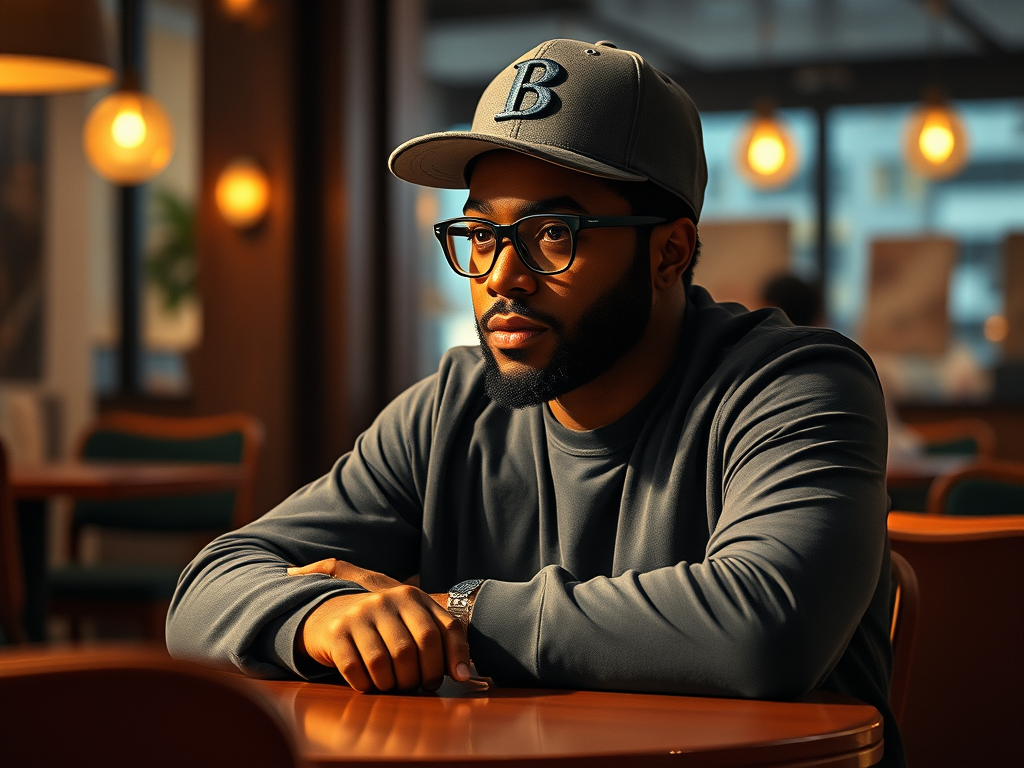
I had followed almost every step of his career—except for Godzilla vs. Kong. So, I couldn’t quite explain why I found myself in a nearly empty hotel dining room, anxiously texting Henry’s publicist, wondering where he was. As I sent message after message, Henry was actually sitting just 20 feet away, wearing glasses and a baseball cap emblazoned with a bold letter “B.”
I found some consolation in knowing that even Julia Roberts, his co-star in an upcoming Sam Esmail film currently shooting in Paris, had experienced similar moments. “He’s got this quiet, chameleon-like quality,” she later told me. “Sometimes I don’t even put it together right away. And then suddenly I’m like, wait a minute—it’s Brian again.”

At 42, Henry possesses a striking presence—tall, broad-shouldered, and full of energy, though he is well aware that his appearance gives off the impression of a former football player. (In reality, he was more of a speech and debate enthusiast and a marching band member.) His ability to vanish into roles—or even into a restaurant table—reflects his immense talent. Yet for someone who has spent his life fighting to be seen and struggling to feel like he belongs, this skill comes with an undercurrent of pain.
“You didn’t even recognize me with glasses,” he pointed out when I finally joined him at his table. “There’s always some kind of expectation people have. And when I walk in, they’re like, ‘Oh, that’s not what we wanted.’ And I think, well, this is who I am.”

Soon, though, Henry will be impossible to overlook. On Friday, Dope Thief, marking his first leading role on screen, debuts on Apple TV+. Based on Dennis Tafoya’s novel, the limited series follows Ray Driscoll, a small-time Philadelphia con man who impersonates a D.E.A. agent to rob stash houses—until he picks the wrong target.
Hollywood had never really considered him as a leading man, and Henry found himself drawn to Ray’s story in a deeply personal way. But portraying the character meant confronting his own self-doubt—the persistent belief that he wasn’t meant to be the star. “I used to struggle with that all the time,” he admitted. “I’d think, nobody’s going to be interested in anything that has ‘Brian Tyree Henry’ on it.”
“I always felt like my very existence was an inconvenience to a lot of people,” he added.

Yet that very struggle gives Henry the ability to imbue his characters with a rare depth—characters who are often overlooked, misjudged, or seen as burdens. Whether it’s Alfred, the drug dealer-turned-rapper in Atlanta; Daniel, the wrongfully convicted man in If Beale Street Could Talk; or James, the grieving mechanic in Causeway, Henry brings them all to life with nuance and empathy.
For him, acting is more than just a career—it’s a mission, even a spiritual calling. (“I know it sounds like hippie nonsense, but it’s true,” he said with a sigh.) His goal is to illuminate the humanity in these men, to argue for their worth, to remind audiences that they matter. In doing so, he finds a form of redemption—not just for his characters, but for himself.
“I know them,” he said. “I can’t forget them. Even if they forget themselves, even if they feel like they’re a burden—they’re not. They’re not.”
In person, Henry is introspective, measured, and unflinchingly honest. His expression often carries a deep-set weariness—something mirrored in many of his roles—but when he smiles, it’s with an unguarded, almost childlike openness.
Growing up in Fayetteville, North Carolina, as the youngest of five children with four older sisters, Henry often felt like an afterthought, an unwanted presence. Determined to carve out his own path, he was in a hurry to grow up.
“I was always running away,” he recalled. “The moment they let go of my hand after I learned to walk, I took off.”
He still remembers his first time on stage: at just five years old, he won the role of Santa Claus in his preschool’s holiday play. He can vividly recall tugging at his cotton-ball beard, trying to remember his one line—“Merry Christmas”—and the pure joy and escape he felt in that moment.

Years later, Henry enrolled at Morehouse College in Atlanta, inspired mostly by a scene from Boyz N The Hood. Initially a business major, he was convinced by friends to audition for Antigone at Spelman College, Morehouse’s sister school. To his surprise, he landed the lead role. Encouraged by visiting professors, he later applied to the Yale School of Drama, still unsure whether acting could be a viable career.
“I did it because it was saving my life,” he said. “It gave me a space where I could be free.”
At Yale, he struggled with belonging. He was once cast as a tree in The Three Sisters, a stark contrast to the rare opportunity he received in his second year—a lead role at the Yale Repertory Theater. Yet, even then, he felt invisible to his peers.
During his final year, a student production of Tarell Alvin McCraney’s The Brothers Size was staged at the Under the Radar festival. His performance as Oshoosi, a recently released convict, caught the attention of director Michael Greif, who later cast him in Romeo and Juliet. Greif still remembers the complexity of Henry’s performance.
“There was so much raw pain and devotion in his anger,” Greif recalled. And just like that, Henry’s professional acting career had begun.
The years that followed were a mix of hardship and triumph. Living on the outskirts of Brooklyn, surviving on food stamps and bologna sandwiches, Henry was doing what he loved. Financial stability came in 2011 when he landed a role in The Book of Mormon on Broadway. But even after three years on stage—finally able to afford a MetroCard—he never truly felt at home in musical theater.

“I always felt like I didn’t belong,” he said. “I was performing in a theater that didn’t see me for who I was.”
In 2014, he took a leap into television and film, soon landing an audition for Atlanta, Donald Glover’s FX comedy. The show, known for its surreal yet profound storytelling, became a critical hit, with particular praise for Henry’s portrayal of Alfred, aka Paper Boi.
“Brian understood that people are layered and complicated,” said LaKeith Stanfield, his Atlanta co-star. Though Henry and Alfred seemed different on the surface, Stanfield recognized a shared ambition and yearning for connection in both.
By the time Atlanta concluded in 2022, Henry had built an impressive résumé, from serious dramas like If Beale Street Could Talk to action-packed blockbusters like Bullet Train. He had earned two Emmy nominations—one for Atlanta and another for This Is Us—and in 2022, he received his first Oscar nomination for Causeway, where he played an amputee mechanic who bonds with a veteran struggling with PTSD.
After Causeway, Henry spoke openly about stepping back from roles that required him to tap into his own pain, prioritizing his mental health instead. So when Dope Thief came his way, it scared him—it felt too personal, too raw.
“Ray scared the [expletive] out of me,” he admitted. “There was nowhere to hide.”
But that vulnerability was also what drew him in. Ray’s journey involves healing a fractured relationship with his father, and Henry, who had been estranged from his own, saw an opportunity for personal catharsis. And the chance to lead a series? He couldn’t turn it down.
“Remember,” he said with a smirk, “I once played a tree.”




Leave a Reply