

Chaos Sweeps Coastal Syria: ‘We Have to Get Out of Here’

Gunfire erupted at dawn on Friday in the town of al-Haffa, located on Syria’s Mediterranean coast.
Wala, a 29-year-old resident, was jolted awake by the sharp crack of gunfire outside her bedroom window. Instinctively, she sprang from her bed, pressing herself into the corner of her first-floor apartment. The staccato bursts of shooting filled the air.
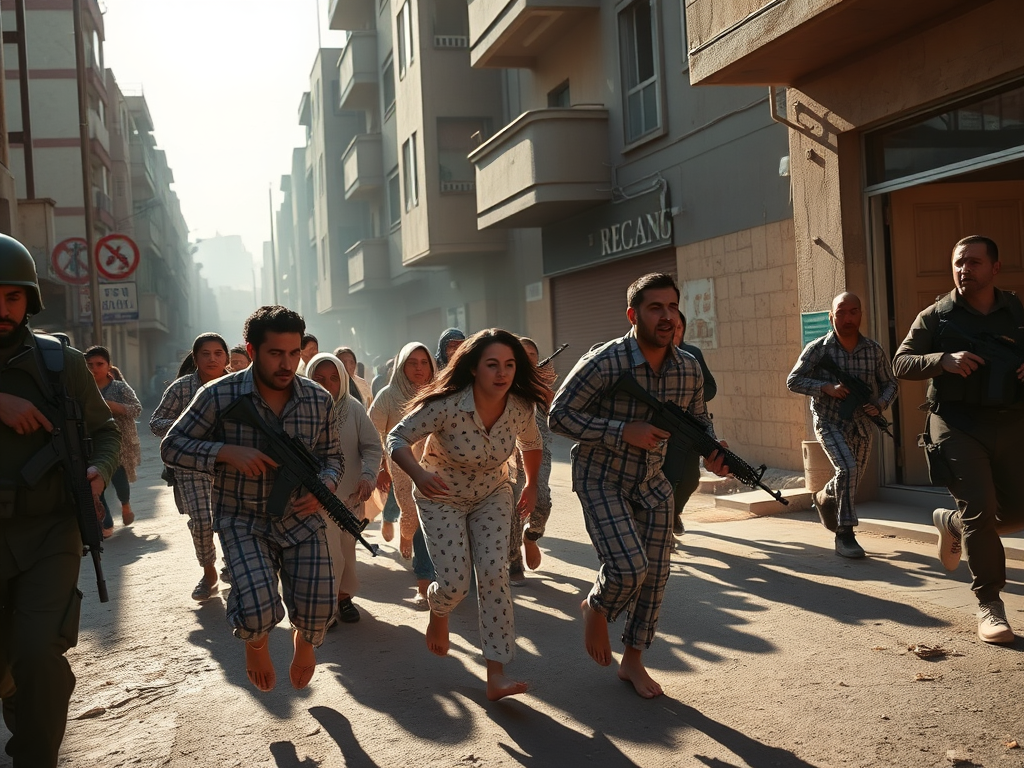
As the noise escalated, she cautiously approached the window and lifted the curtain. Outside, dozens of people, some still in their pajamas, were running frantically down the street. Behind them, four men in dark green uniforms pursued with weapons raised. Then, without warning, the men opened fire. In a matter of seconds, four of the fleeing civilians collapsed to the ground.
“I couldn’t believe my eyes. I was terrified—absolutely terrified,” said Wala, who asked to be identified only by her first name out of fear for her safety.
The attack in al-Haffa was part of a wave of unrest that had engulfed Syria’s coastal regions for four days, leaving more than 1,000 dead, according to the Syrian Observatory for Human Rights. By early Sunday, the organization reported that this was the deadliest violence the country had seen since rebels ousted longtime dictator Bashar al-Assad in December and attempted to consolidate power over a nation fractured by nearly 14 years of civil war.
The violence was triggered on Thursday when Assad loyalists ambushed government security forces in Latakia Province, where al-Haffa is situated. This initial attack sparked days of brutal clashes between government troops and the remaining Assad supporters.
The Britain-based Observatory, which has been monitoring Syria’s conflict since 2011, stated on Sunday that among the more than 1,000 fatalities, approximately 700 were civilians—most of them killed by government forces.

In al-Haffa alone, at least 65 civilians lost their lives, according to the Observatory. Another monitoring group, the Syrian Network for Human Rights, had yet to update its figures on Sunday, but it had previously reported that government forces had killed an estimated 125 civilians as of Saturday.
The reported death tolls could not be independently verified.
Officials from Syria’s new government denied allegations that their forces had committed atrocities, but they pledged to investigate the claims and hold perpetrators accountable.
Ahmed al-Shara, Syria’s interim president, sought to reassure the nation following the violence, calling for unity.
“We must protect national unity and civil peace,” he declared on Sunday at a mosque in Damascus, according to a widely circulated video. “I urge Syrians to remain calm—the country has the foundations necessary to endure.”

The bloodshed has fueled fears of a larger sectarian conflict and heightened anxiety across Syria’s coastal provinces, Latakia and Tartus. The region, historically the stronghold of the Alawite minority, had been central to the Assad regime, including the Assad family itself. Now, the new government, formed by a coalition of rebels led by an Islamist Sunni group, faced accusations of targeting Alawite communities.

According to the Observatory, most of the civilians killed in recent days were Alawites.
By Saturday, authorities had nearly shut down traffic on the highway connecting Damascus to Tartus. Government forces set up numerous checkpoints across the city, where most shops remained closed, and residents sheltered in their homes.
Shadi Ahmed Khodar, a 47-year-old crane operator, sat near the road leading from Tartus to Latakia, watching as ambulances and government vehicles occasionally sped past. His neighborhood had emptied, transformed into a ghost town as fear gripped the city. An Alawite himself, he did not support the Assad loyalists who had taken up arms, yet he feared that the new government’s forces would fail to distinguish between rebels and ordinary civilians like him.
“They might just assume we’re all against them and kill us,” he said.
The country, he feared, was hurtling toward deeper turmoil. By late Saturday afternoon, the violence had yet to abate. Just down the road from where he sat, government soldiers at a checkpoint warned passing drivers that gunmen were ambushing vehicles traveling north toward Latakia.

“We’re only in the shallows,” Khodar said. “We haven’t even reached the deep waters yet.”
In the rural outskirts of Latakia Province, Assad loyalists had taken dozens of government security personnel hostage after seizing control of certain areas, residents reported. Elsewhere, frightened locals armed themselves and stood guard outside their homes, wary of both Assad loyalists and government troops.
In Baniyas, a town at the northern tip of Tartus Province, armed men believed to be aligned with the government stormed into Alawite neighborhoods late Thursday night, according to four residents.
Ghaith Moustafa, a pharmacist in Baniyas, spent Friday and Saturday huddled with his wife, Hala Hamed, and their two-month-old son behind the front door—the only place in their apartment not near a window.
Early Friday morning, the gunfire grew closer. He heard shouting, followed by rapid gunshots and then piercing screams from the apartment below. Later, he learned that his neighbors had been killed.
“I was terrified for my wife, for my baby,” said Moustafa, 30, in a phone interview. “She was so afraid, and I didn’t know how to hide my own fear.”

By Saturday afternoon, as the gunfire finally died down, Moustafa decided to flee. He packed his family into a car and drove to a friend’s home in a neighborhood that had been spared much of the violence. What he saw on the way horrified him.
Every few meters, a body lay motionless on the ground. Blood smeared the pavement. Storefronts had been shattered, their interiors looted.
The Syrian Observatory reported on Saturday that at least 60 civilians, including five children, had been killed in Baniyas.
“I can’t comprehend it. I’m just in shock,” Moustafa said. By evening, one thought consumed him: escape.
“We have to leave as soon as possible,” he said. “It’s not safe here—nowhere is safe.”
Moustafa was one of hundreds who fled Baniyas that day. Many sought shelter with non-Alawite friends, hoping their communities would be spared from further bloodshed.
Meanwhile, back in al-Haffa, Wala and her family remained trapped in their home. An hour after government troops had entered the town, security forces kicked down her front door.

A visiting friend from Idlib, the northwestern region where the rebel forces had originated, begged the soldiers not to harm them.
“She told them, ‘I’m from Idlib. My whole family is from Idlib. Please don’t hurt these people. They are just a peaceful family,’” Wala recalled.
The soldiers demanded the friend’s phone, then turned to Wala, ordering her to open her safe. They forced her mother to hand over her gold necklace and earrings before issuing a final warning: Stay inside.
Terrified, Wala and her relatives retreated to her bedroom.
An hour later, as the gunfire outside faded, she defied the order. She stepped outside to help someone she could hear moaning in pain.
On the street, she found two men who had been shot. One, drenched in blood, weakly asked her to lift his head. The other, wounded in the thigh, pleaded for water.
Before she could act, gunfire rang out again, forcing her to retreat indoors.
By Saturday evening, she had no idea whether either man had survived.




Leave a Reply