

Canadians and Wayne Gretzky: Anatomy of a Relationship on Thin Ice

Where have you gone, Wayne Gretzky? A nation looks to you in disappointment.
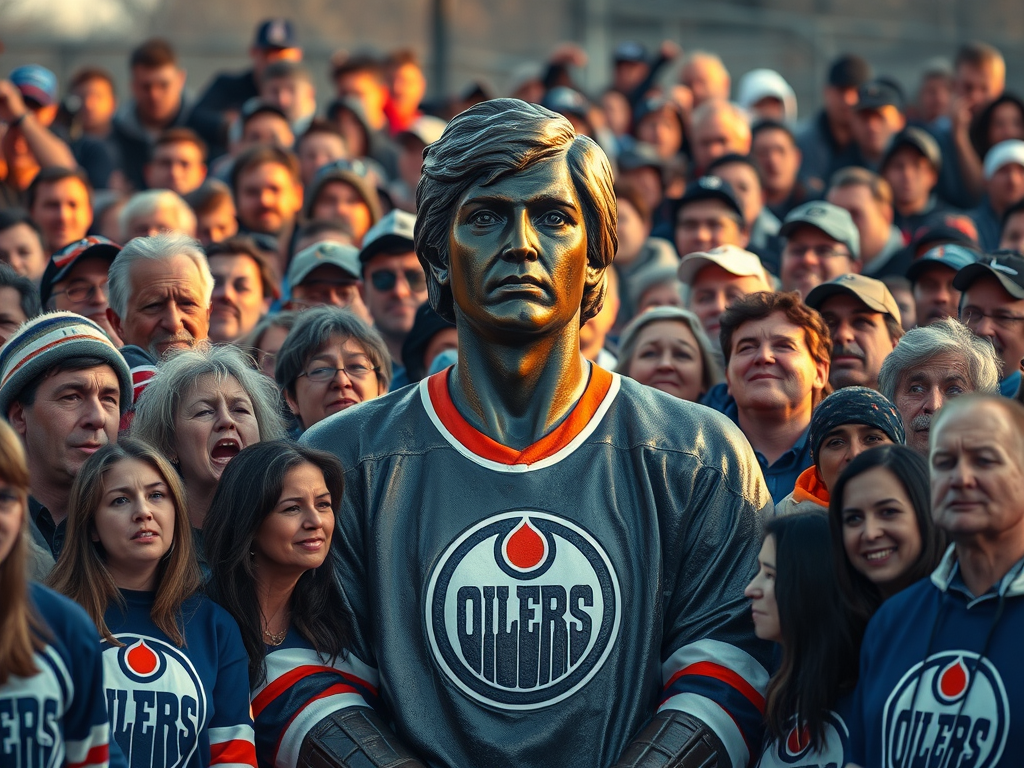
For now, the statue would have to suffice. As the puck drop approached, a crowd of Edmonton Oilers fans swirled around the life-size bronze figure of Wayne Gretzky, once an untarnished Canadian icon, now the subject of controversy.
“I just wish he was a bit more Canadian,” said Rob Munro, a 43-year-old Oilers fan wearing a vintage Mark Messier jersey. “I’m not against Gretzky at all—far from it. It’s just frustrating.”
For decades, Gretzky, now 64, has been more than a hockey legend—he has embodied the Canadian ideal. Dubbed “The Great One,” he led the Oilers to four Stanley Cups in the 1980s and stood as a national symbol of skill and integrity. A plaque at the base of his bronze likeness describes him as “a true champion and gentleman of dedication and character.”
But now, Gretzky has become an example of how quickly hero worship can turn to disillusionment—especially when mixed with the politics of Donald Trump.
“You were once a great Canadian, but not anymore,” said Matthew Iwanyk, chief operating officer and host of Edmonton Sports Talk. “That’s how most Edmontonians feel now.”
It’s a case of guilt by association. Gretzky’s close ties to Trump—and the perception that he has remained silent while Canada faces hostility from its southern neighbor—have led many Canadians to reassess their admiration for him.
“As much as we love hockey,” Iwanyk said, “we love our country more.”
The backlash is particularly strong in Edmonton and Brantford, Ontario, Gretzky’s hometown.
“He’s definitely lost some of his shine here,” said Marina Szeman, watching her son’s hockey game inside Brantford’s Wayne Gretzky Sports Centre.

Gretzky has lived primarily in the United States since 1988, when he was traded to the Los Angeles Kings. That event—still simply called “the trade” in Canada—has long been seen as a painful moment of American poaching. Now, with his connections to Trump, it feels like another betrayal.
Gretzky and his wife, American actress Janet Jones—whom he married in Edmonton in a wedding befitting royalty—celebrated with Trump on election night and later attended his inauguration. At one point, Trump joked that Gretzky could be governor of “the 51st state of Canada”—a remark that Canadians found anything but amusing. Then came the image that sealed Gretzky’s new reputation: a photo of him wearing a white-and-gold Make America Great Again hat.
And because this is Canada, hockey was involved. Last month, tensions between Canada and the U.S. were at a high as the two nations faced off in the final of the NHL’s 4 Nations Face-Off. Gretzky, serving as honorary captain for Canada, opted for a neutral blue suit while his American counterpart, Mike Eruzione, donned a team jersey. When cameras caught Gretzky smiling and giving a thumbs-up to the U.S. bench, Canadian fans were outraged.
What they didn’t see was Gretzky’s pregame speech in Canada’s locker room. The team won in overtime, and Prime Minister Justin Trudeau seized the moment. “You can’t take our country—and you can’t take our game,” he posted on social media. Meanwhile, Gretzky was widely criticized.

His wife came to his defense. “I have never met anyone prouder to be Canadian, and it breaks his heart to see these cruel comments,” she wrote on Instagram—before deleting the post.
As anger grew in Canada, Gretzky remained silent. He declined interview requests. But Trump, whose new tariffs had just taken effect, defended Gretzky on social media—an endorsement that did him no favors in Canada.
Canadians, in response to Trump’s policies, have been staging their own resistance. Many are boycotting American goods, displaying Canadian flags, and even renaming “Americanos” to “Canadiano” in coffee shops. Hockey games against U.S. teams have become rallying points for national pride.
“We’ll probably keep booing the American anthem,” Trudeau said, referring to the new tariffs. “But let me be clear to Americans—we’re not booing you, your teams, or your players. We’re booing a policy that is meant to harm us. We are insulted, we are angry. But we are Canadian, which means we stand together, we fight, and we win.”
For many, the question remains: where does Gretzky stand?
To Americans, the controversy may be puzzling. Why does Gretzky’s political stance matter—especially since he hasn’t lived in Canada for over three decades?


“He’s the best in the sport we care about most,” said Bruce Arthur, national columnist for The Toronto Star. “That’s what makes this such a big deal.”
Gretzky retired in 1999 after three final seasons with the New York Rangers, and his dominance remains untouched. His NHL career scoring record is so vast that even without his 894 goals, his 1,963 assists alone would still make him the all-time leader.
Yet in Edmonton, frustration is growing. Grant Prete, a 31-year-old Oilers fan, launched an online petition to remove Gretzky’s name from a short stretch of freeway known as Wayne Gretzky Drive. In just a week, over 10,000 people signed.

At a Tim Hortons—Canada’s beloved coffee chain, itself named after a hockey player—Prete sipped green tea as he reflected on the controversy. A business development manager for a software company, he has lost friends over his stance on Gretzky.
“People can be friends with whoever they want,” Prete said. “But when it comes to Canada’s sovereignty, that’s where I draw the line.”
Canadians have also taken notice of something once dismissed as a minor footnote. In 2009, Gretzky was awarded Canada’s highest civilian honor, the Companion of the Order of Canada. Yet, it is believed that he has never formally accepted it—another reason to question his loyalty.
Should Gretzky be held to a higher standard as a national icon? Or are Canadians unfairly burdening him with expectations he never asked for?
“It’s not that we demand more from him,” Prete said. “It’s just that the disappointment cuts deeper.”
He referenced a moment from Saturday Night Live two nights earlier, when Canadian actor Mike Myers closed the show wearing a T-shirt reading Canada is not for sale and silently mouthing, “Elbows up”—a hockey term meaning “get tough.”
Imagine the surge of pride if Gretzky had made such a statement, Prete mused.


Back in Brantford, some defended Gretzky.
“There isn’t a prouder Canadian,” said Roger Pamplin, a steel plant worker waiting outside his grandson’s hockey game at the Gretzky Sports Centre. He pointed to Gretzky’s extensive philanthropy, including charity sports tournaments benefiting local communities.
Ontario Premier Doug Ford also came to his defense.
“I spoke to Wayne recently, and he got really emotional talking about this,” Ford told reporters. “He’s a patriot. He loves Canada. He never gave up his Canadian passport. So folks, give him a break.”
At the Oilers game that evening, politics was a topic of conversation, but not all fans held Gretzky accountable.
“He doesn’t need to explain himself,” said Jeff Seifert, a longtime Oilers fan in a Messier jersey.
“I’ve always admired him, and I still do,” added his friend, John Dobrich.
“Sometimes, it’s more dignified to stay silent,” Seifert noted.
As the game against the Anaheim Ducks got underway, the American national anthem was met with boos. During a quiet moment, a woman shouted an expletive about Trump. Then, as the Canadian anthem played, the crowd erupted into a spirited singalong.
Outside, in the cold, the bronze figure of Gretzky stood frozen in time—a relic of a different era. Few stopped to take notice.




Leave a Reply