
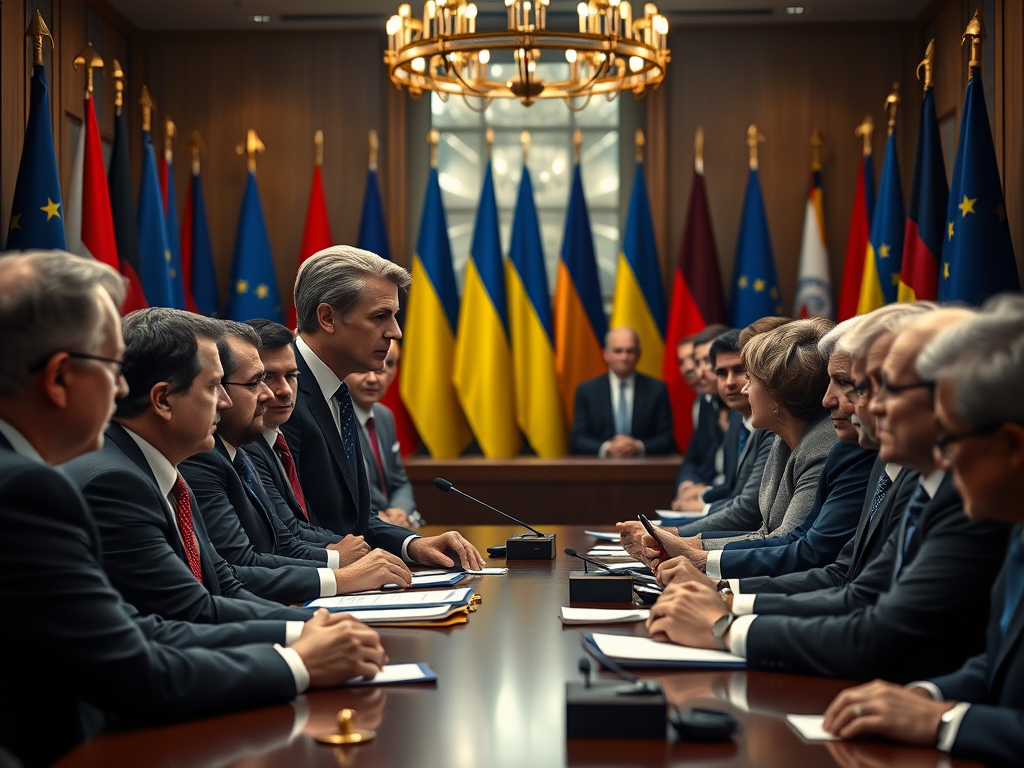

Europe Races to Craft a Trump-Era Plan for Ukraine and Defense

European Union leaders are facing one of the most significant challenges in the bloc’s history, as an increasingly aggressive Russia looms in the east and American support grows uncertain in the west.
On Thursday, they vowed to meet this challenge head-on.
In a specially convened meeting in Brussels, leaders gathered to strategize on strengthening Europe’s own defense capabilities while continuing to support Ukraine amid high-stakes geopolitical tensions. A key concern was how to achieve these goals without further straining their already fragile relations with Washington.
Yet, maintaining unity within the E.U. itself remains a struggle. On Thursday, Hungary declined to sign a joint statement reaffirming “unwavering support” for Ukraine, highlighting internal divisions among member states.
Amid growing urgency, officials pledged to push for a robust peace agreement for Ukraine while striving for a more self-reliant European defense system.
“Europe is facing an imminent and serious threat,” said Ursula von der Leyen, the president of the European Commission, as she entered the meeting alongside Ukrainian President Volodymyr Zelensky. She described the moment as a pivotal turning point.
Roberta Metsola, president of the European Parliament, was even more direct.
“It’s about damn time,” she declared. “We are finally ready to back our words with action.”
The meeting, attended by the heads of state and government from all 27 E.U. member countries, was the latest in a series of urgent summits focused on defense.

Leaders discussed various financing options to increase European military spending, including a proposed €150 billion (approximately $160 billion) loan initiative to support investments in missile defense, anti-drone technology, and other critical defense systems. They agreed that this initiative must move forward swiftly, with the broader goal of strengthening Europe’s military readiness while reducing reliance on American support.
Additionally, discussions explored what a viable peace plan for Ukraine might entail, including potential financial and military assistance—though Russia once again dismissed the possibility outright on Thursday. The 26 nations that signed the joint statement of support for Ukraine committed to providing “regular and predictable” financial aid at a time when U.S. policy is shifting in favor of Russia.
“We are deeply grateful that we are not standing alone,” Zelensky said from the summit’s venue.
In many ways, this meeting marked the beginning of a new era for the European Union. Originally established to promote peace and cooperation, the bloc now finds itself compelled to redefine its role in a world increasingly shaped by conflict and discord, even among allies.
The critical question remains: Can the E.U., with its cumbersome, consensus-driven decision-making process, adapt quickly enough to prevent Europe from being left behind as President Trump reshapes the global order?

In a matter of weeks, Trump has drastically altered the geopolitical landscape for European security. He has pushed for a swift resolution to the Ukraine war, publicly chastised Zelensky, and suspended U.S. aid to Ukraine. He has even initiated talks with Russia without involving either Ukraine or European leaders. At the same time, he has criticized European nations for not contributing enough to their own defense, calling the current system “unfair.”
On Thursday, speaking from the Oval Office, Trump suggested that the U.S. might not defend NATO members who fail to meet their financial obligations, calling it “common sense.” This statement cast doubt on a fundamental principle of the alliance—that an attack on one NATO member is an attack on all.
“Mr. Trump is always full of surprises—unfortunately, they are mostly bad surprises for us,” Belgian Prime Minister Bart De Wever told reporters.

With America’s stance shifting, Europe is being forced to reassess its support for Ukraine.
French President Emmanuel Macron announced on Wednesday that he would engage with European allies to discuss whether France’s nuclear deterrent could serve as a security guarantee for the continent in response to Russian threats.
Meanwhile, both Britain and France have expressed openness to deploying troops as a peacekeeping force if a resolution to the conflict is reached. British Prime Minister Keir Starmer has called for support from a “coalition of the willing.”
On Wednesday, the U.K. hosted a meeting with officials from 20 countries—many of them European—to explore potential military and nonmilitary contributions to such a coalition.
However, Russia remains adamantly opposed to the idea of European peacekeeping forces in Ukraine. Russian Foreign Minister Sergey Lavrov reiterated on Thursday that there was “no room for compromise” on this issue, warning that Moscow would not tolerate such deployments.
Speaking at a press conference in Moscow, Lavrov likened the presence of European forces in Ukraine to NATO’s potential presence in the country.

“We would not simply stand by and watch,” he stated.
The exact role of the European Union in this proposed coalition remains uncertain and was a key topic of discussion on the sidelines of Thursday’s meeting.
What is clear is that not all European nations are equally committed to increasing their support for Ukraine. Hungarian Prime Minister Viktor Orban has been particularly vocal in his praise of Trump and in his opposition to European leaders’ stance on Ukraine. Although it was anticipated that Hungary might refuse to endorse the joint statement, many had hoped to persuade it to maintain unity within the bloc.
While Hungary’s refusal was largely symbolic, its continued resistance to expanding aid for Ukraine could soon have more tangible consequences, potentially complicating negotiations over sanctions or the ongoing freeze of Russian assets in Europe.
Despite Hungary’s stance, the majority of European nations remain aligned in their approach. Several non-E.U. countries, including Britain, Norway, and Turkey, are set to receive briefings from top E.U. officials following the meeting, according to an E.U. official who spoke anonymously about internal matters.

This level of external coordination is unusual and signals a growing commitment to collaboration.
Further actions are expected from the E.U. and its partners. European countries are still considering additional financial contributions to Ukraine and are moving quickly to implement measures aimed at “rearming” Europe—including the €150 billion loan initiative proposed by von der Leyen.
Other plans include relaxing E.U. budgetary constraints to allow increased defense spending without violating strict deficit rules and broadening the European Investment Bank’s mandate to support a wider range of military projects.
And the discussions on enhancing Europe’s defense are far from over.
On Thursday, Zelensky announced on social media that a follow-up meeting would be held on March 11, bringing together military representatives from various countries to deliberate on security guarantees. Later this month, the E.U. is expected to publish a comprehensive report outlining its long-term defense strategy.
“Today, we are witnessing history in the making,” von der Leyen said as Thursday’s meeting concluded. “The urgency is undeniable.”


Leave a Reply