
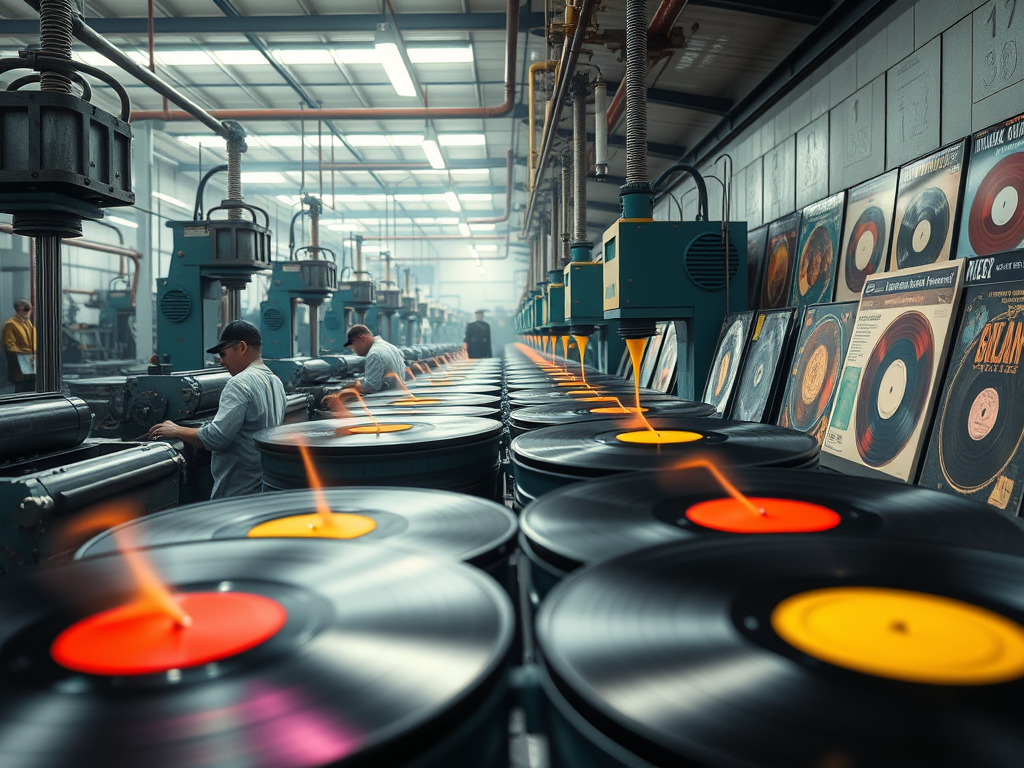

Inside a vast factory in Kansas, hydraulic machines hummed as molten vinyl oozed through molded stampers, much like pancake batter spreading on a griddle, churning out brand-new records at a steady pace of one per minute. Workers meticulously inspected each groove for flaws, slipped album covers into shrink-wrap, and stacked the finished vinyl onto tall dollies, ready for shipment.
The Wizard of Vinyl Is in Kansas

This operation belongs to Acoustic Sounds, a collection of low-rise industrial buildings in Salina, a town of around 50,000 people near the very heart of the contiguous United States. Among the flat plains dotted with towering grain silos and an enormous frozen pizza plant, this unassuming facility has, over the past 15 years, emerged as a powerhouse in the music industry’s most unexpected revival: vinyl records.
At the heart of it all is Chad Kassem, the company’s founder, who first fell in love with high-fidelity sound as a troubled 22-year-old with a criminal record. Now, four decades later, he has become a leading figure in the booming vinyl business. Speaking in a slow Southern drawl but moving briskly across the factory floor, the 62-year-old Kassem described his relentless pursuit of the best possible sound—an obsession that involves tracking down decades-old master tapes and making microscopic adjustments, even tweaking the temperature of raw polyvinyl chloride by a degree or two.

“My mission,” he declared, “is to save the world from bad sound.”
First introduced in 1948, vinyl LPs seemed doomed to extinction by the early 2000s, casualties of the digital music revolution. Yet over the past decade, the format has made a stunning comeback, embraced both as a tangible keepsake in an era of fleeting digital files and as the preferred medium for audiophiles who swear by its rich sound. Today, the vinyl resurgence is often symbolized by colorful limited-edition LPs from pop icons like Taylor Swift and Billie Eilish, eagerly snapped up by young fans—many of whom may never actually play them. But on a crisp afternoon at Acoustic Sounds, the production lines were alive with pressings of John Coltrane, Steely Dan, and Lightnin’ Hopkins albums—deluxe editions priced as high as $150 each.

Founded in 1986, Acoustic Sounds operates as an umbrella for a network of interrelated businesses forming a nearly complete vinyl production ecosystem. This includes a mastering studio, a plating and pressing facility, a record label, and a mail-order distribution service. Specializing almost exclusively in high-end reissues, the company caters to a global clientele eager to acquire the latest, most pristine editions of classic records from legends like Muddy Waters and Dusty Springfield. As a result, it has become a key partner for major labels and artist estates seeking top-tier reissues.
“Chad’s attention to detail is next level—his work is simply phenomenal,” said Jeff Jampol, who manages the estates of The Doors, Janis Joplin, and other legendary artists.

Acoustic Sounds has worked on reissues for the Beatles, Queen, Jimi Hendrix, and Kiss, and has forged partnerships with industry giants like Verve and Atlantic. Altogether, Kassem employs 114 people, and his label, Analogue Productions, releases more than 80 titles annually.
“I’m supplying the world,” Kassem said with a grin. “Just one guy in Kansas.”
FROM TROUBLED TEEN TO VINYL MOGUL
Before he became a leading figure in the vinyl industry, Kassem was a thrill-seeking teenager in Lafayette, Louisiana, whose drug problems landed him in a series of juvenile detention facilities. Eventually, his criminal record grew so extensive that a judge gave him an ultimatum.
“I had 16 felonies,” Kassem recalled. “My choices were jail or a halfway house.”
He opted for the halfway house in Salina, far from the temptations of his hometown, and found work as a cook at a roadside diner. Not long after, a friend introduced him to audiophile vinyl—high-quality pressings and reissues that revealed nuances in the music often lost in mass-market versions. It was 1984, the dawn of the CD era, but for Kassem, this discovery was nothing short of a revelation, setting him on a lifelong quest for sonic perfection. He remains unimpressed by digital music.
“Put on a CD, and even the dogs leave the room,” Kassem scoffed, sitting in the same restaurant where he once flipped pancakes. “I’ve never been moved to tears by a CD. Never gotten goosebumps. But with vinyl? It happens.”
Kassem began selling records by mail, and within a few years, his business had surpassed $1 million in annual sales. In 1991, he launched his own reissue label, Analogue Productions, and by 2010, he had founded his own pressing plant, Quality Record Pressings (QRP). Hiring veteran craftsmen from the record industry, Kassem allowed them to modernize a process that had remained largely unchanged since the 1970s. They introduced computerized controls and developed methods to regulate the temperature fluctuations of vinyl during pressing—small innovations that made a big difference in sound quality.

Gary Salstrom, QRP’s former plant manager, now working at a rival facility, still praises Kassem for investing in improvements others might overlook. “The goal was always to make the best record possible,” Salstrom said. (Many of these advancements built on work done by premium pressing plants like Record Technology Inc. and Classic Records, the latter of which Acoustic Sounds later acquired.)
Meanwhile, Kassem—often seen in a worn hoodie and baggy jeans, looking more like a trucker than a CEO—was steadily expanding his empire in Salina. He transformed an abandoned church into a concert hall and recording studio, specializing in the Delta blues and Louisiana roots music closest to his heart. His latest acquisition? A printing shop that produces manuals for farm equipment, now repurposed to print liner notes for Analogue Productions LPs.
THE VINYL BOOM AND A BILLION-DOLLAR MARKET
Today, vinyl records generate over $1 billion annually in the U.S. alone. Within this market, premium reissues have carved out a lucrative niche, with collectors repeatedly purchasing new editions of their favorite albums.
One of the records in production at QRP was Yes’s 1971 prog-rock classic Fragile, released in a two-disc, 45-RPM edition priced at $60 as part of a series celebrating Atlantic Records’ 75th anniversary. This marked Analogue Productions’ third reissue of the album in two decades, while Mobile Fidelity Sound Lab released a similar edition as recently as 2019, and Atlantic’s own Rhino label offers yet another version. Record labels understand the enduring appeal of feeding collectors’ endless pursuit of the ultimate edition.
“The fact that we can outperform some of the earliest pressings,” said Craig Kallman, a top executive at Atlantic, “is what made our partnership with Chad so compelling.”

For Kassem, vinyl production is a never-ending quest for perfection, requiring rigorous quality control and painstaking refinements. His company presses about a million records each year, yet rejects up to 150,000 that don’t meet his exacting standards. When he’s not lacing his speech with expletives, he offers folksy wisdom. “If you do it the best, you only cry once,” he quipped.
THE ART OF THE PERFECT PRESSING
Over the years, Kassem has distilled the formula for superior vinyl into three non-negotiable principles—rules he believes most of his competitors cut corners on. First, always use the artist’s original master tapes—no copies, and certainly no digital sources. Second, work exclusively with the finest mastering engineers. Third, use the highest-quality pressing plants available.
Kassem’s unwavering commitment to these principles has occasionally frustrated his business partners. Jampol recounted a tense negotiation over a reissue of The Doors’ debut album when the original master tape was thought to be lost. Offered a digital copy, Kassem balked.
“He told me, ‘Jeff, it has to be the original analog tape—my company is called Analogue Productions for a reason,’” Jampol recalled. The original tape was ultimately located, and the reissue went forward.
The debate over vinyl’s superiority remains contentious, with skeptics arguing that its appeal is fueled more by nostalgia than sound quality. But Kassem dismisses such criticisms with a smirk.
“Well, some people still think the Earth is flat,” he said.




Leave a Reply