
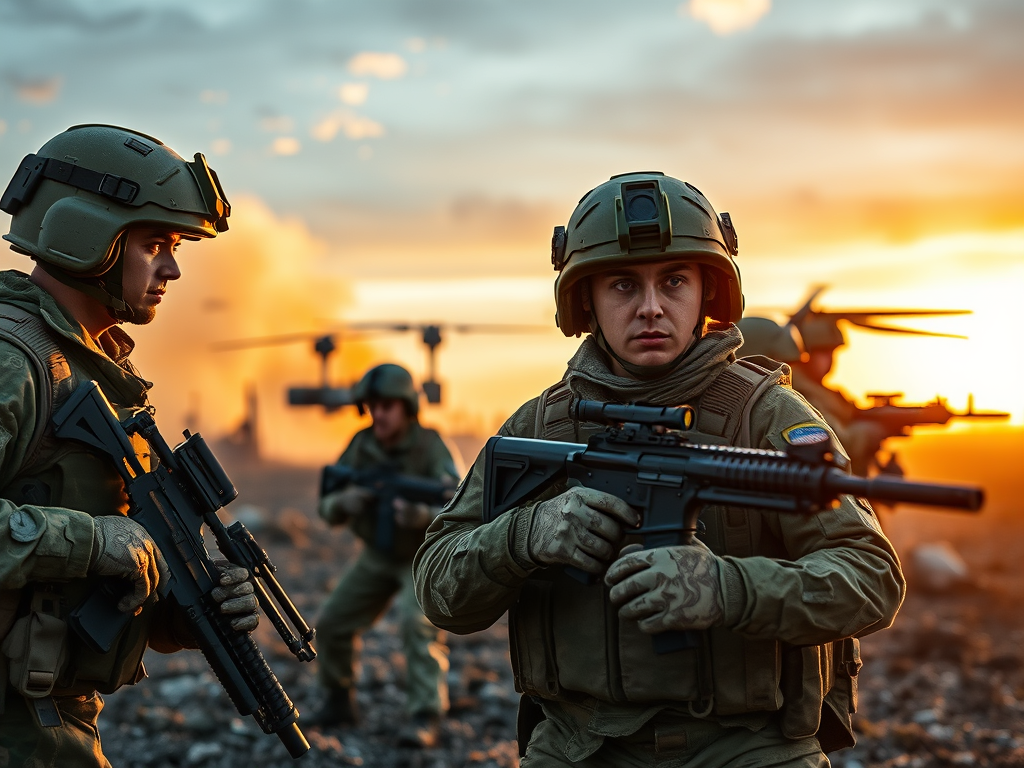

How Soon Could Ukraine’s Forces ‘Start to Buckle’ Without U.S. Weapons?

Without the steady flow of American-made weapons worth billions of dollars, Ukraine’s forces could eventually struggle against Russia—it’s only a matter of time.
The exact timeline, however, hinges on how quickly Europe and Ukraine can compensate for the halted deliveries of artillery, missiles, air-defense systems, and other critical arms. On Monday, Trump administration officials confirmed that these supplies were being put on hold.
The U.S. had pledged up to $11 billion in military aid to Ukraine this year, with some coming from Pentagon reserves and the rest procured through new defense contracts, according to a recent analysis by the Center for Strategic and International Studies in Washington. However, on Tuesday, a former senior U.S. defense official suggested the actual amount was likely closer to $9 billion.
Despite Europe’s unwavering declarations of support for Ukraine—especially since the Trump administration began scaling back aid—quickly bridging the gap left by American assistance remains a daunting challenge. While European defense industries have been ramping up production, progress has been inconsistent, and individual nations must still prioritize maintaining their own military stockpiles.
“Europe cannot possibly replace American aid,” said Lt. Gen. Ihor Romanenko, the former deputy chief of Ukraine’s military general staff, last month.
Ukraine itself has been ramping up domestic arms production, including drones and artillery systems, and has committed 26% of its national budget to defense this year. Still, some top Ukrainian officials warn that without renewed U.S. support, the military will face severe difficulties.
“Ukraine has a safety buffer of about six months, even without consistent aid from the U.S., but beyond that, it will become significantly harder,” said lawmaker Fedir Venislavskyi in an interview with RBC-Ukraine on Tuesday.
Some analysts argue that even this estimate may be too optimistic.
“By the four-month mark, Ukrainian forces would start to falter due to shortages of munitions and equipment to replace battlefield losses,” said Mark F. Cancian, a former White House weapons strategist and co-author of the CSIS study.
Why Can’t Europe Fill the Gap?
Since Russia’s full-scale invasion in February 2022, allies have provided Ukraine with $136 billion in military aid. Nearly half of that came from the U.S., according to the Kiel Institute for the World Economy, a German research organization.
Over time, American contributions have declined as European and Ukrainian defense industries have ramped up production. Currently, around 20% of Ukraine’s military hardware comes from the U.S., according to estimates from the Royal United Services Institute, a British defense think tank.
“But that 20% is the most lethal and essential,” noted Malcolm Chalmers, deputy director general of the institute. While he doesn’t foresee Ukraine’s immediate collapse without U.S. aid, he believes the impact will be cumulative.
As the world’s largest economy, the U.S. simply has greater military resources at its disposal. For instance, its Air Force operates 17 large electronic surveillance aircraft, compared to just three owned by the UK, according to Douglas Barrie, a military aerospace expert at the International Institute for Strategic Studies in London. Additionally, the U.S. supplies more than half of NATO’s fighter jets and ground-attack aircraft.
In response to the urgency of the situation, European Commission President Ursula von der Leyen on Tuesday unveiled an $841 billion initiative aimed at boosting defense budgets and promoting joint weapons procurement across the continent. However, previous efforts have fallen short, with EU nations balancing domestic spending priorities and defense contractors requiring significant upfront capital to scale production.
Von der Leyen acknowledged these challenges.
“The key question is whether Europe is ready to act with the speed and ambition that the moment demands,” she said.
While European artillery production is now almost meeting wartime demand, according to Camille Grand, NATO’s former assistant secretary general for defense investment, more advanced systems like air defenses remain in short supply. Expanding production capacity requires time to train workers, secure raw materials, and build factory space—processes hindered by fragile supply chains.
Defense industry leaders warn that without long-term contracts, typically spanning at least a decade, they cannot justify the necessary investments. Some governments remain hesitant to provide such commitments.
“We are not operating under a true wartime economy, certainly not compared to Russia,” said Grand, now a fellow at the European Council on Foreign Relations. He stressed that political will, not just money, is essential to overcoming these hurdles.
How Is Ukraine Arming Itself?
Ukraine’s Prime Minister, Denys Shmyhal, expressed confidence this week that the country’s military and government have the means to sustain the frontline. However, he refrained from disclosing details about Ukraine’s stockpiles, likely to avoid revealing vulnerabilities to Russia.
Shmyhal stated that Ukraine expects to be self-sufficient in artillery production by the end of the year and is manufacturing its own armored vehicles and anti-tank weapons. In 2023 alone, Ukraine produced over one million first-person-view drones and plans to expand production in 2025.

Additionally, Ukraine is reportedly working to develop air defense systems as sophisticated as the American-made Patriot, which intercepts ballistic missiles. However, each Patriot system—including interceptor missiles, launchers, radar, and a command center—costs around $1 billion and takes up to two years to manufacture.
Of the seven Patriot systems supplied to Ukraine by the U.S. and Germany, at least two have been destroyed, according to data from weapons-tracking site Oryx. Meanwhile, shorter-range air defenses have been provided by the UK, France, Italy, the Netherlands, and Romania.
Yet Ukraine, the second-largest country in Europe, remains under relentless Russian bombardment.
“You can never protect everything—you’ll always have to make trade-offs,” said Barrie, the military aerospace analyst.
Is Ukraine Doomed?
In his study, Is Ukraine Now Doomed?, Cancian warned that without U.S. military aid, Kyiv may be forced into an unfavorable ceasefire deal with Russia. This could mean relinquishing about a fifth of its territory and abandoning its NATO ambitions.
Worse still, some allies might reconsider their support, assuming that without U.S. backing, Ukraine’s cause is hopeless.
The situation is further complicated by the Trump administration’s decision to suspend intelligence-sharing with Ukraine, according to former CIA Director John Ratcliffe. In an interview with Fox Business News on Wednesday, Ratcliffe suggested this pause could be lifted if Ukrainian President Volodymyr Zelensky shows more willingness to engage with Trump’s proposed ceasefire plan.
There are also growing concerns that Ukraine could lose access to Starlink, the satellite internet system vital for military communications and owned by Elon Musk, a close ally of Trump.
However, former National Security Council official David Shimer argues that withholding military aid will only hinder Ukraine’s ability to secure a fair and lasting peace.
“It will weaken Ukraine’s military strength, reduce its negotiating power, and ultimately make it harder to achieve a just resolution to the war,” Shimer said. “Instead of weakening Ukraine’s position, the U.S. should be focused on strengthening it.”




Leave a Reply