

Sadie Sink Heads Back to School, This Time on Broadway

For much of her high school years, Sadie Sink took her classes in an old lifeguard shack that had been repurposed into a schoolhouse for the young actors on the set of Stranger Things. When the cast wasn’t fighting Demogorgons in an alternate dimension, they were juggling different subjects simultaneously. “It was chaos,” Sink recalled in a recent conversation.
With the hit Netflix series approaching its conclusion, Sink began considering her next steps. That’s when she came across the script for Kimberly Belflower’s John Proctor Is the Villain, a play centered on a group of teenagers studying The Crucible—this time in a conventional school setting, though one that harbored its own hidden turmoil.

One afternoon in February, Sink sat at a desk in a Manhattan rehearsal space, the atmosphere evoking a timeless classroom. The melamine desks bore grooves from years of pencils, and tennis balls softened the clatter of chair legs. At the back of the room, a blackboard displayed remnants of a previous lesson: “SEX IS POWER” was scrawled in large chalk letters, and beneath it, in smaller script, the phrase “changes nothing.”

Just as Arthur Miller’s 1953 classic used the Salem witch trials to reflect on McCarthyism, John Proctor Is the Villain uses The Crucible as a lens to explore the complexities of coming of age in the #MeToo era. Set in a high school English class in Appalachia in 2018, the play follows students grappling with Miller’s text as a national reckoning on sexual misconduct disrupts their small town, seeps into their school, and ultimately shapes their understanding of the play itself.

The result is a multifaceted work—part literary analysis, part coming-of-age story, part dark comedy, part rural America portrait, and even a subtle nod to Taylor Swift fandom. This month, the play makes its Broadway debut under the direction of Tony Award-winning Danya Taymor.
In the rehearsal space, Taymor lit a stick of palo santo while the cast—portraying five teenage girls and two boys—rehearsed a scene where a fledgling feminist club erupts into accusations against the men in their lives: a teacher, a classmate, the town’s mayor. Each revelation forces the students to confront their own tangled emotions and moral convictions.

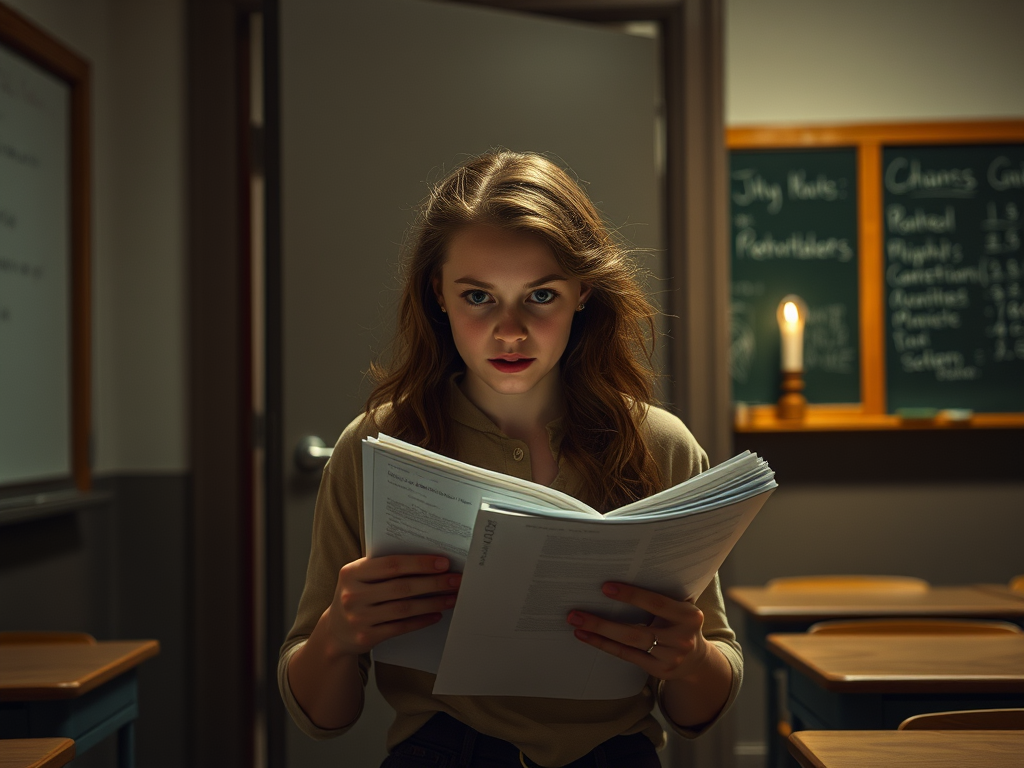
Mid-scene, Sink burst through the classroom door, her script pages rustling. Her character, returning after a conspicuous absence, discovers that despite the revelations of male misconduct, she is the one who has been scapegoated. Her eyes darted around the room, registering her friends’ hypocrisy before she locked onto Mason (Nihar Duvvuri), one of the male students, and cut through his seemingly well-meaning demeanor: “Thank you for being an ally,” she said, her words dripping with irony.
They ran the scene three times, experimenting with different dynamics. After each take, Taymor paused to ask the actors for their thoughts—whether a character should remain seated, if the classroom doors should stay open or closed, and how their interpretations of the script were evolving.
“This is the first scene in the play where the word ‘rape’ is spoken,” Duvvuri observed.
Though these characters can fluently dissect topics like “how white feminism monopolizes the mainstream body positivity movement,” they remain somewhat naïve about how power operates in their own lives. The innocence of youth is slipping away, forcing them to stumble toward a collective awareness of the world’s harsher realities.
Taymor reminded the actors not to rush their characters’ realizations. “I know it’s uncomfortable because you care about them so much,” she said. “But sometimes they don’t know yet. They’re still on the journey.”
A gathering of three or more witches is called a coven, and it took the combined forces of Sink, 22, Taymor, 36, and Belflower, 37, to bring the play to the Booth Theater, where it begins previews on March 20. (Sink also appears this month in O’Dessa, a new musical film premiering on Hulu.) Before that day’s rehearsal, they met over breakfast to discuss the play’s origins.

The spark for John Proctor Is the Villain ignited in October 2017, when Woody Allen likened the growing wave of sexual harassment and assault allegations against Harvey Weinstein to a “witch hunt.” That prompted Belflower to revisit The Crucible. She was struck by how John Proctor—long celebrated as the tragic hero in this quintessential American tale of persecution—was, in reality, a man who engaged in an “affair” with Abigail Williams, a teenager working in his home.
“I thought, wait—this is a teenage girl and a fully grown man,” Belflower said. That realization led her to conceive a play with a title that made her perspective clear: John Proctor Is the Villain.
She completed the script in 2018 with support from the Farm Theater’s College Collaboration program, which commissions works featuring young characters and stages them in college theater departments. Initially, she assumed that would be the play’s only life. “I figured that was it,” she admitted.
But the play gained momentum, earning praise in Washington and Boston before eventually landing in Sink’s hands. She was drawn to the role of Shelby Holcomb, a girl haunted by trauma and accused of ruining a good man’s reputation—much like Miller’s Abigail.
“When she enters, it’s like a storm blowing through,” Sink said of Shelby. “She carries a heavy burden, but it’s disguised by her energy and rapid-fire speech.” Working with Belflower and Taymor, she helped shape a workshop in Manhattan. “Every character felt like a real teenager,” she noted, neither simplified nor prematurely wise. “That’s so rare.”


Sink made her Broadway debut at age 10, playing an orphan in a 2012 revival of Annie before being promoted to the title role. At 14, she joined Stranger Things in its second season, which premiered in October 2017—just as Hollywood’s long-hidden culture of misogyny was being exposed. “It was a scary time,” Sink recalled. “I was so young, and I couldn’t fully grasp what was happening.”
Since then, she has become a symbol of her generation’s pop-feminist awakening—one that revels in reinterpreting cultural artifacts. As the scrappy, sharp-witted Max in Stranger Things, she helped resurrect Kate Bush’s 1985 anthem “Running Up That Hill” on TikTok and the Billboard charts.
In 2021, Taylor Swift cast her in All Too Well: The Short Film, a cinematic expansion of Swift’s 2012 power ballad about a turbulent Hollywood romance. As Swift deconstructed her song to reveal the layers of grief and betrayal beneath, Sink personified the evolution of feminist consciousness, embodying a moment when the world’s biggest pop star reclaimed her narrative.

Now, in John Proctor Is the Villain, that same spirit of cultural revision arrives on Broadway. “The play is about cycles—how systems of power sustain themselves,” Belflower said.
Although she wrote the script during the height of #MeToo, it now functions as a period piece. Yet it remains deeply relevant, speaking to a generation navigating the weight of centuries of American cultural messaging. The characters reference Twilight and John Mayer, Joan Didion and Daniel Day-Lewis, Walt Whitman and SparkNotes.
As part of her research, Belflower read historian Stacy Schiff’s The Witches, which details how the young women of Salem suffered PTSD from rampant violence. She included a quote from the book in her play’s epigraph, noting how these women, though “officially voiceless,” still managed to be heard: “In legal records she hectors, shrieks, quarrels, scolds, rants, rails, tattles, and spits.”
Belflower’s play gives this insight a modern twist, transforming stigmatized expressions of female anger into a raw, unfiltered force for self-assertion. Her writing mirrors the rhythm of text messages—urgent, stripped of punctuation, unfiltered. As her characters push back against traditional narratives—whether about The Crucible or a Lorde song—they claim the right to tell their own stories.
There’s something timeless about this play, and about the teenage experience itself. Taymor, who won a Tony last year for directing The Outsiders, another coming-of-age story, put it simply: “Being a teenager—it never really changes. No matter when or where you grew up, this world will feel familiar.”




Leave a Reply