
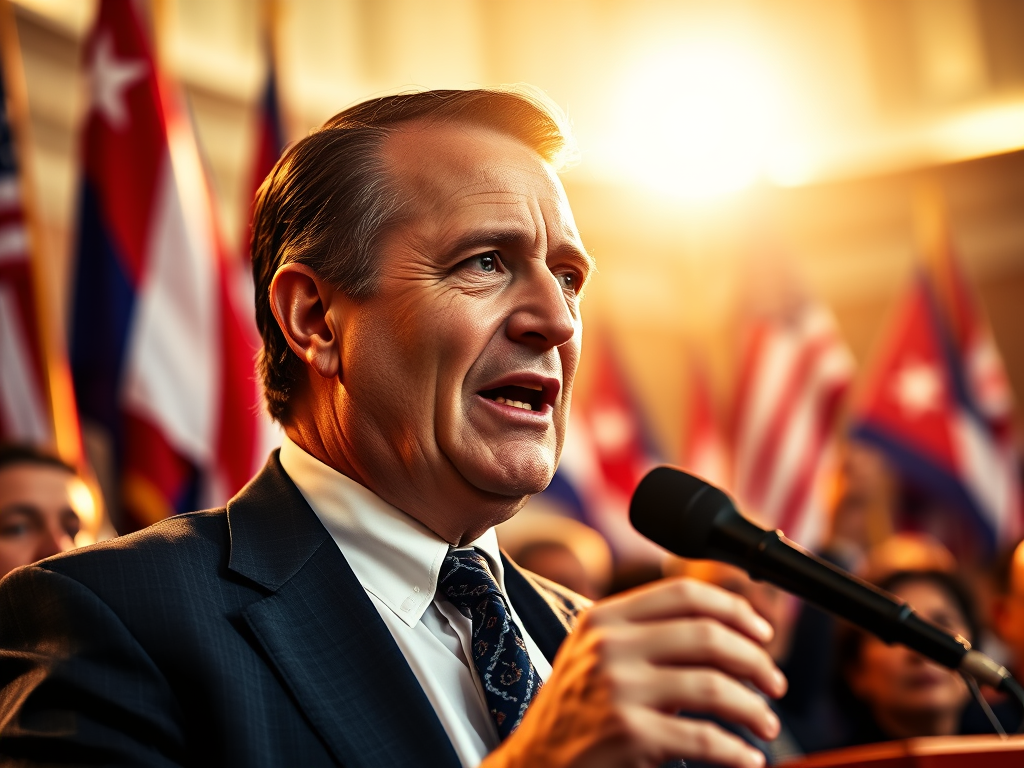

Lincoln Díaz-Balart, a ‘Free Cuba’ Republican in Congress, Dies at 70

Lincoln Díaz-Balart, a steadfast anti-communist and Republican from Florida, played a key role in solidifying the U.S. trade embargo against Cuba while also advocating for immigrant rights during his nearly two decades in Congress. He passed away on Monday at his home in Key Biscayne, Florida, at the age of 70.
His younger brothers, Representative Mario Díaz-Balart, a Republican from Florida, and José Díaz-Balart, a television anchor for MSNBC and NBC News, announced his passing in a statement. According to Representative Díaz-Balart’s office, the cause of death was cancer.
Born into a prominent Cuban political family, Lincoln Díaz-Balart built his own career across the Florida Straits, becoming a passionate speaker and an influential legislator in the House of Representatives during a time when Cuban Americans had significant sway over U.S. policy and elections.

For 18 years, he represented a district in the Miami area with a large Cuban American population, where his name became nearly synonymous with the push for a free Cuba. He was so closely associated with the cause that people occasionally asked whether he aspired to hold office in Havana one day.
In 1995, as a congressman, he was arrested outside the White House while protesting President Bill Clinton’s approach to Cuba, which sought increased engagement. He later played a crucial role in shaping the 1996 Helms-Burton Act, which cemented the trade embargo and other sanctions into law. The legislation prevented Clinton and future presidents from unilaterally lifting the embargo without congressional approval. Critics argue that the embargo has been ineffective, as Cuba’s communist government remains intact.

Beyond his strong stance on Cuba, Díaz-Balart was a dedicated advocate for immigrants, particularly those fleeing left-wing regimes. In 1997, he authored legislation that protected approximately 150,000 Nicaraguans and 5,000 Cubans from deportation and provided a path for hundreds of thousands of other immigrants to seek U.S. residency.
“Lincoln was the greatest champion of Cuban freedom,” former Representative Ileana Ros-Lehtinen, a fellow Cuban American Republican who served alongside him throughout his time in Congress, wrote in an email. “His life’s work was dedicated to promoting democracy and human rights for his homeland.”

Lincoln Rafael Díaz-Balart was born on August 13, 1954, in Havana, Cuba, the second of four sons of Hilda (Caballero) Díaz-Balart and Rafael Lincoln Díaz-Balart. His father, a lawyer, was the majority leader in the Cuban House of Representatives before Fidel Castro seized power in 1959. Politics ran deep in the family—his grandfather and uncle were also involved in government, and his aunt, Mirta Díaz-Balart, was Fidel Castro’s first wife and the mother of his son, Fidel Castro Díaz-Balart, known as Fidelito.
After pro-Castro forces ransacked and burned their home during the Cuban Revolution in 1959, Lincoln, his elder brother Rafael, and their parents fled the country. (The family had been away on a trip at the time.) They lived in New York, Fort Lauderdale, Florida—where Mario and José were later born—Venezuela, and Spain before eventually settling in Miami.

Díaz-Balart earned a degree in international relations from New College of Florida in 1976 and a law degree from Case Western Reserve University in 1979. He initially worked in private practice before becoming a prosecutor in the Miami-Dade County state attorney’s office.
Like many Cuban Americans, he began his political career as a Democrat, leading the Florida Young Democrats and running unsuccessfully for the State Legislature in 1982. However, during the Reagan administration, he, along with many Cuban exiles and their descendants, gravitated toward the Republican Party.
In 1984, he served as co-chair of Democrats for Reagan and formally switched parties in 1985, citing the Democratic Party’s perceived leniency toward communists in Nicaragua and El Salvador. He was elected to the Florida House of Representatives in 1986, moved to the State Senate three years later, and won a seat in Congress in 1992.
During his tenure, Cuban Americans expanded their political influence significantly. In Miami, they became a dominant electoral force, and at the national level, they worked across party lines to oppose Castro’s rule. One of Díaz-Balart’s closest allies in Congress was Senator Robert Menendez of New Jersey, a Democrat and the son of Cuban exiles.
Despite his strong anti-communist stance, Díaz-Balart resisted being defined by a single issue. Representing a district with many working-class immigrants, he was one of only three Republicans to reject his party’s 1994 “Contract With America” and opposed the 1996 welfare reform, which cut off benefits to legal immigrants. The following year, he successfully reinstated disability benefits and food assistance for hundreds of thousands of elderly and legal immigrants.

His most formidable political challenge came in 2008, when national Democrats targeted Miami’s three Cuban American Republican representatives—Díaz-Balart, his brother, and Ros-Lehtinen—for defeat. All three won re-election, but it would be Díaz-Balart’s last term. In 2010, he announced he would not seek re-election and instead planned to return to practicing law and lobbying. His brother Mario successfully ran for his congressional seat that year.
By then, the Tea Party movement was reshaping Republican politics, noted former Representative Carlos Curbelo, a Cuban American Republican who launched his career in Díaz-Balart’s office.
“He was the embodiment of a true statesman,” said Curbelo, who interned for Díaz-Balart at age 15. “He served in an era when bipartisan collaboration was far more common, before the rise of insurgent factions within the Republican Party.”
Díaz-Balart is survived by his wife of 48 years, Cristina (Fernández) Díaz-Balart; their son, Daniel; his three brothers; and two grandsons. Another son, Lincoln Gabriel, passed away in 2013.
Before his passing, he completed a memoir, Sketches From a Life, which remains unpublished.
“Lincoln was a voice for the voiceless and a champion for those who suffered oppression,” José Díaz-Balart said in closing his MSNBC broadcast on Monday. “He dedicated his life to service, doing so with remarkable generosity, effectiveness, and compassion.”




Leave a Reply