

This ‘Swan Lake’ Keeps the Tutus but Sheds the Tights

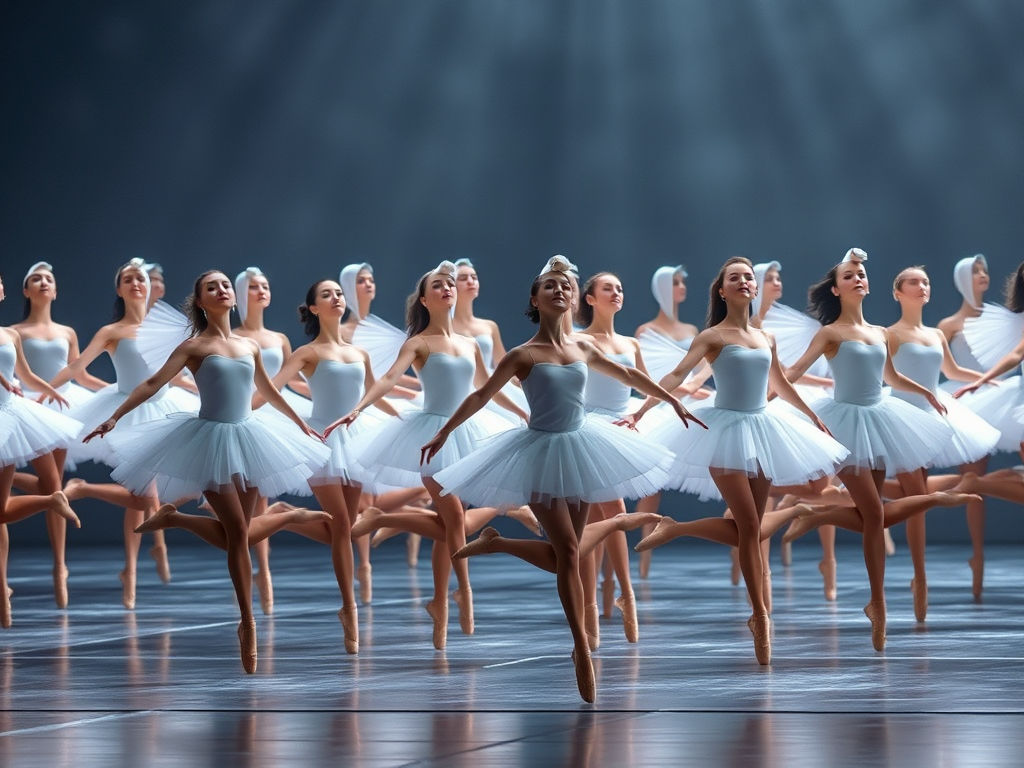
At first glance, the 24 swans gliding across the stage at Toronto’s Four Seasons Centre for the Performing Arts appear to embody tradition. Their tutus form rigid halos of tulle around their waists, bodices gleam with pristine white feathers, and delicate wreaths encircle their heads, covering their ears. Their arms undulate gracefully, wrists flexing to mimic the gentle curve of a bird’s wing.
But a closer look reveals something unusual. Unlike the typical corps de ballet in Swan Lake, where uniformity is paramount, each swan in this production carries a distinct individuality. The dancers appear more athletic, more contemporary—more like real young women than an idealized flock of ethereal birds. Observant audience members might pinpoint the reason: these swans aren’t wearing tights.
Bare legs are a defining characteristic of the National Ballet of Canada’s Swan Lake, which premiered in 2022 and is making its return this month. In a tradition-bound art form, the absence of tights in Swan Lake is a striking departure—akin to playing baseball without a cap or performing in a symphony orchestra in casual wear.

As ballet reckons with its history of racial exclusivity, many of its long-standing customs are under scrutiny. This includes not only hiring and casting practices but also aesthetic standards that have historically marginalized nonwhite dancers. Pale pink tights were originally introduced to match the skin tone of 19th-century European ballerinas, reinforcing whiteness as the default. For dancers with darker skin, wearing these tights has been a daily reminder that they do not fit ballet’s traditional mold.
“I never imagined myself onstage in a tutu with bare legs,” said Erica Lall, who joined the National Ballet’s corps de ballet in June. “But I love it. Swans are fierce, they’re powerful—it makes sense that we should be able to show the strength in our legs.”
The decision to eliminate tights stemmed from conversations about equity and inclusion that began at the National Ballet in 2020. That year, the company had been preparing to debut a new Swan Lake as a farewell production for artistic director Karen Kain, a celebrated ballerina who had led the company for nearly three decades.
Kain envisioned a Swan Lake that incorporated more of Erik Bruhn’s 1967 choreography—the version she had danced herself. She enlisted choreographers Robert Binet and Christopher Stowell to help bring her vision to life, with two key goals: to center the love story at the ballet’s heart and to present the swans as real women rather than fragile, otherworldly nymphs.
Then the world shifted. The pandemic struck, George Floyd’s murder ignited global conversations about race and inequality, and ballet companies, with performances on pause, were forced to confront their own systemic issues. At the National Ballet, discussions about race and inclusion moved to the forefront. Dancers of color questioned why they were still required to wear pink tights and shoes, regardless of their skin tone.
“They’ve always felt restrictive,” said Tene Ward, a dancer of Black and South Asian descent. “Tights are supposed to create a seamless line. But if you have brown skin on top and pink legs below, your line is broken in half.”
Lall, who previously danced with American Ballet Theatre, had experienced the same discomfort. “Growing up, I was taught that ballet tights are pink because they’re meant to match a ballerina’s skin,” she said. “But my skin isn’t pink. So you start to think, ‘Maybe I don’t belong here.’”
For Kain, these conversations were eye-opening. When she trained at the National Ballet, there were no Black women in the company. Her initial solution was to introduce tights in a range of flesh tones. While uncommon in classical ballet at the time, this was not unprecedented—since the 1970s, Dance Theatre of Harlem had used tights and shoes tailored to match dancers’ skin tones, and Lauren Anderson, Houston Ballet’s first Black principal dancer, had been performing in skin-toned tights since the early ’90s.
(Tights don’t carry the same racial connotations for male dancers, as they are rarely intended to mimic bare skin. In this production, all Prince Siegfrieds wear opaque white tights that coordinate with their shirts.)

As the Black Lives Matter movement gained momentum, other major ballet companies also reevaluated their policies. By 2021, productions at Pacific Northwest Ballet, Washington Ballet, and American Ballet Theatre’s Studio Company featured tights in various shades of brown. This shift created an unprecedented demand for diverse skin-tone tights and pointe shoes—so much so that manufacturers struggled to keep up, exacerbated by ongoing supply-chain disruptions.
It was then that Kain posed a radical question to the design team: What if the dancers simply went bare-legged? When the company tried it in rehearsals, she was convinced. Not only did it create a striking visual effect, but it also emphasized the human qualities she wanted to highlight. “It became a design choice that allowed the dancers to appear more vulnerable, more individual,” she said.
The decision sparked mixed reactions. Ward found it deeply meaningful—a sign of true acceptance within the ballet world. But others were hesitant. Traditionally, tutus are worn with tights, and without them, the rough tulle could feel itchy against bare skin. Some dancers worried about the so-called “double-butt” effect caused by the tutu’s bottom pressing against their thighs. Others pointed out the practical benefits of tights: they provide warmth, conceal imperfections, and offer a sense of security onstage.
Stacy Dimitropoulos, the company’s head of wardrobe, sought a solution that balanced the dancers’ concerns with Kain’s artistic vision. Tutus come with a built-in mesh panty that is too sheer to be worn alone, and the basque—a structural component that secures the tutu at the hips—is not designed to sit directly on bare skin. After extensive testing, she found a compromise: seamless, high-waisted underwear dyed to match each dancer’s skin tone.
But one issue proved harder to solve. Without tights, sweat became a problem.

“Tights absorb moisture,” explained Jurgita Dronina, a former principal dancer who led the premiere performance in 2022. Speaking from Vilnius, where she now serves as artistic director of the Lithuanian National Ballet, she recalled her struggles during rehearsal. “By the third act, I could barely stay en pointe. Sweat had dripped down my legs, and my pointe shoes were practically disintegrating.”
Acknowledging these challenges, Kain allowed Odette-Odile dancers to wear ultra-thin, flesh-toned tights to absorb sweat while maintaining the bare-legged aesthetic of the corps de ballet. Binet supported this decision, given the lead role’s intense physical demands. “She’s onstage the entire time,” he said. “She’s doing huge extensions, being lifted constantly—it made sense.”
Just as the sweat issue was resolved, a more delicate concern arose. Documentary filmmaker Chelsea McMullan had been capturing the making of the production for Swan Song, an award-winning film. In it, dancer Shaelynn Estrada shares her struggles with depression and self-harm. When the no-tights policy was announced, she confided in Binet that her legs bore visible scars.
Binet asked whether she was worried about the company’s response or simply didn’t want the marks to be seen. Ultimately, Estrada felt comfortable having the makeup team cover them, a relatively simple fix for a crew already adept at concealing tattoos. But her experience underscored the complexities of allowing dancers greater personal expression within ballet’s rigid framework.
Ballet has long upheld a narrow, idealized version of femininity. What happens, for example, if a female dancer decides not to shave her legs?
Hope Muir, who succeeded Kain as artistic director in 2022, said she hadn’t encountered that question yet, but she welcomed the dialogue. “What matters is that dancers feel empowered to make choices about how they present themselves onstage,” she said. “I want this to be a space where everything is thoughtfully considered, and where dancers truly have agency.”




Leave a Reply