
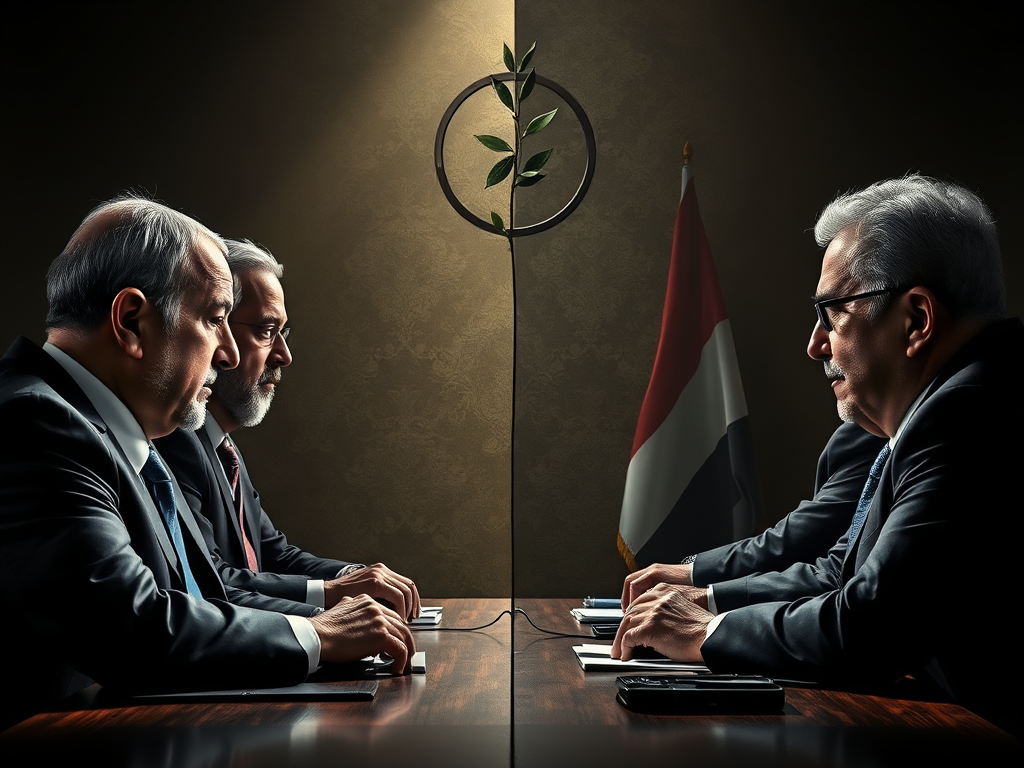

With Cease-Fire Shaky, Israel and Hamas Weigh Diplomatic and Military Options

When the cease-fire agreement between Israel and Hamas was announced in January, both Israelis and Palestinians erupted in celebration, hopeful after 15 months of conflict.
Now, with the first phase of the deal concluding on Sunday and Israel introducing a new proposal—already rejected by Hamas—concerns are growing that the war, which devastated Gaza, claimed tens of thousands of Palestinian lives, and endangered hostages, could resume.
As the cease-fire hangs in the balance, both Israel and Hamas are navigating two tracks: diplomacy and military preparations.
On the diplomatic front, Hamas is pushing for the implementation of the agreement’s second phase, which calls for an end to the war, a complete Israeli withdrawal from Gaza, and further hostage and prisoner exchanges.
Israel, however, has put forward a new proposal for a seven-week cease-fire extension. Under this plan, Hamas would release half of the remaining living hostages along with the remains of half of the deceased captives. Israeli Prime Minister Benjamin Netanyahu credited the proposal to efforts by President Trump’s Middle East envoy, Steve Witkoff.
For weeks, Israel has signaled reluctance to move forward with the second phase. While both parties agreed to it in principle, they never finalized the specifics and remain deeply divided on their objectives.
Netanyahu has consistently stated that Hamas’s political and military infrastructure must be dismantled—a position backed by his right-wing coalition. Hamas, while indicating a willingness to relinquish civilian governance of Gaza, has firmly opposed dissolving its military wing, which remains a key source of its power.
The latest proposal, as described by Netanyahu on Sunday, appears to offer Israel a way to secure the release of more hostages without committing to ending the war. However, analysts suggest it may also be a tactical move to break the deadlock and extend negotiations.
“It’s not a viable solution, but it serves as an opening move,” said Shira Efron, an analyst at the Israel Policy Forum, a New York-based think tank. “It could create an opportunity for discussions that prolong the cease-fire by a few weeks or more.”
However, she added, it does not address the fundamental divide between Hamas and Israel regarding the war’s conclusion.
During a government meeting on Sunday, Netanyahu stated that the proposal includes a temporary cease-fire during Ramadan and Passover. He outlined a plan where half of the remaining hostages would be released at the start of the cease-fire, while the rest would be freed if an agreement for a permanent truce were reached.
In the first phase of the January deal, Hamas released 25 Israeli hostages and returned the bodies of eight others in exchange for over 1,500 Palestinian prisoners held by Israel. However, without further planned exchanges, Israel has diminishing incentives to uphold the truce.

On Sunday, Hamas dismissed Israel’s latest proposal, calling it “a blatant attempt to abandon the agreement and evade negotiations for its second phase.”
Hamas sees the idea of releasing half the hostages immediately as unacceptable but may consider smaller exchanges in return for Palestinian prisoners, even without a definitive agreement to end the war. Analysts note that hostages are Hamas’s primary bargaining chip, and each exchange weakens its negotiating leverage.
Two Israeli officials, speaking anonymously, acknowledged that Hamas is unlikely to release a significant number of hostages without assurances regarding the war’s conclusion. This reality, they said, may eventually force Israel to choose between resuming military operations to remove Hamas or securing the release of the remaining hostages.
According to the Israeli government, about 25 captives and the remains of over 30 others are still in Gaza.
“Israel faces a difficult choice,” said Yaakov Amidror, a retired major general and former national security adviser to Netanyahu.
On Sunday, Hamas spokesman Hazem Qassim reaffirmed that the group is committed to negotiating the second phase of the agreement, aiming to prevent the resumption of war and ensure Israel’s withdrawal from Gaza.

“This is a core principle for Hamas,” he told Al Jazeera, a Qatari-funded news outlet.
Both sides have sent representatives to negotiate with Egyptian and Qatari mediators. Yet, even as diplomatic talks continue, both Israel and Hamas are preparing for a potential return to war.
Hamas has reportedly been gathering unexploded ordnance across Gaza, repurposing materials for improvised explosive devices, according to a member of its military wing, the Qassam Brigades, who spoke on condition of anonymity. The group has also been recruiting new fighters and appointing replacements for commanders killed in combat.
Meanwhile, Israeli officials say they have extensively planned for a renewed offensive in Gaza, which would target Hamas officials accused of diverting humanitarian aid and dismantle infrastructure used by the Hamas-run civilian administration. Though such a campaign has yet to be approved by Israel’s cabinet, some officials believe only pressure from President Trump could dissuade Netanyahu from escalating military action.
As Israel and Hamas continue their struggle over Gaza’s fate, Palestinian civilians and the families of hostages remain trapped in uncertainty.
“They are left in a constant state of anxiety,” said Akram Atallah, a London-based Palestinian journalist originally from Jabaliya in northern Gaza. “If the war resumes, they will suffer the most.”




Leave a Reply