

Europe Races to Repair a Split Between the U.S. and Ukraine

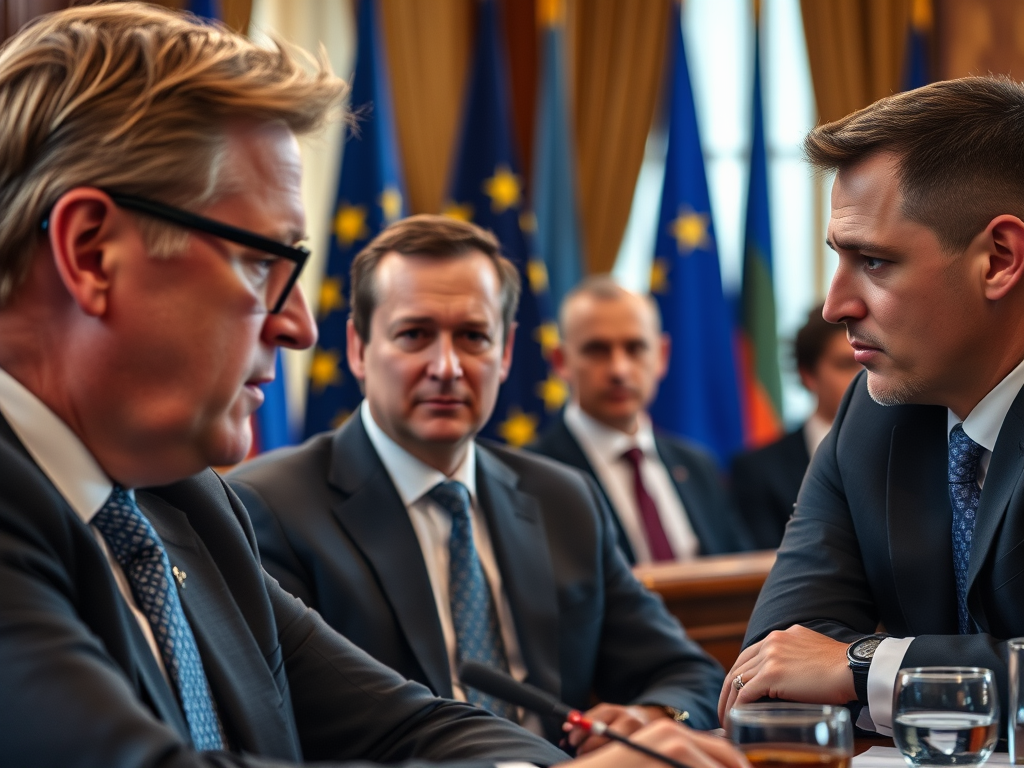
European leaders scrambled on Sunday to mend Ukraine’s fractured relationship with the United States, as Britain and France spearheaded a “coalition of the willing” to formulate a strategy for ending Ukraine’s conflict with Russia. Their goal is to secure the support of a skeptical President Trump.
Meeting in London at the invitation of British Prime Minister Keir Starmer, the leaders reaffirmed their commitment to backing Ukrainian President Volodymyr Zelensky after his tense encounter with Mr. Trump last week. At the same time, many expressed hope for reconciliation between the two, highlighting Europe’s reluctance to jeopardize the transatlantic alliance that has preserved peace for eight decades.
“We stand at a pivotal moment in history,” Mr. Starmer stated after the meeting. “Europe must take the lead,” he emphasized, while also acknowledging, “For peace to prevail, strong U.S. support is essential.”
Despite the tensions from Friday’s Oval Office meeting, Mr. Starmer believes Mr. Trump remains committed to brokering a lasting peace between Ukraine and Russia. He announced that Britain and France, alongside other European nations, would work with Mr. Zelensky to develop an independent peace plan.
While details of the proposal remain unclear, Mr. Starmer indicated that Europe could leverage it to persuade Mr. Trump to offer security guarantees to Ukraine. Britain and France have already committed to contributing troops to a potential peacekeeping force and are working to enlist additional European allies.

“I wouldn’t be pursuing this path if I didn’t believe it could lead to a positive outcome in ensuring we move forward together,” Mr. Starmer said, referencing Mr. Trump.
His remarks underscore Europe’s dilemma following Mr. Trump’s unexpected outreach to Russian President Vladimir V. Putin two weeks ago. Neither Europe nor Ukraine currently has a seat at the table in potential peace talks led by Mr. Trump, nor has he provided any assurances to deter future Russian aggression.
The rift between Mr. Trump and Mr. Zelensky widened following their heated exchange. “Nobody wanted last Friday’s events to unfold as they did,” Mr. Starmer noted, contrasting the incident with his own, more cordial meeting with Mr. Trump the previous day.
Mr. Starmer has taken on the role of mediator, speaking with both leaders by phone after their confrontation. He even suggested that Mr. Zelensky return to the White House that evening to smooth things over, according to a senior British official. However, both leaders declined, preferring to let tensions cool first.

Nevertheless, Mr. Zelensky remains optimistic that his relationship with Mr. Trump is not beyond repair. “I believe our partnership will endure,” he told reporters after the London gathering, though he criticized the way the White House meeting was handled.
“I don’t think such discussions should be completely public,” Mr. Zelensky remarked, adding, “The format in which it happened did not contribute anything positive or beneficial to us as allies.”
In London, European leaders demonstrated their solidarity with Mr. Zelensky, offering warm gestures of support. Among the 18 leaders present were French President Emmanuel Macron, German Chancellor Olaf Scholz, Italian Prime Minister Giorgia Meloni, and Canadian Prime Minister Justin Trudeau.

Following the summit, Mr. Zelensky traveled to Sandringham to meet King Charles III. The visit carried symbolic weight, as Mr. Starmer had personally delivered a rare invitation from the king to Mr. Trump for a second state visit to Britain.
Despite this show of unity, leaders acknowledged that securing continued U.S. involvement remains crucial.
“Starmer has two objectives,” said Mujtaba Rahman, an analyst at the Eurasia Group. “To craft a proposal with Ukraine and Europe that keeps the U.S. engaged in Ukraine’s security, while simultaneously preparing for a scenario where that support may not materialize.”
Achieving this will require European nations to assume a greater role in their own defense. Mr. Starmer urged leaders to follow Britain’s example in increasing military spending. NATO Secretary General Mark Rutte confirmed that several countries had pledged to do so, though he did not disclose specifics.
On Saturday, after meeting Mr. Zelensky, Mr. Starmer extended a £2.26 billion ($2.8 billion) loan to Ukraine for military equipment. On Sunday, he announced an additional £1.6 billion ($2 billion) in British export financing to help Ukraine acquire over 5,000 advanced air defense missiles.
European Commission President Ursula von der Leyen emphasized the EU’s commitment to strengthening Ukraine’s economic and military resilience, likening it to turning the country into “a steel porcupine that is indigestible to potential invaders.”
The Ukraine war has placed Mr. Starmer in an unusual position for a British prime minister—at the center of European diplomacy during a crisis. More than eight years after Brexit, shifting geopolitical realities are drawing Britain closer to Europe once again.
Catherine Ashton, a former EU foreign affairs chief, noted that Mr. Starmer’s effective diplomacy with Mr. Trump has bolstered his standing in Europe. “It’s no surprise that European allies gathered in London this weekend, nor that the UK is gaining renewed influence in Brussels and other capitals,” she said.

However, Mr. Starmer’s diplomatic reach has its limits. Despite his efforts—including the royal invitation—he was unable to extract security commitments from Mr. Trump.
Meanwhile, in Washington, a senior Trump administration official revealed that Mr. Trump would meet on Monday with top national security advisers, including Secretary of State Marco Rubio and Defense Secretary Pete Hegseth, to review potential policy shifts regarding Ukraine. These discussions could include suspending or even canceling U.S. military aid, including the final shipments of ammunition and equipment approved under the Biden administration.
For Mr. Starmer, the crisis presents an opportunity to strengthen ties with Europe. While he has long sought closer trade relations, domestic political sensitivities have made him cautious. The Labour Party is wary of alienating working-class voters—many of whom supported Brexit—who could shift toward the anti-immigration Reform UK party led by Nigel Farage.
However, increasing military investment is broadly popular among Reform voters. Supporting Ukraine while opposing Russian aggression also puts Mr. Farage, who has expressed sympathies for Mr. Putin, in an uncomfortable position.
Whether this alignment will facilitate deeper UK-EU economic integration remains uncertain. Some analysts point out that the EU sees its current trade deal with Britain as advantageous and is in no hurry to renegotiate. Mr. Starmer’s domestic success will ultimately depend on reviving Britain’s struggling economy.
“The UK is in such dire straits that I don’t think Starmer will gain much politically from his role on the international stage,” said Mr. Rahman. “It’s risky for a prime minister to seek political capital abroad when domestic issues aren’t improving.”
Mr. Starmer’s use of the term “coalition of the willing” carries echoes of President George W. Bush’s rhetoric before the Iraq War—when Britain, under Labour Prime Minister Tony Blair, supported the U.S., while France and Germany did not.
This time, however, Mr. Trump’s statements on Russia and Ukraine may foster greater unity among European allies.
“People now realize they can no longer count on a cooperative Russia or a consistently supportive America,” said João Vale de Almeida, a former EU ambassador to both the U.S. and the UK. He noted that Britain’s position aligns more closely with Europe than with America on security matters.
Nonetheless, Mr. Starmer, who discussed his plans with Mr. Trump on Saturday night, dismissed claims that the transatlantic alliance is crumbling. “I do not accept that the U.S. is an unreliable ally,” he stated.



Leave a Reply