
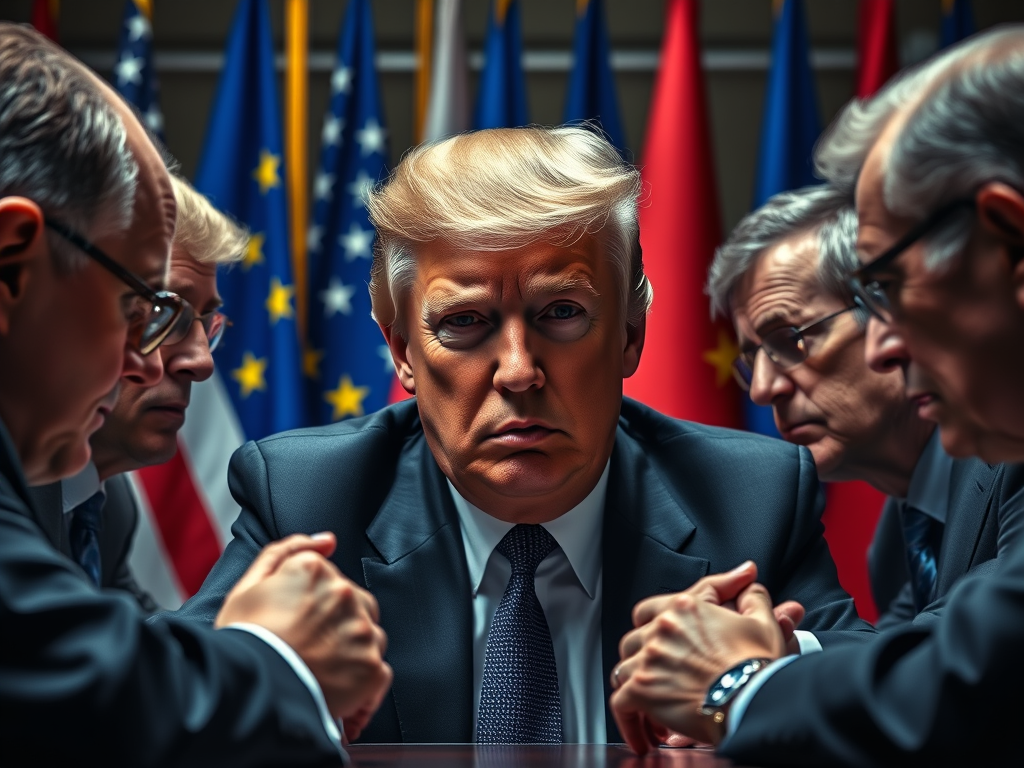

Indifference or Hostility? Trump’s View of European Allies Raises Alarm
In his first term as president, Donald Trump labeled the European Union as a “foe” and claimed it was created to harm U.S. trade interests. He reiterated this at a cabinet meeting, using blunt language: “The European Union was created to screw the United States. That’s the purpose, and they’ve done it well.” He went on to announce plans to impose 25% tariffs on European goods, including cars.

This rhetoric, along with Trump’s close ties to Russia and his statements suggesting Europe should fend for itself, has fueled growing concerns among European leaders and analysts. Many now believe that Trump and his administration view America’s traditional European allies not just as economic competitors, but as adversaries across the board.
While some officials interpret the Trump administration’s stance as indifference toward Europe, others see it as outright antagonism. There is a shared understanding that the longstanding transatlantic relationship has shifted, with the U.S. now seen as a less predictable and reliable ally.

Trump has openly distanced himself from NATO and aligned with Russia, long considered the alliance’s main threat. Vice President JD Vance has criticized European democracy and encouraged the rise of far-right parties, while Elon Musk, a prominent Trump ally, has openly disparaged European leaders and supported extremist factions in Germany.
Perhaps most shocking to European leaders, the U.S. recently abstained from condemning Russia’s invasion of Ukraine at the United Nations, aligning instead with authoritarian regimes like Russia, Belarus, and North Korea.

As European leaders scramble to assess the damage, British Prime Minister Keir Starmer and French President Emmanuel Macron have both visited the White House in an effort to persuade Trump to remain committed to Ukraine and stay engaged in Europe. But Trump, who prides himself on being a disruptor, has remained unmoved by Macron’s diplomatic efforts.
Friedrich Merz, a conservative German politician who is likely to become the country’s next chancellor, has expressed doubts about the future of the transatlantic partnership, calling it clear that Trump’s administration is largely indifferent to Europe’s well-being. Merz even questioned whether NATO’s nuclear umbrella would remain and whether the alliance itself would endure. He vowed to strengthen Europe’s independence from the U.S. as quickly as possible.
Merz’s remarks echoed a 2017 statement by Angela Merkel, who after difficult meetings with Trump, declared, “The times in which we could rely fully on others are somewhat over,” urging Europeans to “take our fate into our own hands.” At the time, many saw her comments as a potential shift in European policy, though little changed. Today, Claudia Major, a German security policy expert, argues that the situation is more dire than ever.

“Vance’s rhetoric declared a culture war,” Major said. “He made it clear that the country that helped restore our freedom and democracy is turning against us.”
Several analysts agree that the Trump administration’s actions go beyond mere indifference toward Europe — they suggest a deliberate effort to dismantle European unity. As Nathalie Tocci of Italy’s Institute of International Affairs puts it, “The intention is clear: to destroy Europe, starting with Ukraine.” The empowerment of far-right movements aligns with the administration’s goal of weakening the European Union’s regulatory power on trade, competition, and even hate speech.
The European Union, the world’s largest trading bloc, has the economic clout to push back against Washington’s policies. This power is particularly evident in regulating high-tech and social media companies, many of whose leaders, like Elon Musk, are close allies of Trump and have a vested interest in diminishing the EU’s influence.
The so-called “Brussels Effect” refers to the EU’s ability to set global norms on critical issues such as climate regulations, digital competition, and artificial intelligence. Trump’s administration views this power as a threat to American interests and is working to weaken it.
However, analysts warn that if the Trump administration truly seeks to dismantle this influence, there may be little that European nations can do to appease the U.S. “If the goal is to destroy European democracy,” Tocci notes, “no amount of European purchasing of American LNG or weapons will matter.”

The strain on U.S.-European relations is not just a matter of policy differences, but a broader ideological, strategic, and economic divide. Camille Grand, a former NATO and French official, says the situation is a profound shock for Europeans, who are now forced to reassess whether they are still partners or, in Trump’s eyes, rivals.
Despite this, some believe that the U.S.-European relationship will continue in some form, with Linas Kojala, a security expert from Lithuania, urging caution. “There is no alternative to the U.S. security guarantee,” he said, adding that severing ties would be akin to abandoning a ship in the middle of the ocean.
Nevertheless, even if Europe must “swallow” the criticism for now, Alex Younger, former MI6 chief, suggests that the relationship is unlikely to return to its previous state. “We are entering a new era where international relations are shaped more by strongmen and deals than by rules and multilateral institutions,” he said.
Matthew Kroenig, a former U.S. defense official, argues that much of the hysteria over Trump’s approach may be overblown. After all, the first Trump term was marked by tough talk but ultimately strengthened NATO. Yet many remain unconvinced, with Nigel Gould-Davies of the International Institute for Strategic Studies warning that Trump’s strategy toward Russia in Ukraine resembles “strategic surrender” — a policy that risks undermining the credibility of the U.S. in the eyes of its allies.
As Roberta Metsola, president of the European Parliament, put it, “We are not out to screw anyone,” but added that isolation may seem appealing “until it leaves you stranded.”




Leave a Reply