
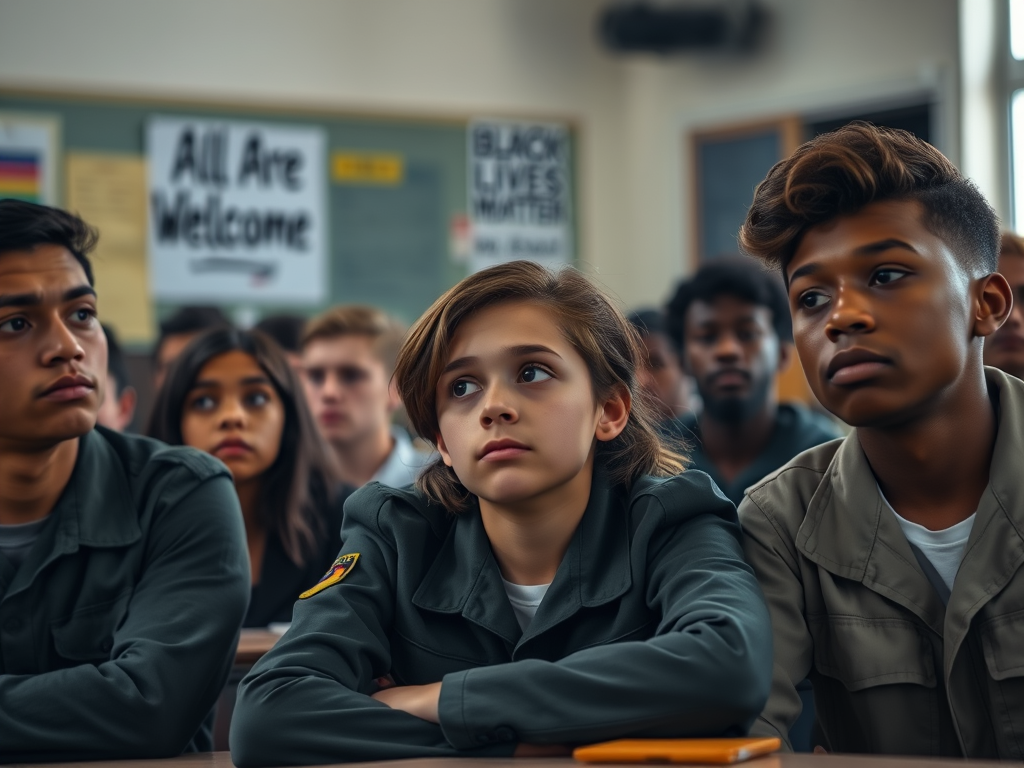

Defense Dept. Schools Pause STEM Club for Girls and Pride Clubs

At Lakenheath High School, a school for children of U.S. military personnel stationed in Britain, both a gay student alliance and a Women in STEM group have had their activities suspended.
Similarly, at Ramstein High School in Germany, clubs supporting Hispanic and Asian students, as well as the Pride and Ally group, have been put on hold.
Across military bases worldwide, school districts are reviewing books in response to directives from the Trump administration aimed at restricting discussions around gender identity, diversity, equity, and inclusion.
While most U.S. school districts have made only minor adjustments in response to these federal mandates, the Defense Department operates a school system that serves about 67,000 students from preschool through high school on military bases globally. As a federal entity, this system is quickly adjusting to the new directives.
In addition to halting certain affinity clubs focused on race and gender, as well as reviewing educational materials, Pride decorations have been removed, and events celebrating Black History Month have been canceled, according to interviews with parents and students, as well as a Defense Department memo.

This shift marks a notable departure for a school system that has historically been relatively shielded from political disputes in education and has long maintained some of the nation’s best math and reading scores.
Defense schools, which are located not just in the U.S. but in countries like Belgium and Japan, serve a diverse student population, reflecting the broad demographics of the military itself. This diversity is foundational to the system, which was originally established to serve the children of military families in the segregated South.
Kadyn, a 16-year-old student at Lakenheath High School, shared his concerns, stating that signs such as “All Are Welcome,” along with symbols like the rainbow flag and Black Lives Matter logo, have been taken down. He added that flags of foreign nations had also been removed, commenting, “I feel like we are losing the essence of what makes our schools thrive.”
Will Griffin, a spokesperson for Defense Department schools, explained that the system was reviewing its policies to comply with directives from President Trump and his Defense Secretary, Pete Hegseth, who called for an end to cultural awareness months like Black History and Women’s History Month.
While students retain the right to form and participate in clubs, Griffin noted that these groups require a teacher to supervise, and since teachers in Defense schools are federal employees, they must follow the new rules.
Some clubs may resume with volunteer supervision, but the situation remains fluid.

The goal, Griffin emphasized, is to continue offering a strong, high-quality educational experience for military-connected students, preparing them for success in college and beyond.
A February memo from the Defense Department instructed schools not to use certain materials, including the book Becoming Nicole, about the life of a transgender girl, and Albert Cashier, a biography of a transgender Civil War soldier. Also banned was material on gender identity and sexuality from Advanced Placement Psychology courses.
However, these restrictions have caused confusion, as educators and librarians in over 100 schools worldwide try to navigate the guidelines.
Actress Julianne Moore caused a stir when she revealed that her book Freckleface Strawberry, which tells the story of a young girl learning to embrace her freckles, was pulled for review. Moore, who attended a Defense school, expressed her disbelief on Instagram, writing, “I can’t help but wonder what is so controversial about this picture book.”
As of this week, Freckleface Strawberry has been reinstated for checkout, Griffin confirmed. He clarified that most of the books under review were not part of the official curriculum but were extra materials available in classrooms or libraries.
Allie Allen, a parent of three children in Stuttgart’s Defense schools, remarked that her school principal assured her that books on historical figures like Rosa Parks or Dr. Martin Luther King Jr. would not be removed, but books referencing Black History Month might face review. “There is not a lot of exact guidance,” she said.
Students, too, are uncertain about the future. Sophia Carey, a 16-year-old junior at a Defense school in Germany, had planned to start a girls’ club focused on Women’s History Month, featuring female military and science speakers and a project to provide feminine hygiene products in school and community bathrooms. But with teacher supervision hard to secure, she said, “Everything is so uncertain.”




Leave a Reply