
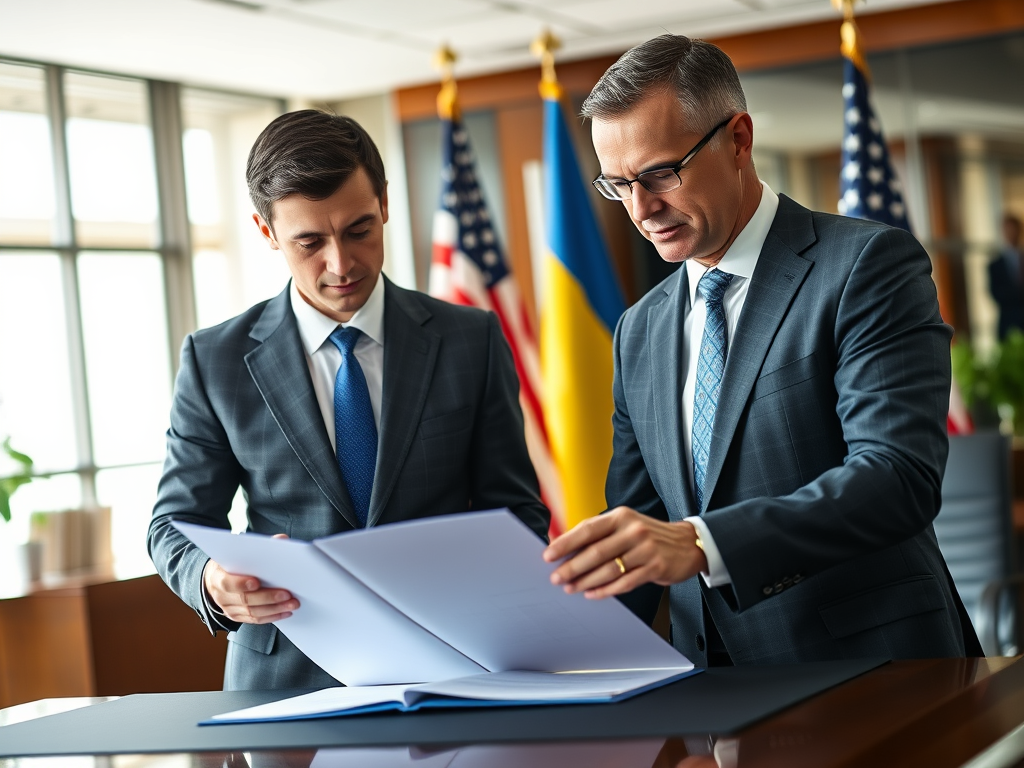

Draft of Minerals Deal Features Vague Reference to Ukrainian Security

A draft agreement, which outlines the transfer of Ukraine’s natural resource revenue to the United States, now includes new language referencing security guarantees—something Kyiv had strongly advocated for during negotiations.
However, the language remains ambiguous and does not indicate any concrete American commitment to safeguarding Ukraine’s security.
The version of the agreement obtained by The New York Times on Wednesday includes a statement affirming that the United States “supports Ukraine’s effort to obtain security guarantees needed to establish lasting peace.” This phrasing was not included in previous drafts.
During a cabinet meeting on Wednesday, President Trump informed Ukraine that he would not extend security guarantees “beyond very much,” emphasizing that Europe should handle that responsibility.
It remains unclear if the Tuesday-dated draft represents the final version.
A Ukrainian official familiar with the draft, along with others involved in the discussions, confirmed the inclusion of security-related language, though they spoke anonymously due to the sensitive nature of the negotiations.
This agreement appears to offer the possibility of continued U.S. support under the Trump administration, either through aid for Ukraine’s war efforts or enforcement of any ceasefire. Both U.S. and Ukrainian officials indicated on Tuesday that an agreement had been reached.
President Trump stated on Wednesday that Ukrainian President Volodymyr Zelensky would visit Washington on Friday to sign the deal.
Mr. Zelensky, speaking to reporters in Kyiv, said that securing a mention of security guarantees had been a critical goal in negotiations and was essential for Ukraine to consider the agreement a success.
“I was really keen to see at least the phrase ‘security guarantee for Ukraine’ appear in the document,” Mr. Zelensky said. The phrase, he added, “appears in point 10, and it’s important that it is included.”
Zelensky also expressed satisfaction that the deal was not framed as repayment for past support, stressing that it was crucial that Ukraine was not depicted as a “debtor.”
The draft obtained by The Times shows Scott Bessent, the U.S. Treasury Secretary, and Yulia Svyrydenko, Ukraine’s Economy Minister, as the initial signatories.
Earlier in the day, Ukraine’s Prime Minister Denys Shmyhal referred to the new security guarantees language, suggesting the United States had not fully agreed to the inclusion of that phrase. Shmyhal stated that neither President Zelensky nor other Ukrainian officials would sign the deal without it, calling it a “key element” of the agreement concerning minerals.
Last fall, Zelensky proposed a deal allowing the U.S. access to Ukraine’s mineral wealth, contingent on Trump winning the American election. However, after Trump assumed office, Zelensky hesitated over the terms presented earlier this month.
Zelensky had strongly insisted that the agreement explicitly detail a commitment to Ukraine’s security. In exchange, Ukraine would allocate half of future earnings from its natural resources to an American-controlled fund.
The Trump administration had resisted this request, arguing that security guarantees were already implied by the U.S.’s financial stake in Ukraine’s resources, such as metals, minerals, and oil, which would provide an incentive to deter Russian occupation of those resources.
Mike Waltz, the U.S. National Security Adviser, stated on Fox News last week that U.S. involvement in Ukraine’s natural resources would offer “the best security guarantee they could ever hope for, much more than another pallet of ammunition.”
The Tuesday draft included previous language stating that the U.S. would take “steps to protect mutual investments,” implying a commitment to safeguard resource sites, some of which are near conflict zones.
President Trump had referred to the deal as compensation for past U.S. assistance, initially requesting $500 billion. This figure alarmed officials in Kyiv and was later removed from the draft.
According to the Ukrainian official briefed on the draft, U.S. negotiators had worked hard to exclude the security guarantees language from earlier versions, arguing it was outside the scope of the mineral rights negotiation. The phrase was only added in later drafts, the official explained.
It remains uncertain whether the new wording signifies a commitment to American security guarantees or simply expresses support for Ukraine’s ongoing diplomatic efforts to secure backing for a European peacekeeping mission and other assurances related to a ceasefire.
British Prime Minister Keir Starmer is expected to visit Washington on Wednesday to present an initiative for a European peacekeeping force of 30,000 troops. European leaders have indicated that such a force would require American military support, such as satellite surveillance or air defense.
Other elements of the draft remain largely unchanged from earlier versions. The Ukrainian government has agreed to transfer half of its revenue from the future monetization of natural resources, including minerals, oil, and gas, as well as earnings from associated infrastructure like LNG terminals and ports. This fund will not include revenue from existing resource operations, such as mines and oil wells.

The fund would allow the U.S. to hold a percentage of ownership and influence “to the maximum” extent permitted under American law, though the exact meaning of this remains unclear.
Mr. Zelensky also addressed ceasefire negotiations with Russia, stating that Ukraine’s army would continue fighting unless a ceasefire included security guarantees.
Zelensky has made it clear that Ukraine will not accept a deal without Ukrainian involvement but had not previously suggested so firmly that the Ukrainian army could keep fighting without a security guarantee in place.
“Ukraine is in a very tough position,” said Oleksiy Melnik, a security analyst at the Razumkov Centre in Kyiv.
“Now Ukraine faces dual pressure, as one of its key partners, whom it considered strategic, appears to be shifting sides,” he explained. “What Donald Trump has done so far is something no one in Ukraine expected. The choice is either Ukraine refuses and faces potential consequences, or it accepts the terms of the U.S.-Russia negotiations.”


Leave a Reply