

Women Watching Women Watching Women

Movies feature a vast array of bodies in different shapes, sizes, and colors—bodies that are slim, muscular, altered, or weathered. However, discussing these bodies, especially women’s bodies, can often be uncomfortable. For some, talking about them is seen as objectifying, even unnecessary, despite the fact that many people—politicians, activists, influencers, and even Supreme Court justices—seem unable to stop discussing them. Filmmaker Agnès Varda once remarked, “We’re always talking about the feminine condition and the role of women, but I want to talk about the woman’s body, about our bodies.” And I want to talk about them too.
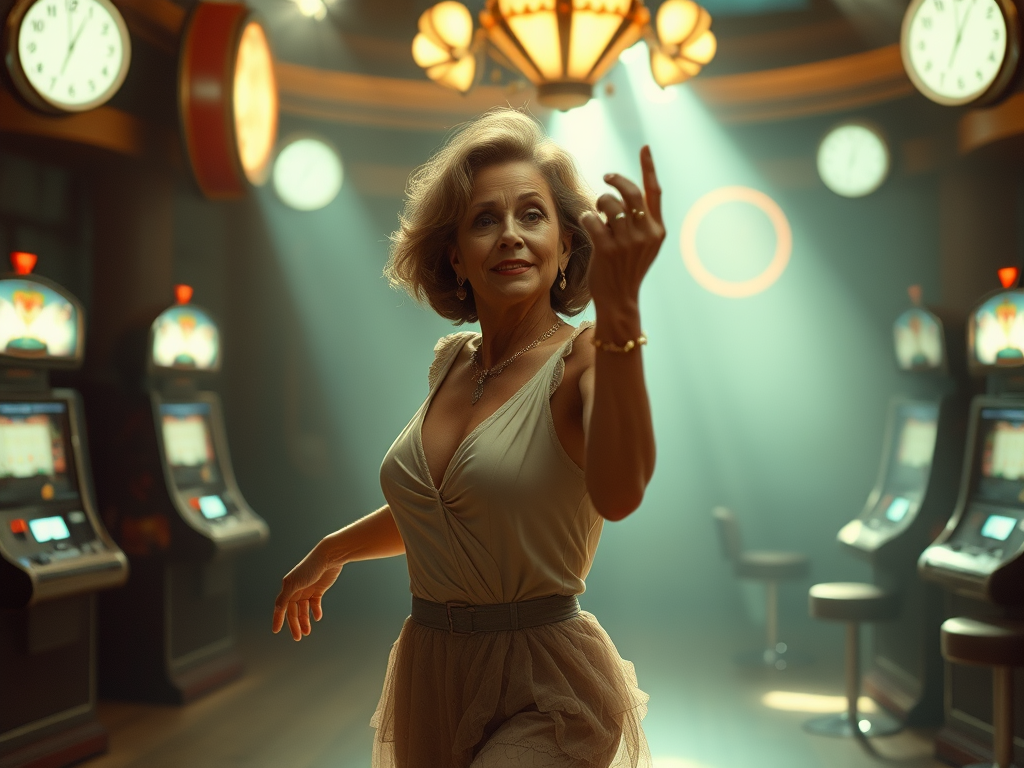
The reason is that some of the most striking films I’ve seen recently are from women filmmakers who are deeply engaged with the subject of women’s bodies and expanding the kinds of women we see on screen. One such film I keep returning to is Gia Coppola’s The Last Showgirl, a drama set in the fading glamour of Las Vegas. One scene in particular stays with me: a cocktail waitress named Annette, played with soulful depth by Jamie Lee Curtis, climbs onto a small platform in the casino where she works and begins dancing. As slot machines chime in the background, she moves slowly to the 1980s classic “Total Eclipse of the Heart.” Annette seems lost in her own world, and she looks magnificent.
Curtis, now 66, has said that the scene illustrates the “degradation of women at the end of their lives,” suggesting that “nobody cares.” It’s true that few casino patrons glance at Annette as she dances. But I did care, and I suspect I wasn’t alone. I understand the feeling of invisibility that can come with age—I’ve felt it myself. But here, Curtis is bathed in soft, ethereal light, the camera seemingly in awe of her, as she moves with strength and grace, her thighs tense and powerful. I loved watching Curtis embody Annette, and I think Coppola wants us to cherish this character just as she does. And that, too, is glorious.
The Last Showgirl touches on themes of motherhood, friendship, beauty’s commodification, and the role women play—sometimes voluntarily, sometimes not—in their own objectification. It delves into how identity is shaped and threatened by others’ gazes, and what it means when women gaze—at others, at themselves. This theme aligns with recent films like Babygirl, Nightbitch, and The Substance (which garnered five Oscar nominations). The protagonist of Showgirl is Annette’s friend, Shelly (played by Pamela Anderson), a dancer whose revue is closing. Shelly, who is 57 like Anderson, worries about her future and her sense of self. Who is she if no one looks at her anymore?

Anderson, who prefers to go makeup-free off-screen, shares this trait with her character. Shelly enjoys being a showgirl—“feeling beautiful is powerful”—but when she dons her costume, she’s embodying an outdated ideal of femininity. On stage, she’s a fantasy. Offstage, Shelly is a woman with a life, everyday concerns, and friendships, mostly with women, who share looks that find solidarity. Coppola uses the world of The Last Showgirl as a metaphor for the American Dream, one in which commodified bodies have expiration dates. It also serves as a symbol for women in film, who have long fought against their perceived disposability and continue to find common ground in female-led work.
In his 1972 book Ways of Seeing, art critic John Berger examined how the female nude has been portrayed in Western art since the Renaissance. He argued that the way women are depicted has remained unchanged: “Women are shown in a completely different way from men,” he writes, “not because the feminine is inherently different from the masculine, but because the ‘ideal’ spectator is assumed to be male, and the woman’s image is designed to flatter him.” This is evident in art galleries everywhere, from the Metropolitan Museum of Art to countless others, where women are often depicted as Madonnas, courtesans, dancers, and nudes designed to capture the male gaze.
The same can be said for movies, where women often play roles as sweethearts, vamps, adventurers, and mothers—always in service of a particular narrative. The early 20th century saw a shift, bringing more diverse portrayals of women to the screen, though this progress was tempered by the industry’s stringent self-censorship. As critic Molly Haskell notes in From Reverence to Rape, it wasn’t until the 1970s and ’80s that adult women began to return to cinema, though their reentry was slow and difficult.
Many of Hollywood’s early actresses—mostly white, in the era of Jim Crow—were revered but also subjected to intense scrutiny. Bette Davis, for example, revealed in her memoir The Lonely Life that she was told her face was not photogenic. Judy Garland’s struggles with addiction and body image were similarly well-documented, and her painful experiences shaped how we understand her performance in The Wizard of Oz today. Despite what Garland endured, my love for the film remains undiminished, in part because knowing her personal struggles adds depth to her portrayal of Dorothy.

The film industry has long been a place of exploitation, where figures like Harvey Weinstein thrived by perpetuating the abuse of young women. As Elia Kazan once noted, the power dynamics in Hollywood were so skewed that studio bosses often had one question when it came to actresses: “Do I want to sleep with her?”
Women have always played a role in creating cinema—writing, producing, and directing their own films—so it’s especially frustrating that they continue to fight for equality, both in front of and behind the camera. One of the early pioneers was Lois Weber, a director who believed in a deeper beauty beyond a pretty face. She was one of Hollywood’s top directors in the 1910s, but as the industry grew, the increasing financial stakes sidelined female filmmakers. For decades, only a handful of women directed in Hollywood, such as Dorothy Arzner and Ida Lupino.
Lupino, once a star, became frustrated with her lack of creative control. In 1949, she took over directing Not Wanted after its original director fell ill, and she went on to make a series of independent films like Outrage and The Bigamist. Lupino’s work spoke to the exclusion of women from Hollywood’s mainstream power structures, something she deeply resented.

It wasn’t until the late 1960s and early 1970s that female filmmakers began to break back into the industry, with directors like Elaine May and Julie Dash. Dash’s Daughters of the Dust was the first film by a Black American woman to receive a national theatrical release, and she aimed to portray Black women in a way they had never been seen before, showing them with diverse complexions and ancient hairstyles.
Since then, the number of female directors has remained disappointingly low, but women continue to influence the industry with their unique visual styles, storytelling techniques, and characters. Greta Gerwig’s Barbie became one of the highest-grossing films of all time, turning a symbol of shallow femininity into a thoughtful and layered character. Despite its commercial success, Barbie has yet to result in significant change in the film industry, though it represents progress.
The industry’s gender imbalance is not something that one individual can fix. However, there is hope: 2024 marked the first year that the percentage of top-grossing films with female protagonists equaled those with male protagonists. This is a sign of change, though much remains to be done.

Change is not just about numbers; it’s about the voices, histories, and bodies that filmmakers bring to the screen. Women are bringing new perspectives, telling their own stories, and presenting a wider range of bodies in films—women of all shapes, sizes, and colors. It’s no surprise that many female-driven films focus on gender construction. In Babygirl, Nicole Kidman plays an executive who has a rejuvenating affair with a younger man, but the most subversive moment occurs when the camera lingers on her face as a needle slides into it, exposing the price of beauty.
In The Substance, Demi Moore portrays a TV entertainer who, after being fired for aging, turns to a rejuvenating process that transforms her into a literal monster. Both films confront the societal pressure on women to maintain an idealized image, with the female stars’ bodies serving as markers of both their authenticity and the cost of such standards.
These films remind me that, like many women, I’ve been shaped by the images I’ve seen on screen. As the industry evolves, it’s clear that change is coming—slowly, but surely. The gaze is shifting, and women are finally being allowed to tell their stories from behind the camera as well as in front of it.




Leave a Reply