

Bill Burr Is About to Hit Broadway. Broadway Better Duck.

In a spacious room on Manhattan’s West Side, rehearsals for the Broadway revival of David Mamet’s Glengarry Glen Ross were already brimming with macho bravado and sharp banter. And this was before the actors even started their scenes.
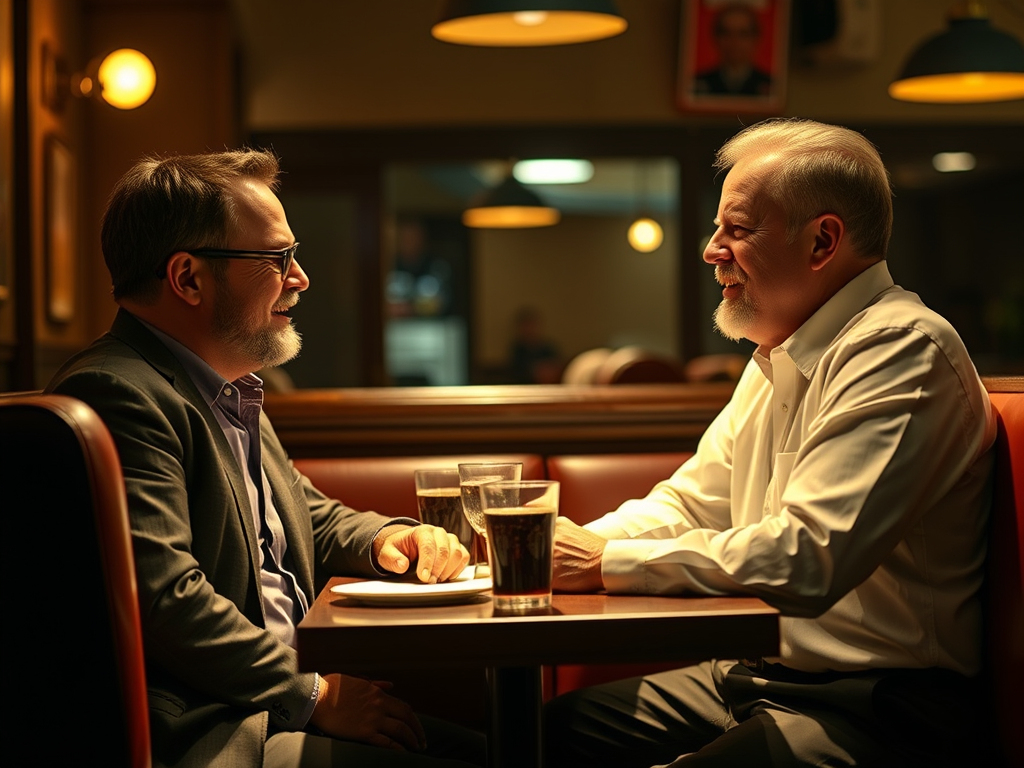
It was a Friday morning, and Patrick Marber, the British director, who had just returned after a brief illness, approached two of his lead actors, Bill Burr and Michael McKean. The pair were seated in a makeshift restaurant booth, preparing to play desperate real estate agents contemplating robbing their office.
Marber noticed a satchel in front of them that he hadn’t seen before. “While you were gone, we made some changes,” Burr quipped in his signature Boston accent.
Marber’s expression teetered between amusement and annoyance. Being teased by one of the best stand-up comics alive was almost a badge of honor. But there was work to be done—previews were just weeks away, set for March 10 at the Palace Theater. He turned back to his table, grabbed his vape, and took a puff. Burr pounced. “What’s that?” he asked, his tone dripping with sarcasm. “Why not smoke a real cigarette, like a man!”https://svtoday.org/2025/02/25/bill-burrs-broadway-debut-in-glengarry-glen-ross/
Burr loves to tease people. It’s more than just playful banter—it’s his trademark. He later shared that he’s learning French out of spite, planning to do a stand-up routine in Paris that would purposely annoy the locals who disdain Americans butchering their language.
For the next hour, Burr continued to joke around with Marber. When Marber asked him to observe how McKean was using a toothpick in the scene, Burr deadpanned, “I have to pay attention to him? Okay, sorry.”
At one point, Burr explained his teasing by pointing out that since Marber is also a comedian, he wasn’t crossing any boundaries. “If he were just a regular person,” Burr said, “I’d probably hurt his feelings.”
Glengarry marks new ground for Burr, 56, who has acted in films and TV shows like Breaking Bad (where he shared a scene with co-star Bob Odenkirk) and The Mandalorian. But this is his professional theater debut.

At first glance, it seems an unlikely move. For years, Burr’s stand-up persona has been that of a loud, brash, ranting guy at the end of a bar. He used to think theater wasn’t for him, associating it with musicals, which, as he put it, “aren’t my thing.” But seeing Philip Seymour Hoffman and John C. Reilly in True West on Broadway in 2000 changed his perspective. “I saw the power of it,” Burr said, noting that it had the same raw energy as stand-up, feeding off the crowd.
Surprisingly, Burr owes this role to Nathan Lane, an actor he’s never met and who isn’t even part of the production. Lane, who was initially offered the role of the older salesman Shelley Levene, agreed to take it only if Burr was cast as Moss. Lane sent Marber and producer Jeffrey Richards clips of Burr’s stand-up, urging them to “pay attention to the room.” They were convinced.
As Lane put it, Burr was perfect for the role: “He has the anger, the simmering rage. He has that danger. I could see him being funny and scary at the same time.”
Sitting in a quiet Little Italy café, I started to bring up something Burr often talks about that resonates with me, but he cut me off.
“Whores?” he asked, leaning back in his chair and laughing, wearing a gray hoodie and jeans. I quickly clarified, “No, not that—what I meant was male anger,” appreciating how absurd the conversation might sound for a journalist to say that out loud.
Burr’s stand-up often delves into the topic of how men, terrified of appearing weak or sensitive, repress their emotions, only for that repressed feeling to eventually turn into rage. When I brought this up, Burr interrupted again.
“Let me ask you this,” he said, locking eyes with me. “After an hour with me, do I seem angry?”

I hesitated. While he had shown some annoyance earlier when I challenged him on a bit he does about women’s sports, Burr was otherwise calm and measured. Alone, he seemed much more introspective than his on-stage persona. “There’s a lot of truth in the guy you see on stage,” he explained. “But you’re only seeing one side of me.”
The side I saw was a man who had learned to manage his anger. Marriage and fatherhood helped, he said, and so did doing mushrooms, as he openly discussed in his 2022 Netflix special. Burr rejects the idea that controlling his temper diminishes his edge.
“I want to lose my edge,” he confessed. “I don’t want to go through life angry. But here’s the thing: if you’ve had an edge, you never lose it. You can tap into it when you need it. You just bark at the other dog to make it go away. I know how to do that.”
He demonstrated this during the rehearsal. Despite his playful irreverence, Burr took his role seriously. He came to the session almost entirely off-book, with a well-developed understanding of the play’s characters and their psychology. Marber praised him, calling Burr a “total pro” and a natural stage actor. “Moss is abrasive and rude, but you can’t dislike him for it,” Marber explained. “He has a charm, a way with words—just like Bill.”
Back in the rehearsal room, during his scene with McKean, Burr portrayed Moss, a salesman trying to sell another salesman on an idea. His delivery shifted from warm and whispery to explosive as the scene called for it. When Moss was caught in a lie, Burr leaned in and shouted, “I lied. Alright?” His voice rose to a roar. That’s where the danger lay.
According to Burr, Moss’s anger comes from a place of hurt. “He doesn’t feel respected. He doesn’t feel loved. He feels alone,” Burr explained. “As a man, you’re not allowed to express that. You can’t be vulnerable with another man in front of others.”
Instead, Burr said, Moss curses them out.
In today’s polarized political landscape, Burr can be difficult to categorize. He loves to rile up liberal sensibilities but also has a populist streak, criticizing banks, insurance companies, and the wealthy. He recently mocked Elon Musk after the billionaire was accused of flashing a Nazi salute, and just the day before I observed him at rehearsal, he trended on X for saying billionaires should be “put down like rabid dogs.”

When I mentioned that conservative pundit Ben Shapiro accused him of going “woke,” Burr scoffed. “All he knows is that calling me ‘woke’ makes him more money. I don’t even know who that guy is, but he’s a jerk.”
Mamet, whose work has become popular among Trump-supporting circles in recent years, crafted Glengarry as a critique of unfettered capitalism, and Burr sees it the same way. “What’s funny,” he said, “is that much of this play I’ve seen in my own life through the rise of streaming services. Thirty years ago, a character actor could make a living. Now, it’s all about the movie stars.”
Burr has reached the pinnacle of his profession. Lorne Michaels invited him to do the monologue for Saturday Night Live after the 2020 presidential election. But if you listen to Burr talk long enough, you realize his memories of struggling early in his career are still fresh. He reminisces about his “crazy German Irish house” growing up, where warmth was scarce, and the tough early days of his comedy career when he often felt out of place.
When asked which Glengarry character he most identifies with, Burr chose James Lingk, the hapless victim of the salesmen, the man who buys something only to apologize for not having the power to make his own decisions. “I was that guy until I was about 30,” he said. “How I didn’t end up in the trunk of someone’s car is beyond me.”
Burr’s upcoming special, Drop Dead Years, set to premiere on Hulu on March 14, continues to reveal his vulnerability, starting with the confession that he got into comedy to make strangers like him. For someone so adept at antagonizing a room, it’s a surprising admission. Burr reflected, “The way I push people away is just another defense mechanism.”
After Burr and McKean finished their scene, Marber offered some feedback and a suggestion for McKean to drink while Burr delivered his lines. The script supervisor then pointed out a minor slip-up: Burr had misquoted a line about how Indian people never buy from salesmen. The line was meant to say that Indian women look like they’ve “had sex with a dead cat,” but Burr had said “by a dead cat.”
“That’s different,” McKean pointed out, in a tone reminiscent of an editor. “The cat’s reputation is bad enough.”
Marber took this opportunity to dive into the meaning of the line, asking, “What are you trying to say?”
Burr, ever the performer, responded theatrically, “He’s an old-school guy who wants pretty women to smile at him. They give him nothing, and it messes with his ego. So, what’s he going to do? Say, ‘I need to work on myself’? No. He says something unbelievably rude.”
Marber, impressed, called it “brilliant,” and then, breaking the fourth wall of the rehearsal, turned to me with a grin. “Proper actor,” he teased, before




Leave a Reply