
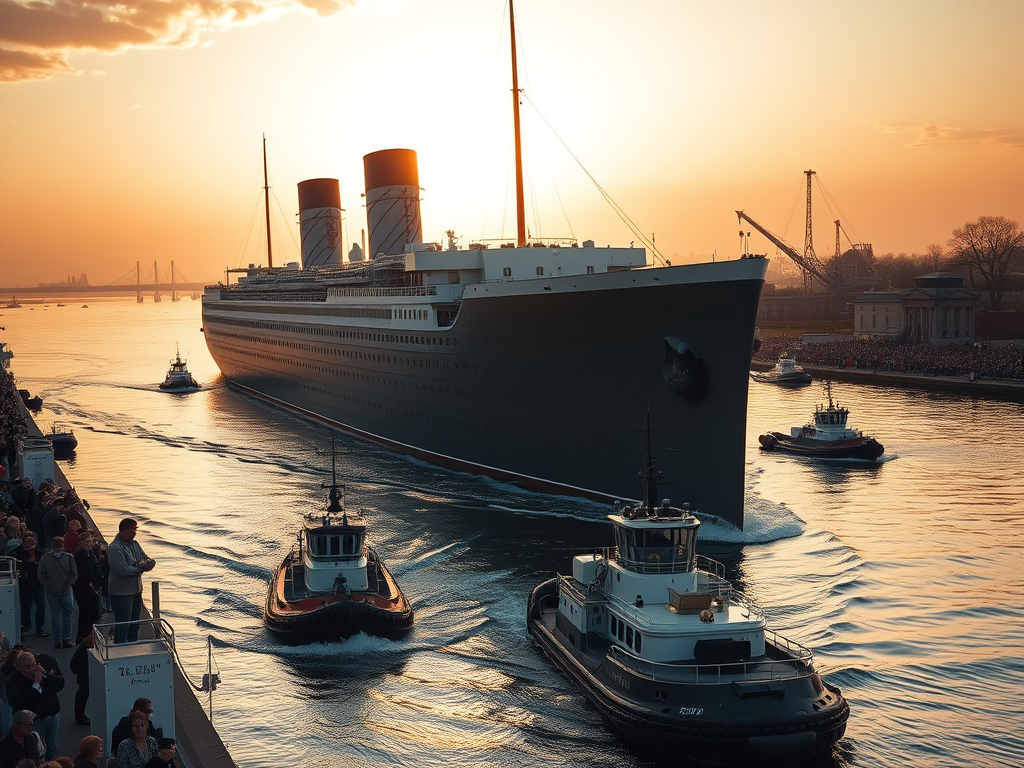
The iconic ocean liner, the S.S. United States, which once carried four U.S. presidents across the Atlantic, hosted legends like Duke Ellington and Sylvia Plath, and captivated global attention in the mid-20th century, is now embarking on its final journey. After spending decades deteriorating in Philadelphia, the ship is now headed for its ultimate resting place—at the bottom of the sea.
Record-Setting Ocean Liner, a Titan of Its Time, Begins Its Final Voyage

Many fans, including former passengers who traveled on the ship before it ceased regular service in 1969, had hoped the ship would be restored and opened to the public. However, it will now be transformed into the world’s largest artificial reef, located off the Florida Panhandle.
Before it is submerged, the 990-foot-long vessel, known as the “Big U,” will make a 14-day journey to Mobile, Alabama. There, workers will remove hazardous materials, including fuel still in the tanks, to ensure it can be safely sunk. Since it can no longer move on its own, five tugboats will tow the ship out of the Delaware River and Bay on Wednesday. Once in the open Atlantic, only one tugboat will be needed to guide it southward.https://svtoday.org/
The S.S. United States, the largest passenger ship ever built in the U.S., was designed in the early 1950s by naval architect William Francis Gibbs. It was built as a luxury ocean liner that could also serve as a swift transport for 14,000 troops during wartime. On its maiden voyage, it set a trans-Atlantic speed record, crossing eastbound in just three days, 10 hours, and 40 minutes at an average speed of over 35 knots.

Over the years, the ship made 800 crossings of the Atlantic, carrying both the wealthy and famous, as well as immigrants and middle-class Americans eager to explore Europe. But with the rise of air travel, the appeal of ocean voyages waned, and the ship was retired in 1969.
The journey down the river began around 12:30 p.m. on Wednesday, with tugboats guiding the vessel under the Walt Whitman Bridge shortly before low tide, when clearance was optimal. Traffic on the bridge was temporarily halted as the ship’s towering funnels passed just 10 feet beneath the roadway.
Onlookers gathered at Freedom Pier in Gloucester City, New Jersey, cheered as the massive ship came into view. Garfield Harper Jr., from Westampton, New Jersey, reflected on the emotional significance of the moment. He had witnessed the ship’s arrival in Philadelphia in 1996 while working nearby and recalled how, as a child, he had watched the grand ocean liner on television.
“Now, as I watch it depart, I’m reminded of my childhood,” he said. “It’s bittersweet, but I just wanted to see it go.”
A small crowd of about 30 people had gathered at Pier 82 in South Philadelphia on Friday to witness the first step of the ship’s final voyage: moving it from the pier where it had been docked since 1996 to a nearby location. Despite its decaying state, the ship remained a beloved landmark, especially for ocean liner enthusiasts who shared stories of its history.
For Stephen Kosciesza, 70, who traveled from Silver Spring, Maryland, the ship had a personal connection. His parents had emigrated to the U.S. aboard the vessel in 1954, fleeing post-war Europe. He fondly recalled the family’s story of his father’s seasickness during the journey.

Some onlookers, like Devin Harrison from York, Pennsylvania, lamented the ship’s lack of preservation. He hoped for a more fitting end for such an iconic vessel.
“I believe it should be treated as a national treasure,” Harrison said.
The S.S. United States Conservancy, a nonprofit group that acquired the ship in 2011, shares this sentiment. The conservancy worked to ensure the ship’s legacy would continue, albeit in a different form. Once sunk, the ship will rest in about 180 feet of water, with the uppermost part about 60 feet below the surface. A museum in Okaloosa County, Florida, will also be established to honor the ship, incorporating preserved elements, including one of its iconic funnels.
As an artificial reef, the ship will serve as a habitat for marine life, attracting divers from around the world. Alex Fogg, the natural resources chief for Destin-Fort Walton Beach, predicted the site would become a major diving destination.
The conservancy’s leadership said that with more time, they might have found a new home for the ship, but after a long legal battle, a federal court ordered its eviction from the Philadelphia pier last summer. Despite their efforts to find a suitable location, every port proved too small, too shallow, or too difficult to access for such a large vessel.
“The ship’s just so darn big,” said Susan Gibbs, the conservancy’s director and granddaughter of the ship’s designer.
For many, like 80-year-old Linda Silva, the ship’s departure is a sad but grateful moment. Silva, who sailed on the vessel to Paris before she turned 20, credits the experience with changing her life and opening her to new possibilities.
“Life doesn’t necessarily decline,” Silva said. “But sometimes, your usefulness ends abruptly, just like this ship’s did. Yet, it doesn’t overshadow the magnificent journey it took to get here.”




Leave a Reply