

Since Trump’s ‘Emergency,’ What Is Actually Happening on the Border?

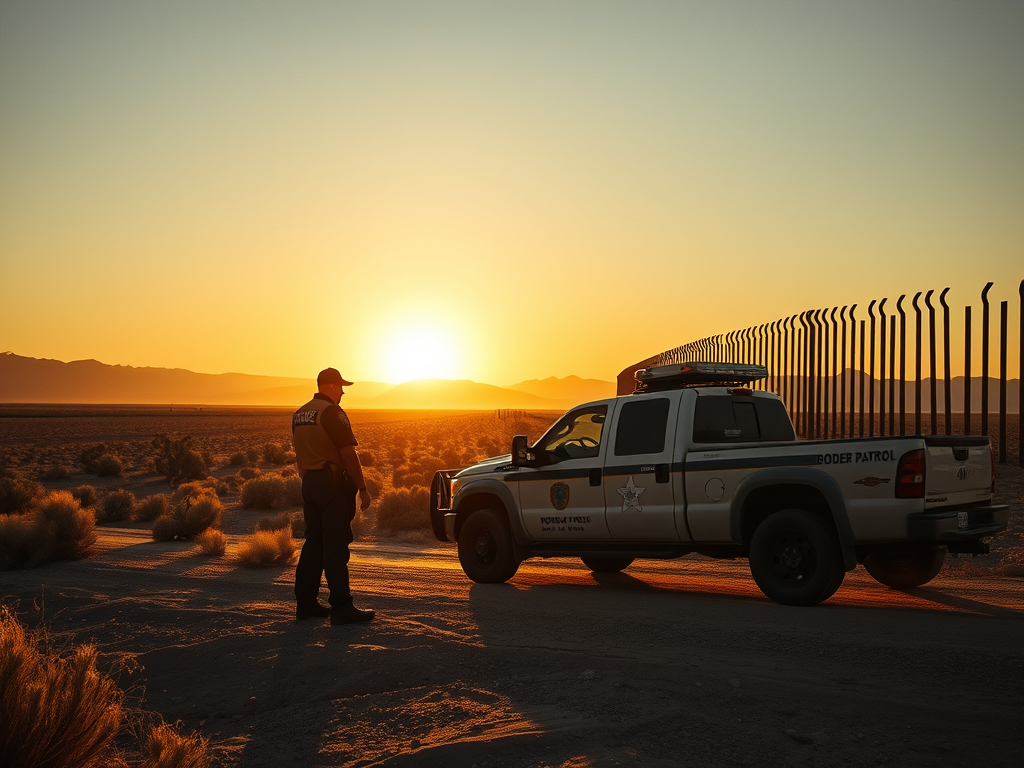
It was another day marked by President Trump’s declared national emergency at the U.S.-Mexico border, yet there were no migrants to be seen outside Nogales, Arizona. Teresa Fast, a Border Patrol agent, drove her truck along rugged dirt roads, passing other agents stationed in the desert. The radios were eerily silent.
“Right now, we really don’t have much going on,” she remarked.
When President Trump first took office, he immediately activated the emergency declaration, claiming that only this measure could prevent the “invasion” at the border. He then deployed military personnel to assist in turning away migrants, sent ICE agents to enforce policies in sanctuary cities, and opened a tent city at Guantánamo Bay for those accused of masterminding the 9/11 attacks — all in an effort to secure a border that, at the time, seemed quieter than it had been in years.
By the time Trump assumed office, the large spike in migration under the Biden administration had largely subsided. The number of border crossings dropped even further during the first weeks of his presidency, according to officials and aid organizations, following his policies of blocking asylum seekers, increasing deportations, and initiating a sweeping crackdown within the U.S.https://svtoday.org/
In South Texas, shelters that had once held dozens of migrants just before Trump’s inauguration were now down to just a few families. For example, a shelter in McAllen reported a drop in population from 97 on January 20 to about 9 by the end of the month. In San Antonio, Catholic Charities announced plans to close a shelter due to the lack of new arrivals.
In Eagle Pass, Texas, located roughly 150 miles west of San Antonio, National Guard troops stood guard near a stray dog on Inauguration Day. As the dog lazed in the dirt of Shelby Park, one of the soldiers mused about the new missions they would be given to break the monotony.
The statistics reflected a significant drop in activity. Last week, the new head of Border Patrol reported that arrests had decreased by 91% during a seven-day period compared to the same time the previous year.
In Tucson, Arizona, once a hotbed of border activity, apprehensions had fallen to around 450 per week from 1,200 at the end of January. One day last week, only 22 individuals were held in custody in the Tucson sector, a steep drop from 500 just a month earlier.
“That’s the lowest I’ve seen it in a long time,” said Sean McGoffin, the chief Border Patrol agent in Tucson. “The certainty of arrest and return is a game changer.”
Border officials in Arizona noted that migrants had stopped surrendering in large groups to seek asylum or be released into the U.S. Instead, many of them now try to avoid detection by crossing through canyons and treacherous mountain paths.
The shift has come with tragic consequences: Many of the migrants attempting to navigate the vast, unmarked deserts end up lost, succumbing to heat exhaustion, dehydration, or exposure. Others are rescued by Border Patrol agents.
It remains uncertain whether the current decline in border crossings will persist. Numbers typically drop during the winter months, and a similar decrease occurred during Trump’s first term before a spike in 2018 and 2019. Additionally, some migrants may be holding off on crossing while waiting for the outcome of legal challenges to Trump’s executive orders halting asylum.
Despite this, the president’s supporters attribute the recent drop to his immigration policies, claiming that his crackdown — which included deportations, closing down an asylum app, and stripping protections from Venezuelan migrants — has discouraged further crossings.
“Under Biden, Border Patrol was too busy babysitting migrants entering the country,” said Pete Hegseth, the defense secretary, during a visit to troops stationed near Sunland Park, New Mexico. “Now, because crossing is illegal and will result in deportation, fewer people are trying to cross.”


Some Border Patrol agents have expressed improved morale under the Trump administration. They are pleased to focus on apprehending smugglers or criminals, rather than processing large numbers of asylum seekers.
“It feels good to be an agent now,” said Fast, the Arizona Border Patrol agent. “We’re out there putting bad people away. That’s what we signed up for.”
Despite the drop in numbers, the Trump administration has sent over 1,500 additional troops to reinforce the border in California, Texas, and Arizona. These soldiers and Marines are tasked with bolstering the border fence, supporting Border Patrol operations, and reinforcing the 2,500 troops already stationed there.
In Sunland Park, just outside El Paso, newly arrived federal troops spent their days standing idly in camouflage uniforms or sitting in rental trucks along the border. While illegal crossings do still occur, particularly when smugglers cut through the aging barriers, one soldier noted she had yet to spot any migrants.


A Pentagon spokesperson stated that some troops were assisting Border Patrol by operating surveillance equipment and driving vehicles.
Border crossings in Texas have been on the decline since early last year. Shelby Park, a known hotspot for crossings in Eagle Pass and a focal point of conflict between the Biden administration and Texas Governor Greg Abbott over immigration enforcement, has seen very few migrants trying to cross in recent months. The park was taken over by state law enforcement early last year.
Governor Abbott announced that Texas would now work with the Trump administration, allowing National Guard troops to make immigration arrests in collaboration with Border Patrol. However, it remains unclear whether any such arrests have occurred. The Texas Military Department has not responded to requests for data.

Still, the troops continue to arrive. The Army recently announced that 500 soldiers from Fort Drum in New York would be heading to Fort Huachuca in southeastern Arizona to take operational control of the southern border.
For some humanitarian volunteers in southern Arizona, the need for additional troops seemed incomprehensible. At a small aid camp near Sasabe, Arizona, where the border wall abruptly ends in the Sonoran Desert, volunteers had watched as the number of migrants dwindled to almost nothing after Biden restricted asylum last June. The drop continued after Trump’s inauguration, and for several days in early February, no migrants arrived at all.
“This is a picture of a nation under siege?” asked Charles Cameron, a 74-year-old volunteer who helps run the camp.
A fellow volunteer, 73-year-old Bill Thompson, stood with Cameron atop a hill overlooking the Mexican side of the border. “If this gap in the wall is such a threat, you’d think there’d be more than just a couple of old men standing on this hill,” he remarked.

On Saturday morning, Jane Storey, another volunteer, was driving to the wall when she encountered about 30 migrants. It was freezing, and the group gathered around her car when she opened the trunk to offer them water.
Most were South Asian men who had been traveling for six months. Some didn’t realize how drastically U.S. immigration policies had changed during their journey, while others were still willing to take the risk to cross.
Farouk, 38, who fled political persecution in Bangladesh, hoped he would be allowed to stay, believing that Trump was only deporting criminals. Ankit, 21, who had fled India, feared for his life as a Christian and hoped for divine intervention in his attempt to cross into the U.S. Both men, undocumented, shared only their first names.
Santos Paxtor Pelicó, 15, left Guatemala on Inauguration Day in hopes of reaching his grandfather in Los Angeles and finding work to support his younger siblings back home. He knew that Trump was now president, but as he waited for Border Patrol to pick him up, he wasn’t sure what his American dream would look like under the new administration.




Leave a Reply