
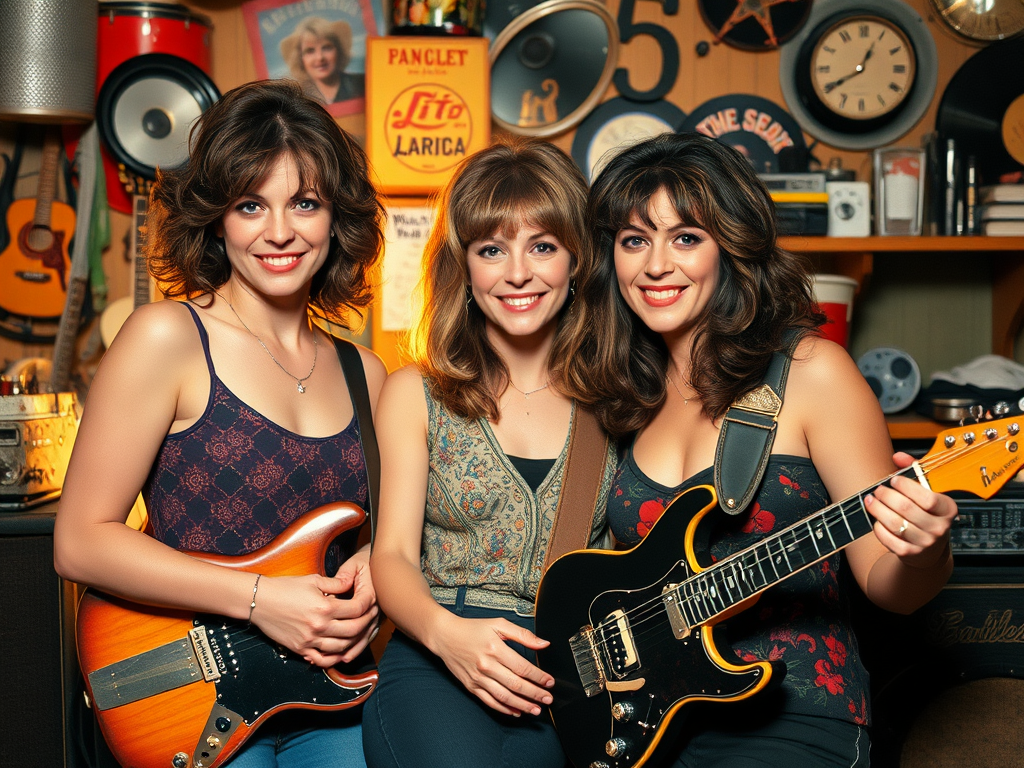

The Bangles, One of the Biggest All-Female Bands, Want to Reclaim Their Legacy

The moment Susanna Hoffs and the Peterson sisters first harmonized together, their voices meshed so effortlessly that they immediately recognized they had something special. “We knew we had something,” Hoffs recalled. “In that instant, we formed a band.”
Now 66, Hoffs smiled at the memory as she sat in her kitchen one chilly January afternoon. Wearing a sweater and slacks, she sipped her coffee with a vintage Margaret Keane painting adorning the wall behind her. Her bright home in Brentwood, California, was only a few blocks away from where the Bangles were born in 1981, in her parents’ garage on a cool evening.https://svtoday.org/
“We were really organic,” said guitarist Vicki Peterson, 67. “We came together on our own, played the music we loved. We were definitely a garage band.” But Debbi Peterson, 63, the drummer, added, “A garage band that somehow became pop stars.” Both sisters spoke during video interviews.
The Bangles soared to fame with five Top 5 hits and iconic MTV hits like “Manic Monday” and “Eternal Flame.” As one of the few all-female groups of the era, they became one of the most successful female bands in history, showcasing their songwriting and vocal skills as a dynamic 20-something ensemble.

However, their success was short-lived. Less than a decade after their formation, the group’s internal strife and the pressures of fame caused their spectacular collapse in the manager’s Hollywood mansion.
This dramatic tale is recounted in Eternal Flame: The Authorized Biography of the Bangles by Jennifer Otter Bickerdike, released on February 18. Bickerdike, also the author of books about Nico and Britney Spears, captures the story of a bygone era of the music business, where powerful labels, overbearing producers, and manipulative managers could easily make or break a band.
“When I first saw the Bangles as a kid, I thought they were powerful and in control,” Bickerdike shared. “It was shocking and sad to learn how much they had to contend with the agendas of those around them and the pervasive misogyny in the music industry. It was hard to reconcile that with the image I had of them.”
From a young age, Vicki Peterson had dreamed of starting a band after seeing the Beatles perform on The Ed Sullivan Show. Growing up in the San Fernando Valley, she played in a series of rock bands with her younger sister, Debbi. Meanwhile, Hoffs, raised in an affluent family in Brentwood and the daughter of a psychoanalyst and an artist, attended UC Berkeley before pursuing her musical dreams in Los Angeles.
The fateful meeting between Hoffs and the Peterson sisters in early 1981 — sparked by an ad in a local paper, LA Recycler — was the beginning of something magical. As Debbi Peterson wrote in her journal, “Not only does she love the Beatles, but she’s all about the ’60s! She’s into everything from that decade, just like us. We clicked instantly, it was amazing! She plays rhythm guitar and has a cool black Rickenbacker.”
The band, initially called the Colours, later renamed themselves the Bangs before settling on The Bangles. They were part of Los Angeles’s Paisley Underground scene, which celebrated ’60s music, along with groups like the Dream Syndicate and the Three O’Clock. The Bangles caught the attention of Miles Copeland, who also managed the Police. They released an indie single in 1981, followed by an EP in 1982. Their original bassist, Annette Zilinskas, left to pursue rockabilly music, and they found their missing member in Michael “Micki” Steele, a former member of the Runaways, the band managed by the infamous Kim Fowley. Although initially hesitant, Steele joined the group, completing the lineup of four talented musicians.

In 1983, the Bangles signed with Columbia Records after impressing a label representative at a Magic Mountain gig. Bruce Springsteen, a major Columbia star, was in attendance and gave his approval. They worked with David Kahne, a young producer who had worked with punk indie label 415 Records.
“When the Bangles sang, it was something magical,” Kahne recalled in an interview. “Sue had a fantastic pop voice, but when they sang together, it was even more powerful.”
Kahne pushed the band hard in the studio, often clashing with the Peterson sisters and even bringing in session musicians when necessary. Hoffs was frequently caught in the middle. “I was always open and engaged because I was raised by a psychoanalyst,” she laughed. “And by the way, I was in therapy throughout the Bangles years — and I needed it!”
The band’s major-label debut, All Over the Place, was released in 1984, gaining moderate success with a few hits on college radio. However, Columbia kept the band on tour relentlessly, and by the time they began working on their follow-up, Different Light, they had little new material.
Luckily, Prince, then at the peak of his creativity, offered the band a lifeline with his song “Manic Monday.” Instead of just singing over his demo track as originally planned, the Bangles reworked the song, and Prince was impressed with their version. “Manic Monday” became their first big hit, reaching No. 2 in 1986, just behind Prince’s own “Kiss.”
The success of “Manic Monday” wasn’t enough to mask the cracks forming within the band. “I spent a lot of time trying to hold it together,” said Vicki Peterson. “I didn’t want it all to fall apart.”
After enduring an exhausting 18 months of touring and promoting Different Light, the Bangles went back to the studio. Tensions were running high, and Hoffs began collaborating with outside songwriters Tom Kelly and Billy Steinberg, which caused friction with her songwriting partner, Vicki Peterson.
“For me, it was crucial for the band to have a voice in the writing,” Vicki Peterson said. “I loved writing songs with Susanna, but she had her reasons for branching out. The label didn’t care; they just wanted us to make the next album.”
Their third album, Everything, was another hit, selling a million copies and featuring Hoffs’s collaborations on “Eternal Flame” and “In Your Room.” Despite the success, the band was drained, and the personal tensions within the group were apparent. Hoffs, the focal point for the press, felt unsure about everything. “The only thing I was certain of was that I couldn’t handle the tension anymore. It was too much.”
By the late 1980s, the Bangles’ managers, Arnold Stiefel and Randy Phillips, decided it would be easier to manage Hoffs as a solo act, and they orchestrated the band’s disbandment. In a meeting at Stiefel’s home in late 1989, the Peterson sisters were blindsided by the news that the band was over.
“It was a shock,” Vicki Peterson recalled. “I didn’t want to face what was happening, didn’t want to believe people could be so manipulative.” There were no arguments, just quiet resignation.
In hindsight, Vicki Peterson believes the band should have taken a break instead of breaking up. “That mentality didn’t exist back then. I didn’t think we had the power to do that,” she said.

The Bangles’ breakup left everyone with a sense of loss. Hoffs’s solo career never really took off, while Steele’s never materialized. The Peterson sisters, traumatized, turned away from music for a time, though both eventually returned to the scene in smaller projects.
“That was the worst,” said Debbi Peterson. “No one got what they wanted. The only thing that got destroyed was the Bangles.”
Despite the painful split, a reunion became a possibility in the mid-1990s when Hoffs suggested the idea. Though initially resistant, especially to becoming a nostalgia act, the Bangles eventually reconnected. They released a new song for Austin Powers: The Spy Who Shagged Me in 1999, followed by a performance at a Beatles tribute concert and the release of Doll Revolution in 2003. Though Steele left soon after, the band continued to tour and record for another 15 years.
Despite their renewed activity, the Bangles received little recognition compared to other contemporary female bands like the Go-Go’s, who received a biopic and Broadway musical. The Bangles’ contributions were largely overlooked by a new generation.
However, the group is now working to reclaim their legacy, with plans for a documentary and a biography in the works. Despite their continued success, they have yet to be nominated for the Rock & Roll Hall of Fame, with some pointing to lingering controversies over their use of session musicians and outside writers.
“We know what we did,” said Vicki Peterson. “We played our own records.” Though they’re not waiting for an induction, the band would welcome the recognition. “Of course, we want to be remembered — who wouldn’t?”
Today, Hoffs is working on a new solo album, her second novel, and adapting her first book for the screen. Vicki Peterson and her husband are releasing new music this spring, while Debbi Peterson has started a new project with members of R.E.M. in the band the Minus 5.
“What’s important is that they’re all still creating,” Bickerdike said. “The Bangles were pioneers in their 20s, and they’re still doing groundbreaking work in their 60s.”
At present, none of the Bangles seems eager to reunite. “I don’t have a perfect explanation,” Hoffs admitted. “But as for a reunion, I never say never.”
Vicki Peterson summed it up: “Even if we never do




Leave a Reply