
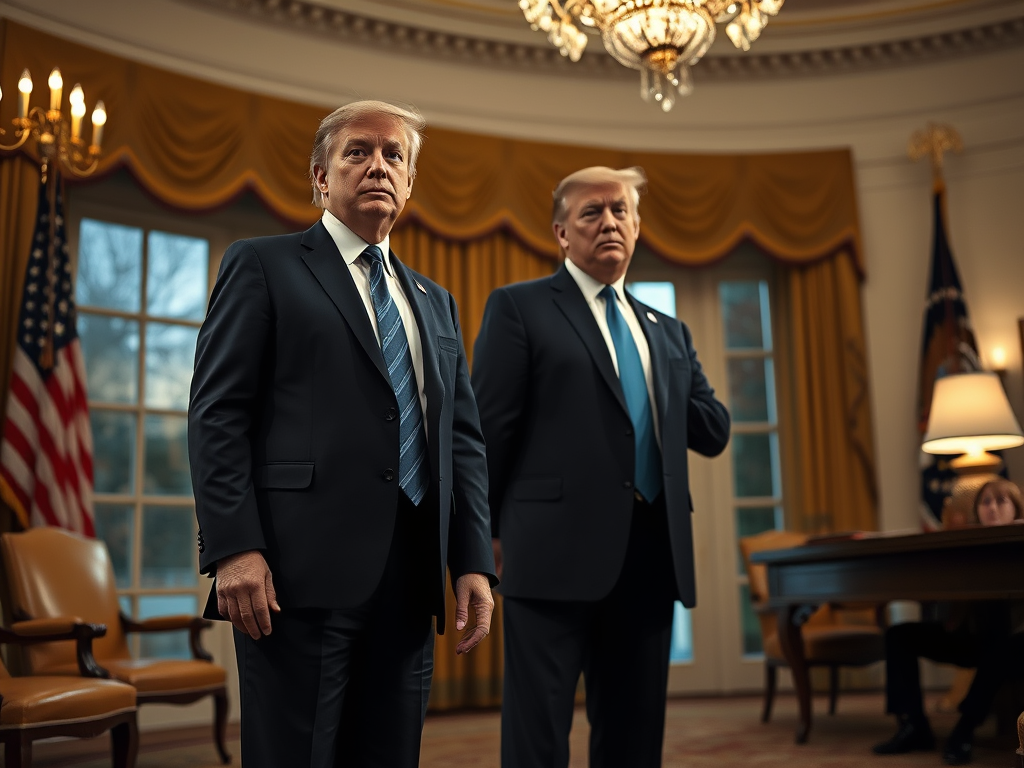

At President Trump’s inauguration, OpenAI’s CEO, Sam Altman, found himself in the overflow room while prominent tech figures like Elon Musk and Mark Zuckerberg secured prime seats on the dais beneath the Capitol rotunda.
How Sam Altman Sidestepped Elon Musk to Win Over Donald Trump

However, just days before arriving in Washington, Altman was on a call with Trump, laying the groundwork for a major announcement that would place OpenAI at the forefront of the administration’s artificial intelligence agenda—leapfrogging Musk in the process.
During the 25-minute conversation, Altman played to Trump’s affinity for grand narratives and high-stakes deals. According to three individuals familiar with the call, he assured the president-elect that artificial general intelligence—the theoretical milestone where AI matches human intelligence—would be reached during Trump’s tenure. To ensure the U.S. outpaced China, OpenAI, alongside Oracle and SoftBank, had finalized a $100 billion deal to construct data centers nationwide.https://svtoday.org/
The day following the inauguration, Altman stood behind Trump in the Roosevelt Room of the White House as the president announced the initiative, dubbed Stargate, calling it the “largest A.I. infrastructure project in history.”
Although Stargate had been in development for months, Altman and his partners strategically timed the announcement, allowing Trump to take credit for the project early in his presidency.
“We wouldn’t be able to do this without you, Mr. President,” Altman declared in front of gathered reporters.
Since Trump’s election, Silicon Valley billionaires had been maneuvering for influence over the new administration. None had been as successful as Musk, who had contributed over $250 million to Trump’s campaign and now wielded significant power, even influencing job cuts and budget decisions across the federal government.
Given Musk’s close ties to Trump, Altman’s path to political influence seemed uncertain. A longtime Democratic donor and vocal critic of Trump’s first term, Altman was also among Musk’s most notable adversaries. The two had previously clashed over control of OpenAI and remained entangled in legal battles. Musk had even launched a rival AI company to compete directly with Altman’s.
Despite these obstacles, Altman successfully positioned OpenAI as the focal point of Trump’s AI policy—an achievement that underscored his adaptability and nearly two decades of deal-making expertise in Silicon Valley. It also highlighted Trump’s willingness to shift allegiances when courted and revealed the limits of Musk’s influence over tech policy.
According to over a dozen insiders, Altman had been quietly working his way into Trump’s inner circle even before the election. Many details of this effort, which spanned several months, had remained undisclosed until now.
In a statement to The New York Times, OpenAI spokesperson Liz Bourgeois emphasized the company’s commitment to collaborating with Trump’s administration to maximize AI’s role in economic growth and scientific advancement. The White House did not provide a comment.
Altman leveraged relationships with North Dakota Governor Doug Burgum—Trump’s eventual nominee for interior secretary—and two other influential Trump allies: Oracle co-founder Larry Ellison and SoftBank’s founder, Masayoshi Son.
During the Biden administration, Altman had become a regular presence in Washington, meeting with White House officials and bipartisan lawmakers to shape AI regulations. He also maintained direct communication with Commerce Secretary Gina Raimondo through a private text channel, according to a source familiar with the arrangement.
As the 2024 election approached, Altman privately questioned Biden’s chances of winning. Nevertheless, he donated to Biden’s reelection campaign in 2023, alongside contributions to various state Democratic Party organizations. At the same time, he also supported Republican candidates—though not Trump directly—and maintained ongoing discussions with GOP lawmakers.
Internally, OpenAI hedged its bets. In early June, two OpenAI executives met with Trump in a Las Vegas hotel room, according to sources familiar with the meeting. Altman had planned to attend but canceled after testing positive for Covid.
Governor Burgum arranged the meeting, leveraging his long-standing connection with OpenAI President Greg Brockman, a North Dakota native. Some OpenAI staff jokingly referred to the two as the most influential tech figures the state had ever produced.
During the meeting, Brockman and OpenAI COO Brad Lightcap demonstrated Sora, the company’s AI-powered video generator, which had yet to be publicly released. The technology enabled users to create videos—such as a herd of woolly mammoths crossing a snowy plain—by simply inputting a text description.
To develop such cutting-edge AI, they explained, companies like OpenAI required vast data centers supported by enormous energy supplies. They framed the discussion around construction and infrastructure—language they knew would resonate with Trump, given his real estate background. They stressed that these massive facilities were essential for the U.S. to maintain its lead over China in AI development.
When Trump accepted the Republican nomination the following month, he echoed their message, emphasizing the massive power demands of AI.
“A.I. requires tremendous—literally, twice the electricity available now in our country. Can you imagine?” he said.
Yet, even as Altman and his team strengthened political ties, securing the full $100 billion for Stargate remained a challenge.
OpenAI’s reliance on investors was a major hurdle. The company had already secured over $13 billion from Microsoft, granting the tech giant exclusive access to its computing power. But OpenAI needed far more computational resources.
In late 2023, Altman had been negotiating with Microsoft CEO Satya Nadella to fund Stargate’s $100 billion data center expansion. However, those plans unraveled when OpenAI’s board abruptly fired Altman. Though reinstated five days later, the shake-up alarmed Nadella, who ultimately withdrew Microsoft’s financial commitment to Stargate.

With Microsoft out, Altman turned to other investors. He had previously discussed funding possibilities with SoftBank’s Masayoshi Son, and by mid-2024, they met again at OpenAI’s offices. After Microsoft agreed to a contractual exception, OpenAI secured a $10 billion data center deal with Oracle—paving the way for an even larger initiative.
As Oracle began constructing a data center campus in Abilene, Texas, Altman envisioned scaling it into the full-fledged $100 billion Stargate project. However, the Biden administration voiced concerns over OpenAI’s attempts to secure Middle Eastern investment, and potential backers hesitated, fearing government delays in land and power approvals.
Trump’s election changed everything. Over the next few weeks, SoftBank, Oracle, and OpenAI finalized their investments in Stargate, according to three sources familiar with the negotiations. They also secured backing from MGX, a tech investment firm controlled by the United Arab Emirates.
In the lead-up to the inauguration, many of Altman’s AI competitors—including Musk and Zuckerberg—met with Trump at Mar-a-Lago. Meanwhile, Altman’s best opportunity came through a meeting in Palm Beach with Howard Lutnick, Trump’s nominee for commerce secretary.
Altman’s contributions to Trump’s inaugural fund—totaling $1 million—earned him an invitation to the festivities. However, his most crucial interaction came from an unexpected phone call with Trump on the Friday before the inauguration, reportedly arranged through a mutual acquaintance.
At the inauguration itself, Altman, Ellison, and Son were present but largely unnoticed. The next morning, they convened in a suite at Washington’s Riggs Hotel, finalizing the blog post that would unveil their partnership.
That afternoon, the Stargate team traveled in a motorcade to the White House. Upon arrival, they were left waiting outside in freezing temperatures due to logistical issues, including White House computer malfunctions and Ellison forgetting his ID.
Eventually, they followed Trump into the Roosevelt Room. In his speech, Trump reiterated the importance of data centers, describing them as “big, beautiful buildings that will create countless jobs.”
Introducing Altman, Trump praised him as “by far the leading expert, based on everything I read.”

That evening, Musk took to social media, ridiculing the Stargate deal and questioning whether Altman’s team had even secured the initial $100 billion—let alone the $500 billion they had pledged for future expansion.
Altman responded the next day, posting a measured but optimistic comment about Trump:
“I won’t agree with him on everything, but I believe he will be incredible for the country in many ways!”
The administration sided with Altman over Musk. White House Press Secretary Karoline Leavitt reaffirmed Trump’s commitment to AI investment, telling Fox News, “These projects are happening, and they’re bringing American jobs with them.”
Trump, however, remained blunt:
“Musk doesn’t like one of these people,” he said, seemingly referencing Altman. “But I’ve got my own list of people I don’t like too.”
Less than a week later, the unexpected rise of DeepSeek—a Chinese AI startup—sparked concerns over America’s AI strategy. But as markets reacted, Altman was already back in Washington, reaffirming his vision for Stargate’s future.
“Not $100 billion—$500 billion,” he clarified.

Leave a Reply