
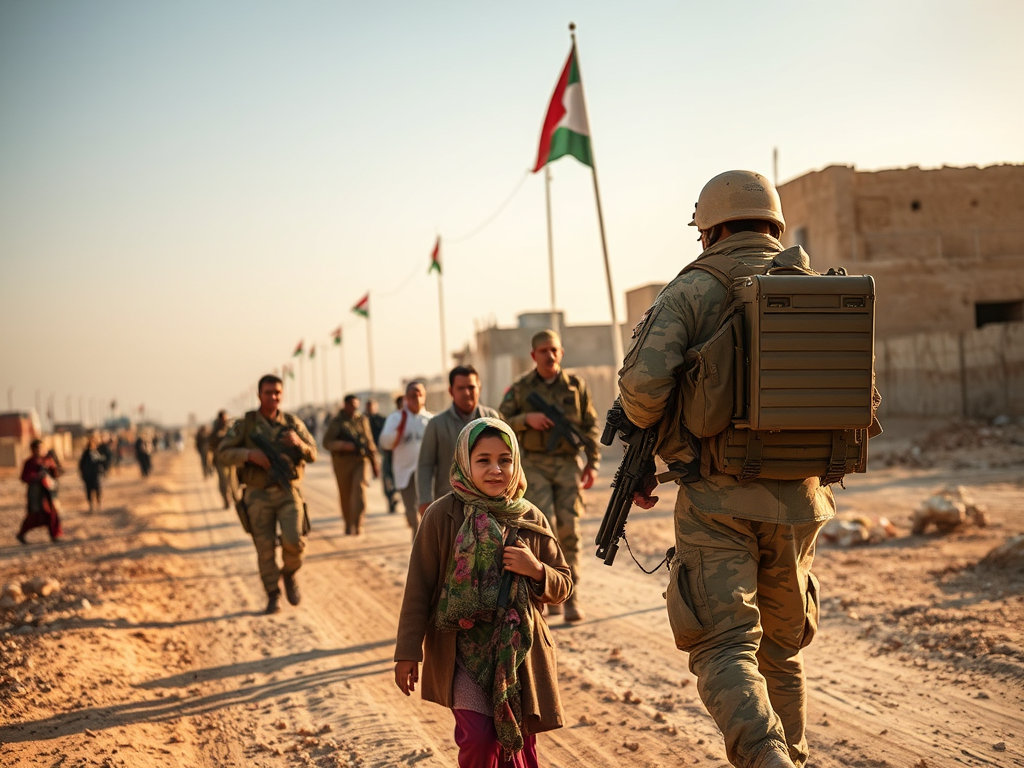

Israeli Troops Withdraw From Key Zone Bisecting Gaza

On Sunday, Israel’s military withdrew from a crucial corridor dividing the Gaza Strip, effectively relinquishing control of most of northern Gaza as stipulated by a fragile cease-fire with Hamas. This withdrawal was a key requirement ahead of potential negotiations for a more enduring agreement.https://svtoday.org/
The departure from the Netzarim Corridor coincided with Israel’s dispatch of a delegation to Qatar over the weekend. The discussions centered on the next group of Israeli hostages and Palestinian prisoners to be released as part of the initial phase of the cease-fire, which has been in effect since last month.
Public outcry intensified after the release of three Israeli hostages on Saturday, whose frail and malnourished appearances drew comparisons to Holocaust victims, adding further urgency to ongoing negotiations.
In a statement on Sunday, the Israeli military confirmed that its forces were “implementing the agreement” by vacating the corridor, enabling hundreds of thousands of Palestinians to continue returning to northern Gaza.
Two Israeli military officials and a soldier stationed in Gaza, speaking anonymously as they were not authorized to discuss the matter publicly, confirmed that troops had left the Netzarim Corridor by Sunday morning.
Hamas also acknowledged the withdrawal, declaring it a “victory for the will of our people.”
With this withdrawal, Israel’s military presence in Gaza is now largely confined to a narrow strip in the south near the Egyptian border and a buffer zone along the Israeli border.
Meanwhile, Gaza’s interior ministry warned Palestinians traveling north that their vehicles might still be subject to inspections by foreign security contractors tasked with preventing the smuggling of weapons from the south.
“We urge citizens to proceed cautiously and follow the currently approved movement procedures for their safety,” the ministry stated on Sunday.
At the start of the war, Israel had ordered a mass evacuation of northern Gaza and patrolled the Netzarim Corridor to block displaced Palestinians from returning. A partial withdrawal from the corridor took place last month, with foreign contractors taking over security duties.
The complete withdrawal was mandated as part of the initial 42-day phase of the cease-fire deal, which is now at its midpoint. This step was essential for progressing to the next stage of the agreement, which aims to bring the war in Gaza to a full conclusion.
However, new obstacles to advancing the negotiations arose last week after former U.S. President Donald Trump suggested that the United States could assume control of Gaza and transform it into the “Riviera of the Middle East” by relocating its Palestinian residents.
On Sunday, Saudi Arabia’s foreign ministry firmly rejected this idea, reiterating that a lasting peace agreement is unattainable without the establishment of a sovereign Palestinian state—a long-held diplomatic objective that experts now view as increasingly unlikely.

Egypt’s foreign ministry announced that it would host an emergency Arab summit in Cairo later this month to address the escalating crisis. The meeting, requested by Palestinian officials, is being coordinated with high-ranking representatives from Arab nations.
The frail condition of the three Israeli hostages released by Hamas on Saturday has fueled widespread concern in Israel, with criticism mounting against Prime Minister Benjamin Netanyahu for not securing their release sooner. Pressure is growing on the Israeli government to expedite the return of the remaining captives and advance the second phase of the agreement.
On Sunday, the family of Alon Ohel, a hostage still in captivity, issued a statement through a group representing relatives of the abducted. They revealed that for the first time in over 490 days, they had received confirmation that Ohel was alive and being held in Gaza’s tunnel system alongside recently freed hostages. They urged Israeli leaders to take “the necessary humanitarian steps” to rescue him and the others enduring the “hell” of captivity.
“Time is running out,” the statement warned. “The second phase of the deal must proceed to bring all the hostages home.”
Despite high-level talks in Qatar over the weekend, negotiations regarding the next stage of the cease-fire were not expected to advance until Netanyahu convenes a meeting with his top security officials in the coming days.
Speaking in Washington on Saturday, where he had been meeting with the Trump administration, Netanyahu blamed Hamas for the hostages’ conditions. He expressed confidence that at least six more captives would be freed by the end of next week.

“We have three main objectives in Gaza,” Netanyahu told Fox News. “One, dismantle Hamas’s military and governing capabilities. Two, secure the release of all hostages. Three, ensure that Gaza never again poses a threat to Israel. I am committed to achieving all three.”
Even as Israeli forces exited the corridor, sporadic violence persisted. Mahmoud Basal, a spokesman for Gaza’s civil defense agency, which does not distinguish between civilians and combatants, reported that three people were killed and several wounded by Israeli gunfire in eastern Gaza City. He urged residents to avoid the Israeli border and military zones.
On Sunday, the Israeli military stated that soldiers had fired at several individuals in northern Gaza who were “a few hundred meters” away, adding that warning shots were initially fired before “hits were identified.” No casualty details were provided.
Matan Weitz, a spokesperson for Kibbutz Nahal Oz, a community near the border, reported that Israeli troops stationed nearby had detected a perimeter breach and fired at individuals in a restricted area.
“From inside the kibbutz, we heard the gunfire,” Weitz said, describing the subsequent increase in military activity, including tank and vehicle movements.

Israeli Defense Minister Israel Katz reiterated on Sunday that there would be “zero tolerance” for threats against Israeli soldiers or communities near the border.
Addressing lawmakers in Israel following his return from Washington, Netanyahu also referenced the border incident. “No one crosses the perimeter fence or enters it,” he stated.
Separately, the Israeli military reported firing warning shots at a suspicious vessel after the Israeli Navy detected it violating security restrictions in Gaza’s maritime zone. The vessel withdrew following the warning.
Additionally, Israeli forces continued operations in the occupied West Bank, which the military claims are aimed at neutralizing militants before potential attacks. “We will maintain an extremely aggressive offensive stance in the West Bank,” said Lt. Gen. Herzi Halevi, the outgoing chief of staff, during a visit with troops on Sunday.
Palestinian health officials reported that at least two people, including a woman eight months pregnant, were killed in an Israeli raid on the Nour al-Shams refugee camp in Tulkarm. The Israeli military stated that its police criminal investigation unit had launched an inquiry into the incident.




Leave a Reply