
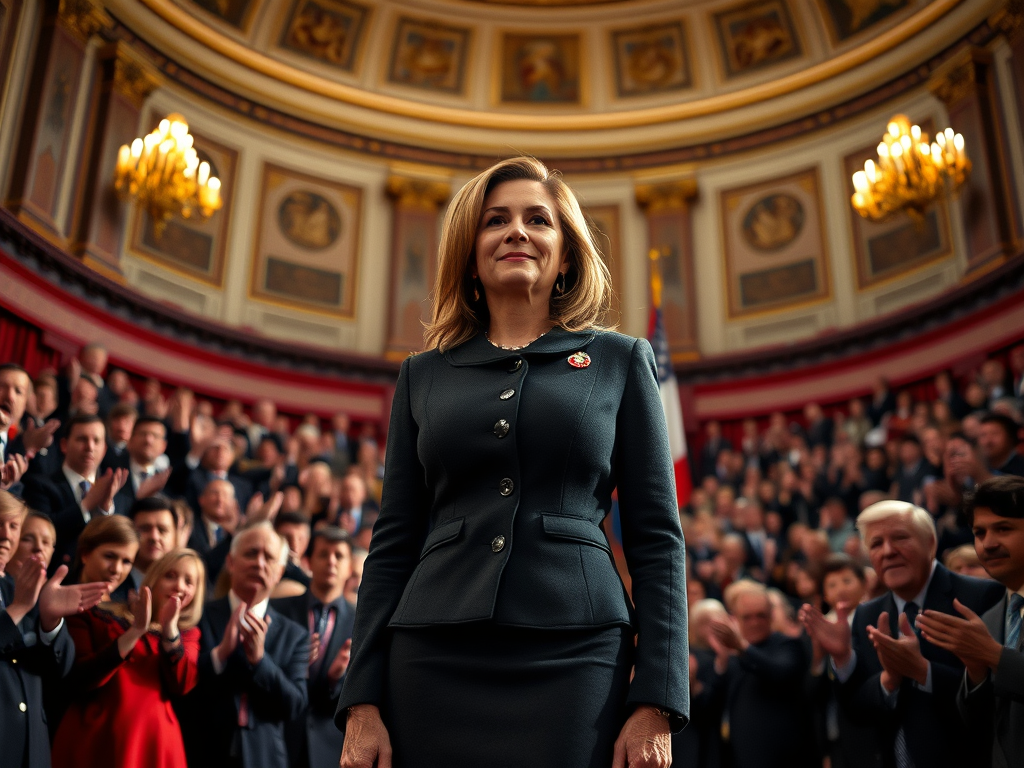

As she stood in the rotunda, Italian Prime Minister Giorgia Meloni was a distinguished guest at President Trump’s inauguration.
For Europe’s Right, Trump Stirs Caution Alongside Celebration

Last month, she was the sole European leader in attendance—a reflection of the ideological alignment she shares with Trump’s brand of conservative nationalism. Ms. Meloni also maintains a friendly rapport with his billionaire adviser, Elon Musk. Many of her supporters hope that her close ties with Trump will enhance both Italy’s global standing and her own political influence.
Yet, despite joining in the standing ovation for the new American president, Ms. Meloni and other right-wing European leaders were quickly reminded that Trump’s unpredictability could make him as much a rival as an ally.https://svtoday.org/
“I will, very simply, put America first,” Trump declared in his inaugural speech. “We will tariff and tax foreign countries to enrich our citizens.”
Since then, Trump has made it clear that he intends to impose tariffs on Europe “pretty soon,” causing unease even among European nationalists who might otherwise see him as a natural ally.
While Trump is committed to prioritizing American interests above all else, nationalist parties across Europe champion a similar approach for their own nations. His economic threats, however, directly challenge their agendas and could harm the very constituencies these parties rely on for support.

These potential trade disputes underscore the inherent contradictions within an international coalition of nationalists. The question remains: Can their partnership withstand the inevitable clash of competing national interests? Concerns also extend beyond trade, as European leaders worry about a possible American withdrawal from European security commitments and Trump’s pressure on allies failing to meet military spending targets.
“To support someone who might harm your own country’s interests is not a sound strategy,” remarked Renaud Labaye, secretary general of France’s far-right National Rally.
National Rally’s president, Jordan Bardella, recently acknowledged his respect for Trump, praising his swift deportations of Colombian migrants and his willingness to use tariffs as leverage. Yet, he also framed Trump as a potential threat to France and Europe. Tariffs on French agricultural exports, for instance, would be a major blow to French farmers—a key voter base Bardella cannot afford to alienate.
“If we don’t defend our interests, we will disappear,” he warned at a press conference last week.
This more cautious stance marks a departure from National Rally’s enthusiastic response to Trump’s victory in 2017, when then-leader Marine Le Pen effusively praised him and even made a visit to Trump Tower in New York in hopes—ultimately unsuccessful—of crossing paths with him before his inauguration.
Labaye acknowledged that in 2017, Trump’s anti-immigration rhetoric helped propel National Rally’s message onto the global stage. But now, with nationalist movements gaining ground in Europe, the party is no longer as reliant on Trump’s influence.
Moreover, Trump’s bombastic style may not resonate well with the French electorate, Labaye noted. “It’s not our culture—being over the top, trash-talking, speaking loudly,” he said.
In fact, too close an association with Trump could undermine National Rally’s long-standing effort to soften its image and broaden its appeal among French voters.

“There is a radical aspect to Trumpism today,” observed Maya Kandel, a researcher at Sorbonne University specializing in the U.S. right wing and its connections to Europe. “They’re unsure whether they want to be part of it or stick to their strategy of normalization.”
Despite these reservations, Trump’s election has undoubtedly energized Europe’s right-wing parties, reinforcing their conservative agenda.
Some, such as Germany’s Alternative for Germany (AfD), have embraced endorsements from Trump’s inner circle—including Musk—hoping to gain legitimacy. However, the results have been mixed. While AfD received a modest boost in the polls following Musk’s endorsement, its impact remains unclear. A recent survey found that three-quarters of Germans disapproved of Musk’s efforts to influence their elections, and 71 percent of respondents in Germany and Britain held a negative view of him.

At least for now, Trump’s most significant impact on Europe’s right may lie in the adoption of his tactics, as evidenced by a gathering of far-right leaders in Madrid under the slogan “Make Europe Great Again.”
Among the expected attendees were Hungarian Prime Minister Viktor Orbán, France’s Marine Le Pen, and Matteo Salvini, whose League party is part of Ms. Meloni’s coalition. They are likely to celebrate Trump’s return to power, yet beneath the surface lingers an uneasy question: What does his presidency truly mean for Europe?
Meloni’s allies hope she can serve as a mediator between the U.S. and Europe in upcoming trade negotiations. “We want to be a bridge,” Italy’s foreign minister, Antonio Tajani, told Corriere della Sera.
However, experts warn that attempting to act as Trump’s intermediary could place Meloni in a precarious position—caught between an unpredictable American president and an increasingly wary European Union. If relations deteriorate, she could find herself with little room to maneuver.
In a confrontation between Trump and the EU, siding with the American president would be difficult for Meloni, noted Jean-Pierre Darnis, a professor at Côte d’Azur University specializing in Italian foreign policy.
“Italy is a founding member of the European Union, and its economy depends on the EU as its largest trading partner, not to mention billions in post-pandemic recovery funds,” he explained. “It’s EU first—then you deal with the U.S.”
Beniamino Irdi, a senior fellow at the Atlantic Council’s Transatlantic Security Initiative, emphasized that while Meloni’s rapport with Trump may offer initial advantages, it is unlikely to sustain a lasting political relationship.
“That connection may give Meloni a head start,” Irdi observed. “But it won’t be enough.”
This is particularly true if Italy’s economic interests come under threat.
According to research by the Italian consultancy Prometeia, a 10 percent increase in U.S. tariffs on Italian exports could cost Italy between 4 and 7 billion euros.

Additionally, Trump has repeatedly warned that European countries failing to meet NATO’s military spending targets will face repercussions. Italy, which currently allocates just 1.5 percent of its GDP to defense—far below the 2 percent benchmark, let alone the 5 percent Trump is now demanding—could be in the crosshairs.
Meloni’s close ties with Musk have also drawn scrutiny. Critics argue that her cooperation with the billionaire contradicts her past denunciations of foreign interference in domestic affairs.
Italy has been in talks with Musk’s SpaceX over a potential agreement to use Starlink for secure government and military communications. Yet, when reports of these negotiations surfaced, opposition figures accused Meloni of prioritizing Musk over a European Union satellite initiative.
In response, Meloni defended her position, stating that she was merely exploring options and that, for now, there was no viable alternative to Starlink.
At the same press conference, she faced repeated questions about her relationship with Musk and his involvement in foreign politics.
For now, Meloni remains steadfast in her alliances.
“What I consider real interference,” she said, invoking the name of billionaire investor and longtime Democratic donor George Soros, “is that.”


Leave a Reply