
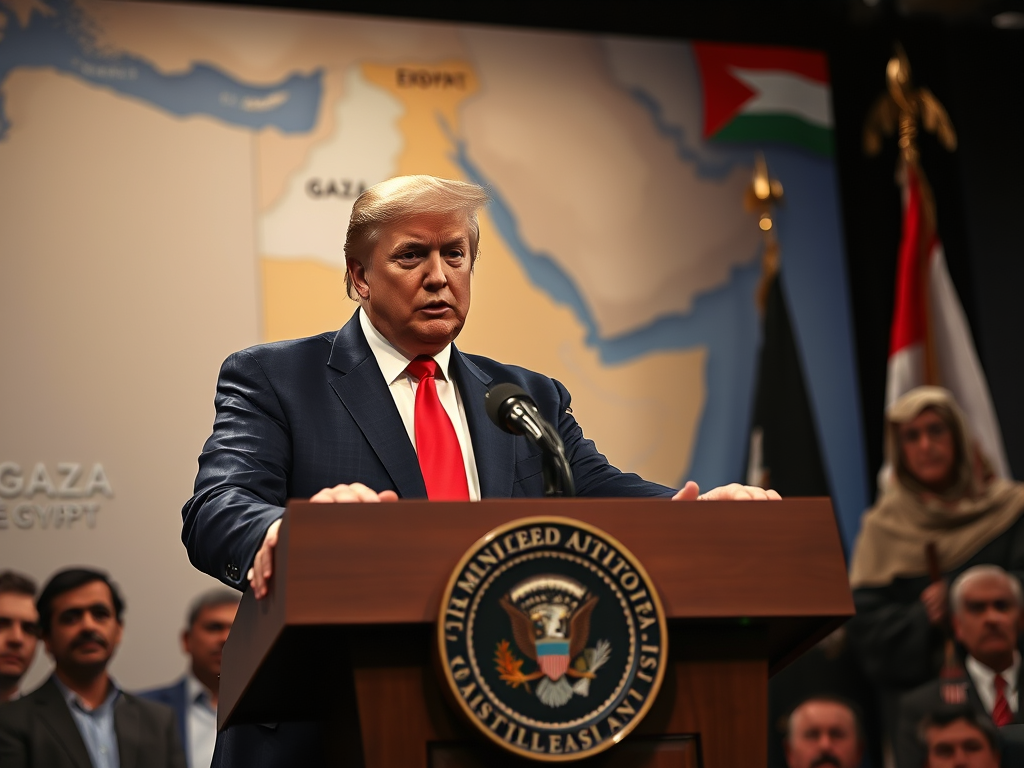

Trump Proposes U.S. Takeover of Gaza and Says All Palestinians Should Leave

On Tuesday, President Trump put forward one of the most audacious proposals in recent American political history, suggesting that the United States should assume control of Gaza and forcibly relocate its entire Palestinian population.https://svtoday.org/
During a White House meeting with Israeli Prime Minister Benjamin Netanyahu, Trump argued that the two million Palestinians in Gaza should be relocated to countries such as Egypt and Jordan, citing the destruction caused by Israel’s military campaign against Hamas following the October 7, 2023, terrorist attack.
“The U.S. will take over the Gaza Strip, and we’ll do a great job with it,” Trump declared in an evening press conference. “We’ll manage it, clear out the unexploded ordnance, and rebuild it into a hub for jobs and tourism.” Drawing from his background in real estate, Trump envisioned transforming Gaza into “the Riviera of the Middle East.”
Although Trump framed his plan as both a humanitarian mission and an economic opportunity, it reawakened deep-seated geopolitical tensions. Gaza has long been a focal point of the Israeli-Palestinian conflict, and the mass displacement of its people echoes a historical pattern of Western powers redrawing borders without regard for local sovereignty.
Trump’s proposal marks a striking departure from his previous stance on U.S. involvement in the Middle East. In his 2016 campaign, he criticized prior administrations for entangling America in the region’s conflicts. Notably, he did not reference any legal justification for seizing Gaza, nor did he address the fact that forced displacement violates international law and contradicts longstanding U.S. foreign policy.
The announcement came as the U.S. was working to secure the next phase of the Israel-Hamas ceasefire, which aims to secure the release of remaining hostages and bring an end to the fighting. Even before Trump’s proposal, negotiators had described the peace talks as extraordinarily difficult.
Hamas, which has controlled Gaza for most of the past two decades, immediately rejected the idea, while Egypt and Jordan also dismissed the prospect of taking in a large number of Palestinian refugees, citing historical tensions and security concerns.
Sami Abu Zuhri, a senior Hamas official, called Trump’s proposal “a formula for chaos and regional instability.”
“Our people in Gaza will not allow this to happen,” he stated. “What is needed is an end to occupation and aggression, not expulsion from our land.”

Trump dismissed the objections from Arab nations, expressing confidence in his ability to persuade them.
“They say they won’t accept it,” Trump remarked during his meeting with Netanyahu. “I say they will.”
Netanyahu, seated beside Trump, appeared pleased as the president unveiled his vision. Later, during their joint press conference, the Israeli leader praised Trump’s unconventional approach.
“You cut through the noise,” Netanyahu told him. “You say what others won’t, and eventually, they realize—you’re right.”
Trump insisted that Palestinians would ultimately embrace his plan.
“I don’t think they should return to Gaza,” he said. “They’ve had terrible luck there. Their living conditions are horrible—it’s like hell. The only reason they want to go back is that they don’t see another option.”
He suggested that regional nations could fund the relocation, potentially creating new, well-developed areas for Palestinians to settle. “Maybe a fresh, beautiful piece of land, or even a dozen different places,” he speculated, offering no concrete details.
When asked how many Palestinians he envisioned relocating, Trump responded, “All of them.” Pressed on whether he would force them to leave if they resisted, he added, “I don’t think they’ll tell me no.”
Gaza’s turbulent history is marked by repeated cycles of conflict and displacement. Many of its residents are descendants of Palestinians expelled from their homes in the 1948 war following Israel’s founding—an event known as the Nakba, or “catastrophe.” Trump’s proposal suggests uprooting them once again, despite international laws prohibiting forced population transfers.
Gaza was under Egyptian rule until Israel captured it in the 1967 war, along with the West Bank and other territories. Israel withdrew from Gaza in 2005, but Hamas took control two years later, using the enclave as a base for attacks against Israel. Years of conflict followed, with Israel enforcing a blockade and Hamas launching rockets. The latest escalation, triggered by Hamas’s October 2023 attack, resulted in an intense Israeli military campaign that, according to Gazan health authorities, has killed more than 47,000 people.
Following the recent ceasefire, hundreds of thousands of displaced Palestinians have returned to find their homes in ruins. Steve Witkoff, Trump’s Middle East envoy, visited Gaza last week and estimated that rebuilding the territory could take 10 to 15 years.
“If even a fraction of this destruction happened elsewhere, people wouldn’t be allowed back,” Witkoff told reporters. “There are 30,000 unexploded munitions. Buildings could collapse at any moment. There’s no basic infrastructure.”
Echoing this sentiment, Trump argued that it was unrealistic for Palestinians to return. “Right now, they have no choice but to leave,” he told reporters. “Gaza is just a pile of rubble.”
He likened the resettlement plan to his real estate projects, suggesting that if a suitable location were found and well-funded, it would provide Palestinians with a better future than returning to Gaza.
“I see long-term U.S. ownership of the area,” he said. “Everyone I’ve spoken to loves the idea of America developing that land and creating thousands of jobs. It’ll be something truly magnificent.”
Trump’s summit with Netanyahu was his first face-to-face meeting with a foreign leader since resuming office. It was part of Netanyahu’s extended visit to Washington, aimed at showcasing the strength of their alliance.
Despite their history of cooperation, Trump and Netanyahu had previously clashed over issues such as Iran’s nuclear ambitions and the Israeli leader’s acknowledgment of Joe Biden’s 2020 election victory. However, they now appear to be working to mend their relationship.
The Trump administration has made it clear that it wants Hamas removed from power and is pursuing a broader diplomatic arrangement that includes formalizing Saudi-Israeli relations.
Saudi Arabia reaffirmed its commitment to an independent Palestinian state on Tuesday, stating that any normalization with Israel would depend on the establishment of such a state.
Trump’s advisers emphasized that he and Netanyahu share a common goal: ensuring Hamas does not remain in power in Gaza. However, with Netanyahu’s government under pressure and no clear alternative for governing Gaza, analysts expect him to prolong the conflict rather than advance a final settlement.
“Netanyahu is stalling,” said Shira Efron, senior director of policy research at the Israel Policy Forum. “He’s always buying time, avoiding definitive action.”
Regional tensions escalated further on Monday amid reports that U.S. intelligence officials believe Iran is progressing toward a nuclear weapon.
It remains uncertain whether Iran has made a final decision to pursue a bomb. However, its new leadership has signaled an interest in negotiating with Trump’s administration, even as its nuclear program advances.
On Tuesday, Trump reinstated his “maximum pressure” sanctions policy against Iran but refrained from inflammatory rhetoric, declining to say whether he would support an Israeli military strike.
“This one has me torn,” he admitted while signing the order. “Hopefully, we won’t need to use it much.”




Leave a Reply