

One Family in Gaza Returned Home. But Home Was Gone.

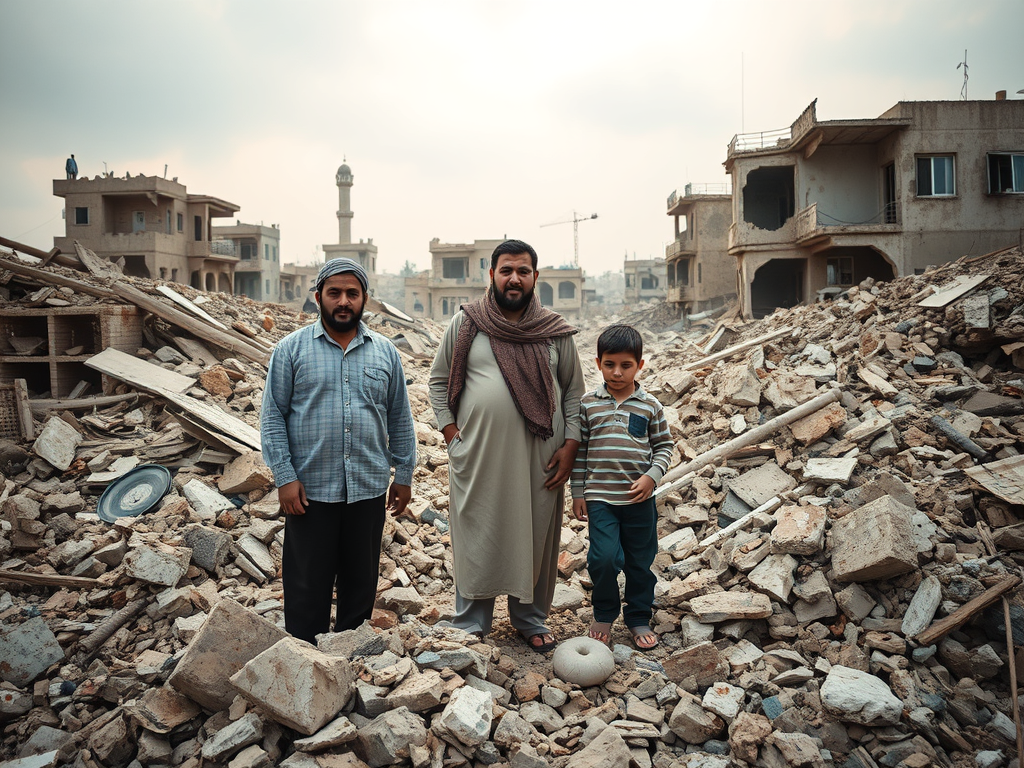
Minutes after the fighting subsided in Gaza on Sunday, Islam Dahliz, along with his father and brother, headed back to the neighborhood they once called home. They hoped to find their family house, but the surrounding area was unrecognizable. Familiar streets, landmarks, and neighbors’ homes had been reduced to rubble.
Then, Mr. Dahliz spotted the remnants of a local wedding hall. That was when they realized they had already passed the spot where their house used to stand. The house, built by his father over 50 years ago, was now a pile of debris.https://svtoday.org/

“It took us a few minutes to come to terms with the fact that this heap of rubble was our home,” said Mr. Dahliz, 34, a worker with local aid organizations. The three stood in silence, overwhelmed.
Abed Dahliz, 74, said the sight left him breathless. His sons had to help him back to their tent to recover. “I felt as though everything I had worked for my entire life was wiped out,” he said, his voice shaking. A lifelong farmer, he spoke of the house he built over decades, pouring all his savings into it, now completely destroyed.
This was far from the moment they had imagined during their months of displacement. Having been forced to move from one tent to another, restarting four times, they had clung to the hope of returning home and resuming their lives.

On Sunday morning, in their latest temporary tent in a park in western Rafah, the family anxiously listened to the radio as the cease-fire was set to begin. Islam scrolled through social media for updates. When reports suggested the truce might fall apart because Hamas hadn’t provided the list of Israeli hostages as promised, the tension in the tent was palpable. But at 11:15 a.m., the cease-fire was confirmed. The brothers and their father immediately set out for their home.
Their home had been a spacious two-story house on al-Imam Ali Street in Rafah, built in 1971. Like many homes in Gaza, it housed three generations of the family. The parents occupied one apartment, while Islam lived in another with his wife and children. He had even invested in a new kitchen and furniture after returning from Hungary, where he had studied agricultural science. Two of his brothers, Mohammed and Anas, also lived there with their families, while another brother lived nearby. During the first months of the war, they had sheltered about 10 families from other areas in Gaza.
Adjacent to the house was their family farm, started by their father and managed by Mohammed. It was filled with olive and palm trees, alongside greenhouses growing parsley, lettuce, and arugula. The farm also had rabbits, chickens, and 40 sheep that Mohammed used to graze each morning. Mohammed recalled watching his father plant the palm trees when he was a child, and his own kids collecting eggs and chasing chickens around the yard.
The Israeli military claimed it targeted residential areas because Hamas fighters were using civilian buildings for cover. However, a New York Times investigation revealed that Israel had relaxed civilian protections during its bombing campaigns in Gaza.

When Israeli forces invaded Rafah in May, they ordered all residents of eastern Rafah to evacuate. At the time, the Dahlizes’ crops had just begun to sprout. The families they had been hosting dispersed, and the Dahlizes packed up what they could—clothes, tarps, and other essentials—and set up a tent as close to their home as possible.
Though just miles away, they hadn’t seen their house in months. Relatives who managed to sneak into the neighborhood occasionally brought news. At first, they said the house was intact, though its doors and windows had been damaged. Later, satellite images showed the house still standing. But on December 8, when the family checked again, the house was gone.
The farm had been destroyed, with palm and olive trees uprooted and Israeli tank tracks crisscrossing the land. Only a few concrete pillars with exposed rebar remained.
“I feel completely lost,” said Mohammed Dahliz, his voice rising with anger. “This was an agricultural area, a place of peace. We weren’t involved in politics. We posed no threat to anyone.”
Islam’s 9-year-old daughter, Juan, cried when he showed her pictures of the destruction. “Remember, Daddy, when you threw me a birthday party in the big hall?” she asked through tears.
On Monday morning, the family returned to their neighborhood, joining a long line of families searching through the rubble for anything salvageable. Cars were crammed with people and their belongings. All across Rafah, residents filled bags with scrap metal, wood, or any items they could sell, reuse, or burn.

Mohammed hoped to find his 14-year-old daughter Jana’s toys, gifts he had bought for her birthdays and school achievements. “I just want to recover a piece of her childhood,” he said, his voice heavy with emotion.
While sifting through the debris, Islam found his old school certificates, briefly smiling at the memory they evoked. But beyond that, they recovered little—some firewood, a few pillows, and an empty tank they hoped to fix.
Despite the devastation, Islam clung to plans for the future. If the cease-fire led to a permanent resolution, they would clear the rubble with a bulldozer, rebuild basic structures on the farm, and set up a toilet and water tank.
“It won’t erase the pain,” he said, “but at least we’ll be closer to the home where we created so many memories.”
For now, however, they had to return to their tent. What was left of their past fit into the back of one small car as they drove away at dusk.



Leave a Reply