
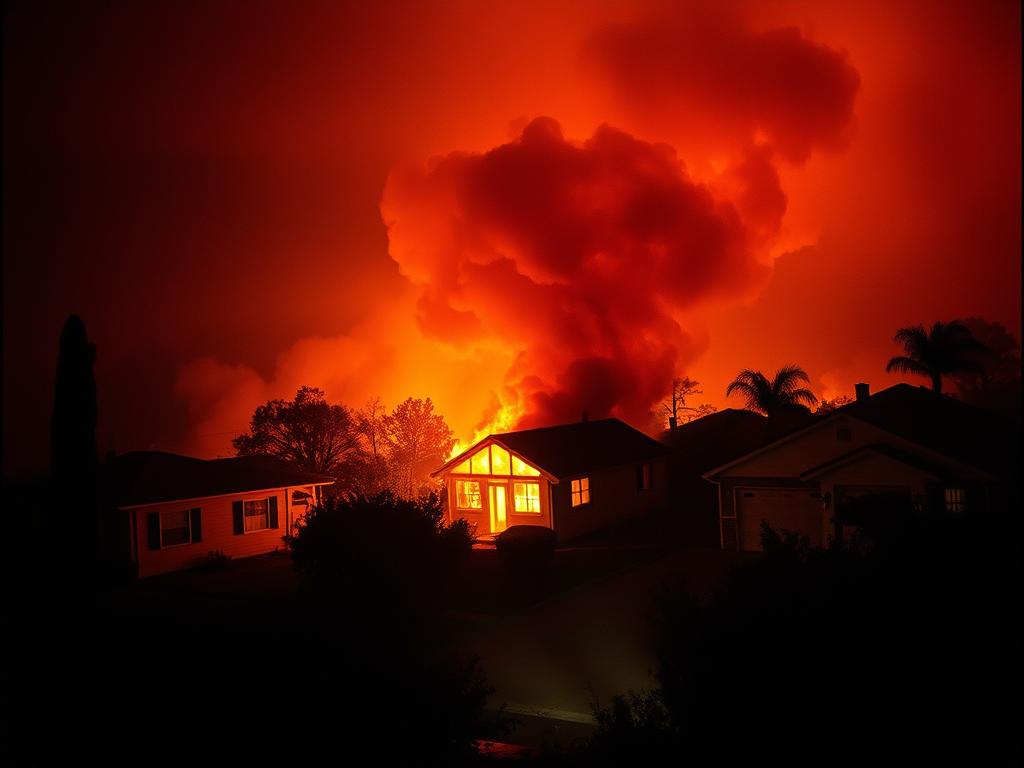

When the Eaton fire ignited earlier this month, sending embers cascading into homes in Pasadena and Altadena, California, evacuation orders were issued within minutes. However, one neighborhood didn’t receive the evacuation order until hours later, long after some homes had already succumbed to the flames.
Evacuation Orders Given Late to Area Where Fire Deaths Were Concentrated

The delay proved catastrophic.
All 17 fatalities reported by the Los Angeles County medical examiner occurred in an area west of Lake Avenue. Evacuation orders for this neighborhood were not issued until after 3 a.m.—more than seven hours after orders were sent to areas closer to the fire’s origin and hours after reports of burning homes had reached officials. Even then, some residents said they never received a warning.
“The tragic loss of life in western Altadena is deeply troubling,” Kathryn Barger, the county supervisor for the district, said in a statement. “We need a thorough investigation into the emergency notifications that were issued the night the Eaton fire broke out.”
Among the victims was Dalyce Curry, a 95-year-old who had been dropped off at home around midnight by her granddaughter, believing the situation was safe. Just a few blocks away, Anthony Mitchell and his son, Justin, called for help evacuating after 5 a.m. Both perished when their home was engulfed in flames.https://svtoday.org/
For Diana Lieb, the night began with preparations for a stormy evening. Winds howled outside her Altadena home as she lit candles in the living room with her 6-year-old twin daughters. The power outage was nothing unusual in her nine years in the neighborhood. Then her husband entered, his face pale.
“Diana,” he said, “you need to check the backyard.”
It was 7:06 p.m., and a wall of fire was bearing down on their home. An evacuation order for her area wouldn’t be issued until 3:25 a.m.—long after the family had fled.
“That’s the most unsettling part,” said Ms. Lieb, 39. “It could have been so much worse.”
Across Altadena, residents scrambled to warn one another using Facebook, WhatsApp, and text messages. Official evacuation alerts, primarily sent to cellphones, failed many. Residents without internet access or smartphones were left unaware of the impending danger.
“There are factors beyond our control,” said Irwin Redlener, founding director of Columbia University’s National Center for Disaster Preparedness. “But what concerns me are the failures in areas we can control—like warning systems.”

Dr. Redlener pointed out that emergency notifications often suffer from delays, technological glitches, or inaccurate messaging. These issues, he said, seemed to have played a role in this tragedy.
Ms. Barger has called for an independent review to investigate delays in the evacuation orders, following a report by The Los Angeles Times. According to Elizabeth Marcellino, a spokeswoman for the county’s joint information center, emergency alerts rely heavily on cellphones, but their effectiveness depends on factors like network reliability and whether phones are turned on.
Up to 10% of Californians may lack functioning cellphones, Dr. Redlener noted, while 15% lack broadband internet. Many don’t sleep with their phones nearby or charged. “These systems, while useful, are not foolproof,” he said.
Ms. Curry rarely used her cellphone, and evacuation orders for her section of Altadena came only after 3 a.m., by which time it was too late.

Officials also relied on door-to-door notifications, loudspeakers, and media alerts. However, the response fell short, leaving residents like Jeffrey Ku and his wife to act on their own. At 6:19 p.m., as embers rained down near their home east of Lake Avenue, they began packing. By 6:48 p.m., they had evacuated, despite receiving only a vague text message to “monitor the situation closely.”
“It didn’t say to evacuate,” Mr. Ku noted. “But we had to go—it was either that or risk being consumed by the fire.”
Jeffrey Schlegelmilch, director of Columbia’s National Center for Disaster Preparedness, explained that evacuation decisions are complex. Premature alerts can cause unnecessary harm, particularly to elderly or medically fragile residents, and erode trust in future warnings.
“There’s no easy formula for deciding when to evacuate,” he said. “Wildfires are uniquely unpredictable and fast-moving.”
Radio communications among fire officials that night reveal how stretched resources were as the fire spread uncontrollably.
“It’s a very dynamic situation, and while it wasn’t as bad as it could have been, it certainly wasn’t as good as it should have been,” Dr. Schlegelmilch said.

By the time evacuation orders finally reached neighborhoods west of Lake Avenue, the flames had already claimed lives. Calls reporting burning homes in the area began before 1 a.m., yet it wasn’t until 3:51 a.m. that reports of “multiple structures” on fire came in—too late for many residents to escape.
In total, 17 people lost their lives, many of them elderly or with disabilities that hindered their ability to flee. Two weeks later, the devastation remains overwhelming. Blackened palm trees loom over neighborhoods where entire blocks have been reduced to ash, leaving only a handful of ghostly, uninhabitable structures standing.
Ms. Lieb’s home is among those destroyed. Her family escaped with only a few belongings and their two cats, relocating to her parents’ house in West Los Angeles. Though grateful to have survived, she is haunted by thoughts of what could have been.
“If my husband hadn’t come home when he did,” she said, “I probably would have just put the girls to bed, completely unaware. It’s terrifying to think about.”




Leave a Reply