
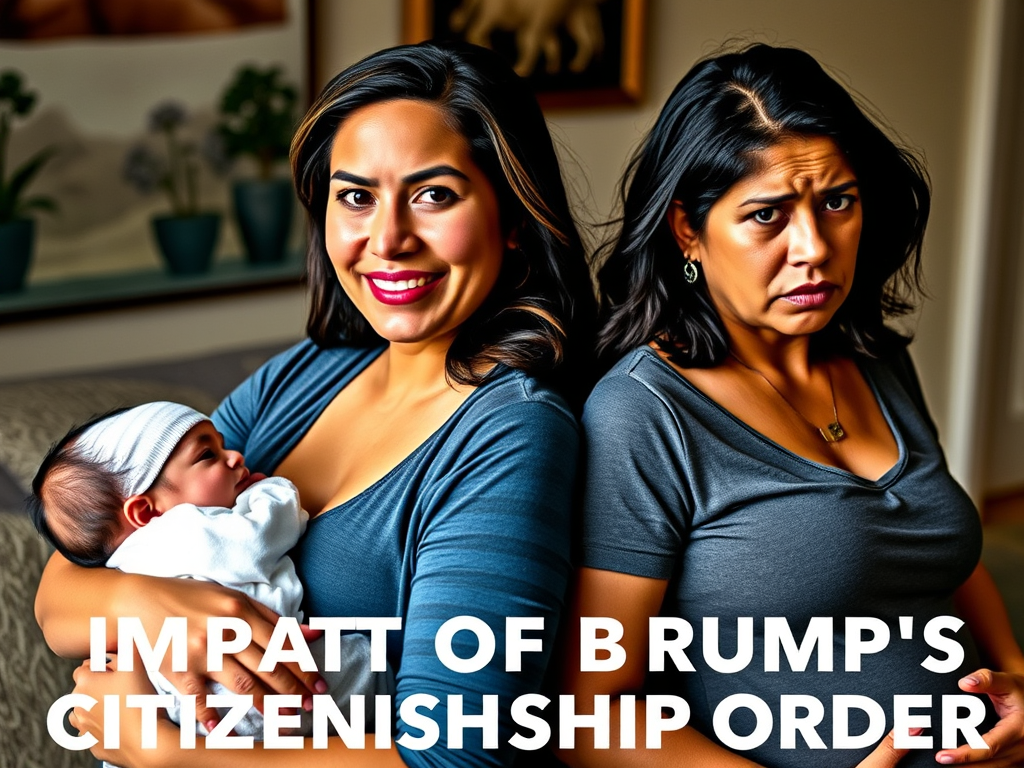

Andrea Chavez arrived in the United States nearly 20 years ago without legal documentation. Last year, she gave birth to a baby girl in Maryland, who was issued a Social Security number just days after her birth.
A New Fear for Undocumented Women: Will My Unborn Child Be a Citizen?

In contrast, Ms. Chavez’s cousin, Maria Calderas, also undocumented and currently a few months pregnant, faces the unsettling possibility that her child may not have the same citizenship rights as Ms. Chavez’s daughter.https://svtoday.org/
On his first day in office, President Trump signed an executive order aimed at ending birthright citizenship for children born in the United States to undocumented immigrants. Birthright citizenship has been a constitutional right for over 160 years, and experts argue that overturning it would require a constitutional amendment.
The new administration made its intent to challenge birthright citizenship clear even before taking office. Hours after the order was announced, lawsuits were filed by two state coalitions and the American Civil Liberties Union, citing violations of the 14th Amendment. Many legal experts share this perspective.
However, for President Trump, a staunch advocate of stringent immigration policies, these legal challenges seem secondary. For women like Ms. Calderas, who is expecting to give birth after the order’s implementation on February 19, this legal battle offers little solace.
Ms. Calderas, originally from Guatemala, expressed deep concern about the future of her family and her unborn son. “I’m worried the new president doesn’t want to grant citizenship to our baby,” she said. “This is where he will grow up, go to school, and speak English like any American.”
Many mothers emphasized that citizenship ensures their children access to essential services like healthcare and education, enabling them to fully integrate into American society.

The executive order mandates that federal agencies withhold documentation recognizing U.S. citizenship for children born to undocumented mothers or those with temporary legal status unless the father is a green-card holder or citizen.
This order seeks to reinterpret the 14th Amendment, which has long been understood to grant citizenship to nearly all individuals born on U.S. soil. Ratified after the Civil War, the amendment was intended to secure citizenship for formerly enslaved individuals.
President Trump and his supporters argue that birthright citizenship incentivizes illegal immigration, asserting that undocumented immigrants are not covered by the amendment. “Policies like these attract millions of people to enter our country illegally,” Trump claimed in a campaign video last year.
Ms. Chavez, a 23-year-old graduate student at Brown University’s School of Public Health, reflected on the vastly different future awaiting her daughter compared to her own upbringing. Brought to the U.S. at age 4, Ms. Chavez lived without legal status until receiving temporary legal protections in 2023.

“My daughter, Ivana, is my firstborn and a first-generation American,” Ms. Chavez said. “She’ll have opportunities I never did—access to resources, travel, and college without barriers.”
If birthright citizenship is successfully repealed, the implications could be severe. Children born without citizenship might be denied driver’s licenses, in-state tuition, military service opportunities, and even the ability to hold public office.
“This could create a permanent underclass,” warned Kathy Mautino, an immigration lawyer specializing in citizenship issues.
The 14th Amendment’s Citizenship Clause declares that all individuals “born or naturalized in the United States, and subject to the jurisdiction thereof” are citizens. Although it has been broadly interpreted to apply to almost everyone born in the U.S., some advocates for restrictive immigration policies argue that undocumented individuals fall outside its jurisdiction.

The last significant legal test of this clause occurred in 1898 with United States v. Wong Kim Ark. The Supreme Court ruled that a child born to Chinese immigrants was a U.S. citizen despite his parents’ ineligibility for citizenship under the Chinese Exclusion Act.
Experts believe that any modern challenge to birthright citizenship could take years to resolve and would likely end up in the Supreme Court. In the meantime, families may face uncertainty and hardship.
Sandra Camacho, a 28-year-old DACA recipient who was brought to the U.S. from Mexico as a child, expressed relief that her two children, born before the executive order, have U.S. citizenship. “I’m glad my kids made the cut,” she said. Still, she worries about growing her family under these uncertain circumstances.
The U.S. remains one of approximately 30 countries granting automatic citizenship to children born on its soil. However, nations like Finland, Sweden, and the United Kingdom impose more restrictive policies.
Critics of birthright citizenship often deride the children of immigrants and tourists as “anchor babies,” alleging they secure public benefits for their families. Yet, obtaining legal residency through a U.S.-born child is often an arduous and risky process, requiring undocumented parents to leave the country and face potential re-entry bans.
For some, the timeline is painfully close. Yajaira Torres, a 33-year-old undocumented immigrant from Colombia, gave birth to her son just days before the executive order was set to take effect. “Eithan Daniel will enjoy all the benefits of being an American,” she said.
Meanwhile, Nivida, an undocumented Honduran in Louisiana, worries about the fate of her unborn son, due in April. “He hasn’t even been born, and already he has to live in the shadows,” she lamented.




Leave a Reply