

At Trump’s Rally, the Contradictions Are in the Music

A once profane white rapper reinvented as a symbol of right-wing country defiance. A legendary disco-pop group with a hit song often interpreted as being about gay cruising, now an anthem at sports events and bar mitzvahs worldwide.https://svtoday.org/
These are the kinds of paradoxical figures that have long energized American pop music—an art form where competing interests and creative impulses are in constant close proximity, often colliding in unexpected, yet productive ways. The mix of American pop is chaotic, a product of centuries of artistic fusion, both voluntary and forced, and sometimes unpredictable.
So, it perhaps shouldn’t come as a shock that even at President-elect Donald J. Trump’s Make America Great Again Victory Rally at Capital One Arena on Sunday—seemingly an environment unsympathetic to such narratives of collaboration and diversity—these tensions persisted.
In speeches from Mr. Trump and his allies, there was a strong undercurrent of nativism and isolationism, with promises of mass deportations. And yet, for a party and movement partly founded on exclusion, and a campaign sometimes marked by racial provocation, there were notable gestures toward diversity, inclusion, and even subtle nods to the power of America’s multiracial pop culture.
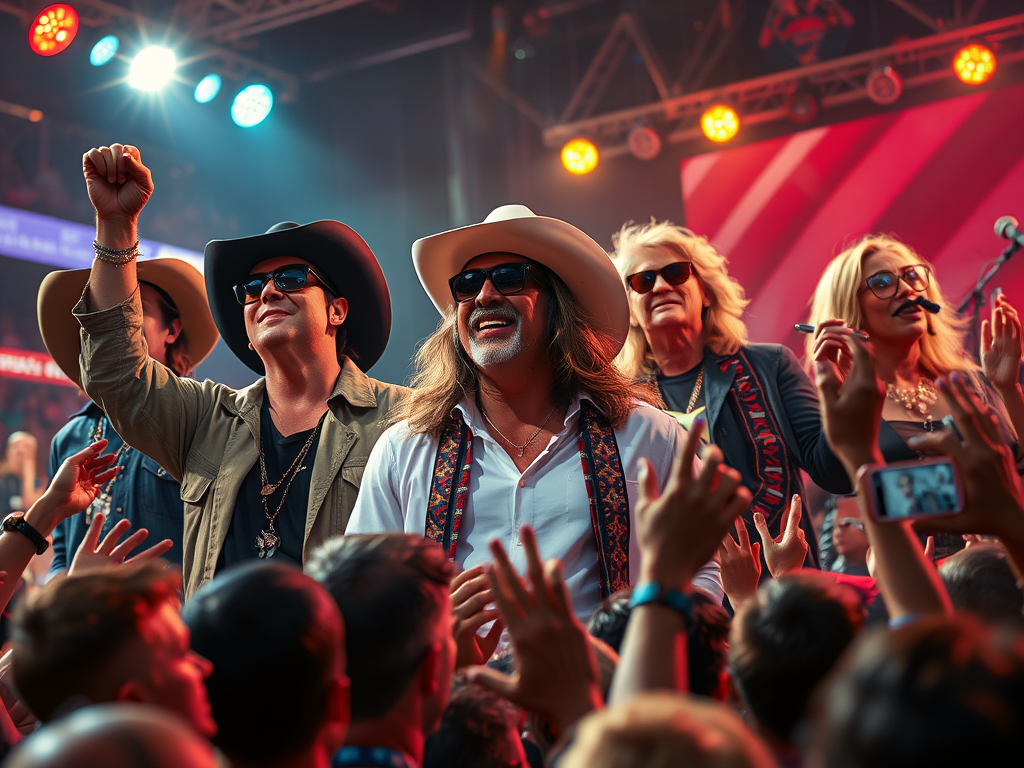
Kid Rock took the stage, his raspy, forceful voice echoing through the arena as he performed “All Summer Long,” followed by a raucous rendition of “Sweet Home Alabama.” He capped it off by donning a red Make America Great Again cap and spinning tracks on his DJ’s turntable. Meanwhile, in a video message, Mr. Trump vowed to “Make America Rock Again,” interspersed with clips of Run-DMC’s iconic tracks.
Billy Ray Cyrus, who was listed as one of the rally’s performers but whose contribution was limited to a sound check, would have further fueled this intriguing narrative. A former country heartthrob, Cyrus saw his career revived by collaborating with queer hip-hop artist Lil Nas X on the smash hit “Old Town Road.”
And, of course, there were the Village People, who performed “Y.M.C.A.” at the rally’s close with Mr. Trump behind them, occasionally shimmying and singing along.
Did the song’s origins matter? Not in the least. (Victor Willis, the group’s frontman and the only remaining original member, made headlines recently by stating that “Y.M.C.A.” is “not really a gay anthem.”)
But this is how Mr. Trump perceives music: as anthems, fight songs, soundtracks to nostalgia, rather than artistic expressions. He favors tunes stripped of deeper meaning, as long as they remain catchy and enduring. He walked onstage to Lee Greenwood’s “God Bless the U.S.A.,” as though accepting a homecoming king crown at a high school prom.

The pre-rally playlist, apart from occasional modern hits like Bruno Mars’s “Versace on the Floor” and The Weeknd’s “Starboy,” leaned heavily on songs from the past four or five decades. It was a soundtrack that felt rooted in the era of Studio 54, transformed by history, irony, and post-history, until only the rhythm remained.
Most of the speakers were introduced to the electrifying pulse of hard rock guitar, energizing the predominantly white crowd. But the speeches themselves were often more layered and nuanced. Dana White, CEO of the Ultimate Fighting Championship, highlighted Mr. Trump’s appeal among nonwhite voters, a point also underscored by Mr. Trump in his own remarks, eager to portray MAGA as a multiracial movement.
Yet, the contradictions were never far beneath the surface. Puerto Rican superstar Anuel AA embraced Mr. Trump, claiming to speak “on behalf of the entire Spanish community” and sharing the backlash he faced for supporting the president. Moments later, Stephen Miller, a key Trump advisor, condemned President Biden’s border policies, while former Fox News anchor Megyn Kelly championed Facebook and McDonald’s for abandoning diversity, equity, and inclusion initiatives.
It was the ultimate double-edged sword—quietly celebrating the fruits of America’s diversity while simultaneously attacking DEI initiatives. They wielded the optics and sounds of integration as subtle tools in a battle against further inclusion. The rally’s purpose seemed straightforward, but the music hinted at a far more complicated—and unresolved—truth beneath the surface.




Leave a Reply