
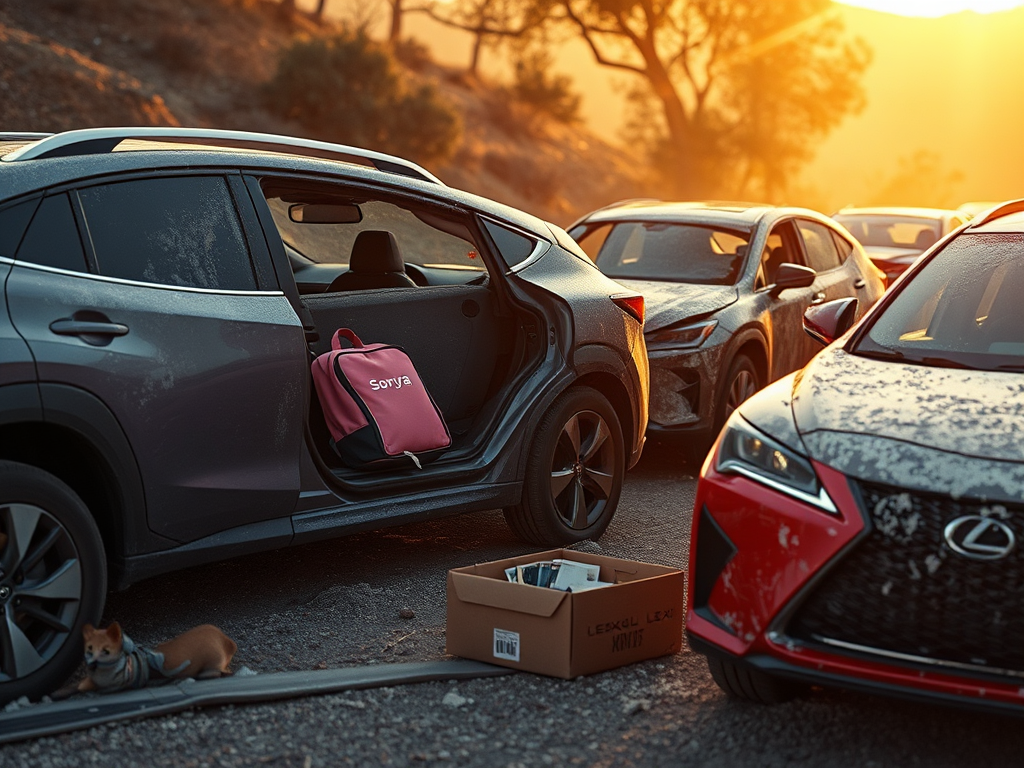

In Car-Loving Los Angeles, the Charred Remains of Vehicles Cut Deep

Dozens of vehicles remain abandoned, coated in ash, along a stretch of Palisades Drive near Sunset Boulevard in the Pacific Palisades area of Los Angeles. A pair of black boots is left beside a gray Subaru Crosstrek, while a pink backpack marked with the name “Sonya” sits in a Tesla Model X. Nearby, a box of family photos rests in a partly melted red Lexus UX.https://svtoday.org/
Further east, in Altadena, countless more vehicles lie in ruin.
The exact number of cars affected by the Palisades and Eaton fires this month is still uncertain. However, for many locals, the loss of these vehicles feels profoundly personal.

For many, cars are more than just a mode of transportation in Los Angeles, where having a vehicle is almost a necessity. In a city so ingrained in car culture, a vehicle is often an extension of one’s home—where you store an extra pair of sneakers, grab a quick bite during lunch breaks, or even make a call to a friend while stuck in traffic.
Liliana Baqueiro, 18, lost her 2012 Honda Civic, her very first car. The Eaton fire also destroyed her home in Altadena, along with two of her grandfather’s cars.

Ms. Baqueiro and her family evacuated before official orders were issued, thinking it was just a precaution and they would return the following day. All she was able to bring were her pajamas, passport, birth certificate, two dogs—Baby and Ángel—and her parrot, Milo.
Two days later, after the fire had ravaged Altadena, Ms. Baqueiro viewed the remnants of her home. Learning that her car was also destroyed felt like an additional blow.

“It felt almost like a second loss,” she said. Her Civic had been a gift from her grandfather, who had promised for years to buy her a car once she graduated from high school.
She had just begun to feel at ease behind the wheel. She had a learner’s permit and had scheduled a driving test for the week, but with her permit lost in the fire, she had to postpone the test. “It’s not my top priority right now,” she added.
For others, losing their vehicles meant losing their livelihood.
Pablin Arevalo didn’t pack much more than a change of clothes when he evacuated, as he thought his house in Altadena was safe. The house, where he lived with his wife and two children, also served as the base for his landscaping business.

Now, his home and tens of thousands of dollars worth of tools are gone, and the property is lined with charred work vehicles: two Ford Transit vans, three old pickup trucks, and a Hino dump truck.
“The six burned completely,” said Mr. Arevalo, 53, in Spanish. “There’s nothing left—along with all the equipment inside.”
He lost tools like rakes, leaf blowers, line trimmers, lawn mowers, power drills, and jackhammers—items he had slowly accumulated as his business grew.

Fortunately, most of his clients were not in Altadena. With 10 employees and plenty of work, he quickly secured a mix of donated and second-hand vehicles and tools from friends to keep going. He even drove to Las Vegas to buy a truck from one of them.
Within a week, Mr. Arevalo had his team back to work.
“They’re part of my family, and they have people to provide for,” he said in Spanish.

In a Malibu neighborhood devastated by the Palisades fire, one vehicle—a blue and white 1977 Volkswagen Type 2 van—somehow survived.
Almost everything around it was destroyed. Homes were reduced to rubble, and in some places, only chimneys remained.
The van’s owner, Megan Krystle Weinraub, 29, evacuated on the day the fire started. She left in a hurry, taking only her dog and some clothes, leaving the van behind.
“I thought it was a goner,” Ms. Weinraub said.
Her apartment survived the fire, and a few days later, a neighbor informed her that the van, parked a few streets away, had also been spared.
“I’m one of the lucky ones,” she said.


Ms. Weinraub had recently bought the van from her friend and business partner, Preston Martin, 24. He was equally relieved that it was intact, partly because of his personal connection to the vehicle. It had been his home during his senior year of college, offering him a place to escape along the Pacific Coast Highway.
“Whenever I had a really bad day, all I had to do was turn the van from house mode into drive mode, take it for a spin up the P.C.H., and whatever problem I had would just disappear,” he recalled. “That’s the magic of this van.”




Leave a Reply