
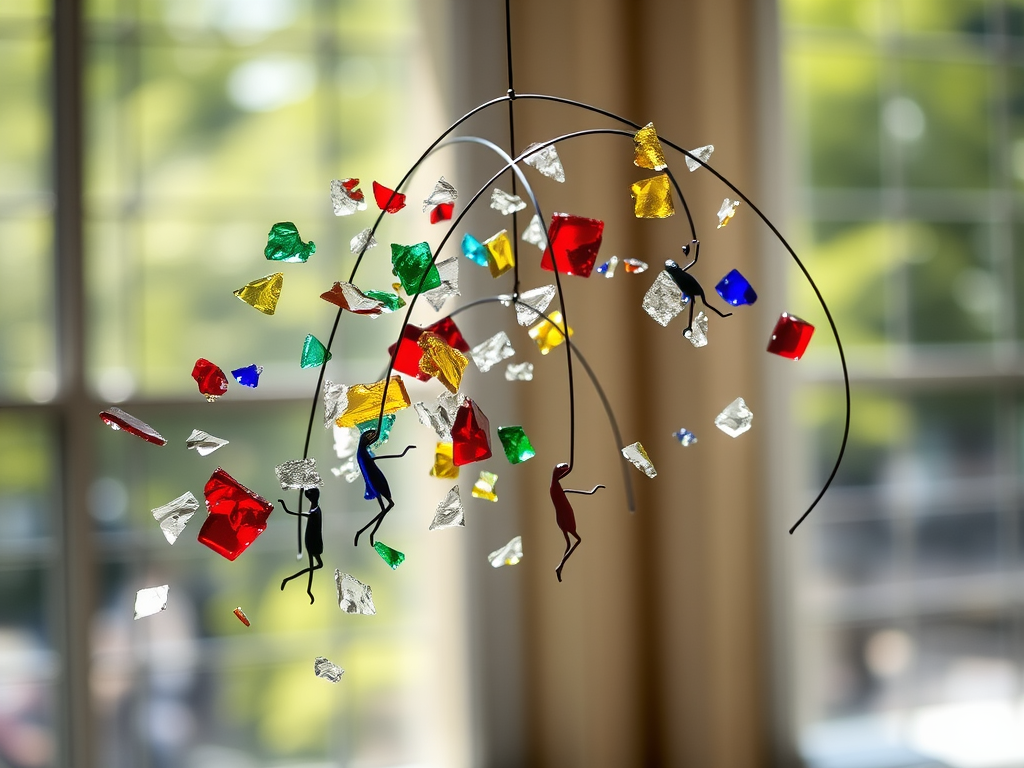

The intricate sculpture currently at the heart of a legal dispute is referred to in court documents as a “glass and wire mobile,” composed of “intentionally broken, colored glass fragments,” “wire figures,” and “connecting and hanging wire.”
Suit Disputes Ruling That a Sculpture Is Too Broken to Still Be a ‘Calder’

It is one of the kinetic sculptures created by Alexander Calder many years ago, and there is no disagreement that it was originally crafted by the artist himself.https://svtoday.org/
However, a federal lawsuit filed this month in Manhattan by Richard Brodie, an art collector, claims that the Calder Foundation has hindered his ability to sell the piece by incorrectly asserting that it is now too damaged to be considered a legitimate Calder work.
Brodie, a board member of the Detroit Institute of Arts, argues in court that the sculpture is not broken. While the suit does not specify the name of the work, it is described as being worth over $8 million and previously owned by Pierre Matisse, the son of renowned artist Henri Matisse, who purchased it directly from Calder.
Brodie’s attorneys argue that the Calder Foundation, led by president Alexander S. C. Rower, has actively sabotaged a potential sale by claiming the mobile is damaged, which, according to Brodie, deterred buyers.
The lawsuit states, “This case concerns a fraudulent scheme by Rower and the Foundation to destroy the market value of a multimillion-dollar piece of art owned by the Plaintiff,” accusing them of attempting to devalue the work.
The Calder Foundation, on the other hand, maintains that it is simply safeguarding the artist’s legacy and asserts that the work is, in fact, damaged. Luke Nikas, an attorney representing the Foundation and Rower, who is Calder’s grandson, dismissed the case as meritless, claiming it was filed by a disgruntled collector seeking to pressure the Foundation into accepting a damaged piece that no longer aligns with Calder’s original vision.
Various factors, including humidity, direct sunlight, and careless handling, can damage artwork, as casino magnate Steve Wynn learned when he accidentally damaged his Picasso painting in 2006. (Wynn’s Picasso, Le Rêve, was eventually restored and later sold for $155 million to billionaire hedge fund manager Steven A. Cohen.)
Despite this, Brodie insists that the Calder Foundation’s claims of damage are unfounded. In court documents, he contends that the artwork has suffered only minor damage over the years, the most significant of which occurred in 2018 when he submitted it to the Foundation for authentication. According to the lawsuit, the sculpture was returned without its original hanging hardware and with a newly broken glass shard.
Brodie claims that all the damage was subsequently repaired.
Calder, who passed away in 1976, gained fame for his kinetic sculptures, often featuring broken glass pieces incorporated into his mobiles and suspended by wire.
Brodie, who is the current president of the Collections Committee at the Detroit Institute of Arts, has accumulated over 20 Calder works over the years. He purchased the mobile in question in 1994 from Calder’s close friend and gallerist, Klaus Perls. Brodie’s attorneys argue that the sculpture appears almost identical to how it was depicted in a 1989 catalog of Calder’s works.
However, when Brodie sought to sell the piece in 2018 and submitted it to the Foundation for authentication, the Foundation reportedly refused to assign it the “Application” or “A” Number—an official designation confirming the piece’s authenticity in the Foundation’s registry. Without this recognition, the lawsuit asserts that the sculpture’s market value is severely diminished. When Brodie made a second attempt to sell it in 2019, a conservator reportedly found no significant issues with the work.
Brodie argues that shortly afterward, Rower intervened, instructing the conservator to conduct a second review, which was funded by the Foundation. During this second inspection, the lawsuit claims that Rower did not personally examine the sculpture but instead dictated his opinions, which led the conservator to report notable issues in a December 2019 assessment.

The report noted that “many of the elements are missing sections of glass, judging by sharp break edges,” which, the conservator speculated, indicated that the glass pieces had originally been larger. The expert suggested that the mobile would have had a different appearance and weight distribution, requiring the strings to be attached in different locations.
Nikas, the Foundation’s lawyer, countered that the second review was a much more thorough analysis than the initial, brief inspection. He emphasized that Rower only reviewed photographs of the piece and provided input, but did not dictate the conservator’s conclusions about alleged damage and modifications.
Art foundations, such as the Calder Foundation, are often regarded as the ultimate authority on the authenticity of artworks. However, the Foundation also buys and sells Calder pieces, and Brodie’s lawsuit raises concerns about a potential conflict of interest. The legal papers argue that the Foundation’s decision to withhold authentication from certain pieces could drive up the value of the works it holds, as fewer authenticated Calder pieces would be available on the market.
Nikas rejected the notion of a conflict of interest, insisting that the Foundation had no intention of manipulating the market and that any pieces it owned were retained for scholarly research purposes.
Brodie continued his efforts to sell the artwork in 2023 through an auction house, hiring another conservator who found the piece to be in good condition. Despite this, the Foundation persisted in claiming the sculpture was damaged, asserting that it no longer represented Calder’s artistic intent.




Leave a Reply