
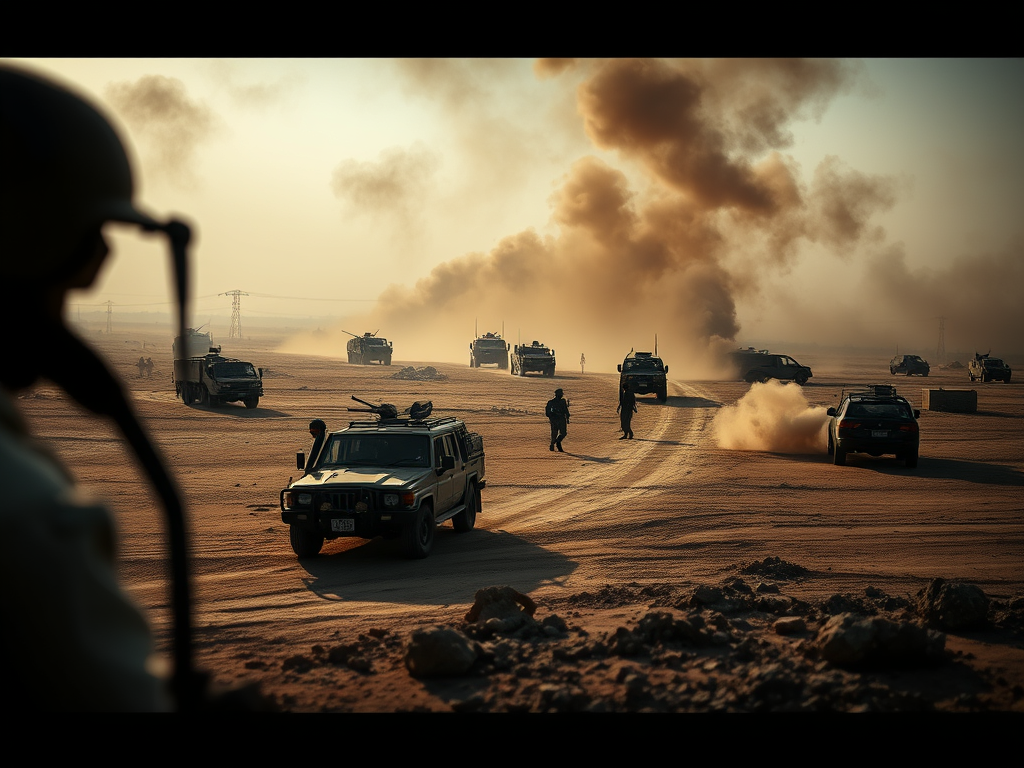

Sudan’s military has reportedly deployed chemical weapons on at least two occasions against the paramilitary group it is fighting for control of the country, according to four senior U.S. officials on Thursday.
Sudan’s Military Has Used Chemical Weapons Twice, U.S. Officials Say

The weapons were used recently in remote regions of Sudan, targeting fighters from the Rapid Support Forces (RSF), a group the military has been clashing with since April 2023. However, U.S. officials are concerned that these weapons may soon be used in more densely populated areas, including the capital, Khartoum.
The disclosure of chemical weapons use came as the U.S. imposed sanctions on General Abdel Fattah al-Burhan, the head of Sudan’s military, for documented atrocities committed by his forces, such as indiscriminate bombing of civilian areas and using starvation as a warfare tactic.https://svtoday.org/
The use of chemical weapons marks an alarming escalation in the conflict between the Sudanese military and the RSF, once allies. The war has already caused what many call the world’s worst humanitarian crisis, with up to 150,000 people killed, over 11 million displaced, and an impending famine of unprecedented scale.
“Under Burhan’s command, the Sudanese Armed Forces (SAF) have employed tactics such as indiscriminate bombings, attacks on civilian structures, and extrajudicial killings,” the U.S. Treasury Department stated.
In response, General al-Burhan defiantly told reporters, “We are prepared to face any sanctions to serve our nation, and we welcome them,” during a visit to El Gezira state.
The U.S. move is a significant blow to a figure seen by many as Sudan’s de facto wartime leader, who also represents Sudan at the United Nations. Humanitarian groups fear that Sudan’s military might retaliate by further limiting aid operations in famine-stricken or at-risk regions. This decision could also shift U.S.-Sudan relations, especially with Tom Perriello, the U.S. Sudan envoy, playing a key role in the peace efforts that have so far stalled.

Although chemical weapons were not specifically mentioned in the official sanctions notice, U.S. officials acknowledged that their use was a key reason for targeting General al-Burhan.
Two anonymous officials briefed on the matter said that chlorine gas was likely used in the chemical attacks. Chlorine, when weaponized, can severely damage human tissue and displace breathable air in confined spaces, potentially causing suffocation and death.
The knowledge of the chemical weapons program was restricted to a small group within Sudan’s military, the U.S. officials said, but it was clear that General al-Burhan authorized their use.
Sudan’s U.N. ambassador, Al-Harith Idriss al-Harith Mohamed, denied the claims, insisting that Sudan’s military had not used chemical or incendiary weapons. “In fact, it is the militia that used them,” he said, referring to the RSF.
However, U.S. officials said the evidence was compelling, with numerous chemical weapons tests detected this year and two separate instances in the last four months where they were deployed against RSF forces.

The U.S. also gathered intelligence indicating that chemical weapons could soon be used in Bahri, a northern district of Khartoum where fierce fighting has taken place.
Chlorine gas was first weaponized during World War I, and its use in combat is prohibited under international law. It has been employed in past conflicts, including by insurgents in Iraq, ISIS, and the Syrian regime.
The intelligence on the chemical weapons did not originate from the U.A.E., a key ally of the U.S. and a staunch supporter of the RSF, officials confirmed.
Until recently, Sudan’s military seemed to be gaining momentum. Last weekend, its forces recaptured the city of Wad Madani, a strategic area that had been under RSF control for over a year. The victory, along with U.S. accusations of genocide against the RSF, suggested the military was turning the tide in the conflict.
However, reports of brutal reprisals by Sudanese forces against suspected RSF collaborators have surfaced, including torture and extrajudicial killings. The U.N. condemned the reports and called for an investigation.

The sanctions targeting General al-Burhan were partly due to the military’s use of chemical weapons, but also in response to its bombing campaigns that have killed many civilians, as well as attacks on hospitals and other protected infrastructure.
U.S. officials, while protecting the intelligence sources, emphasized the urgency of acting before President-elect Donald J. Trump’s inauguration on Monday. A classified hearing on the chemical weapons issue is scheduled for next month.
In addition to General al-Burhan, the sanctions targeted a Sudanese arms supplier and a Hong Kong-based company involved in providing Iranian-made drones to Sudan’s military.
The sanctions have received mixed reactions. John Prendergast, co-founder of The Sentry, praised the decision as critical and urged the European Union to follow suit. Nathaniel Raymond from Yale questioned whether the U.S. had sufficient evidence, noting that there were no ground reports to confirm the deployment of chemical agents.


Leave a Reply