

In His Dark, Disturbing Visions, David Lynch Showed Us Who We Are

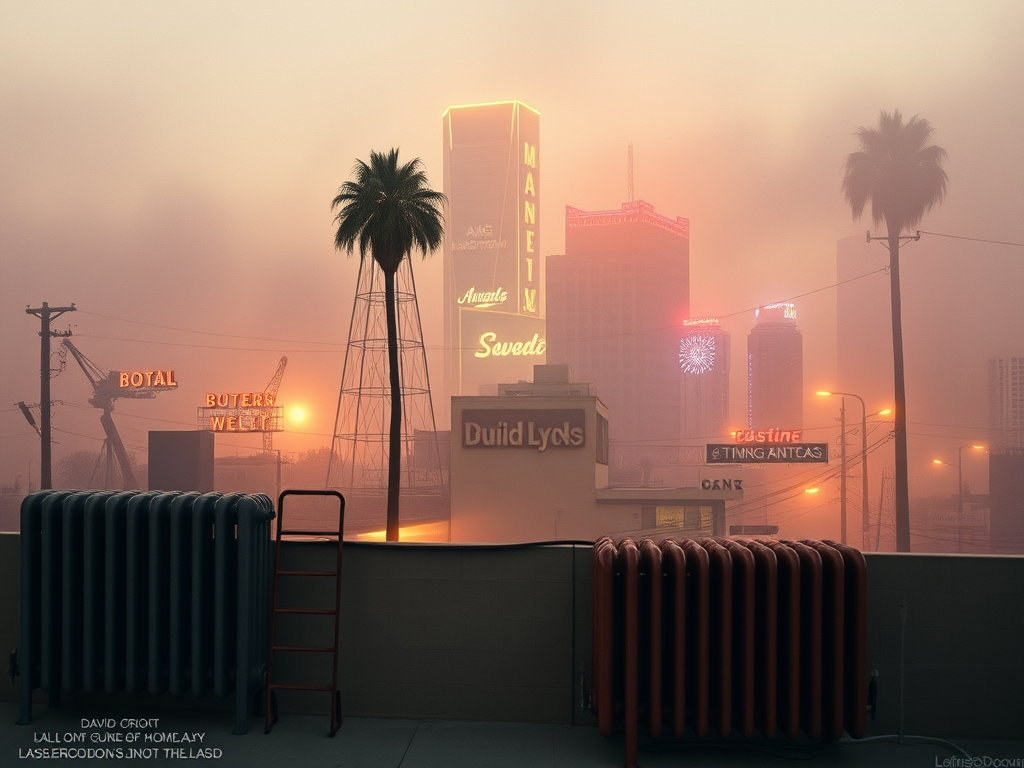
It felt strangely fitting that my city was burning as I learned on Thursday of David Lynch’s passing at the age of 78. Few filmmakers understood Los Angeles’ complexities as deeply as Lynch, and even fewer seemed so intimately connected to its surreal blend of beauty and chaos, sunshine and noir. This city was where he made Eraserhead, his debut feature — a film that’s almost impossible to describe, featuring a lady living in a radiator and a grotesque alien-like baby. Now that Lynch is gone, I feel like another piece of this city has vanished with him, leaving me with a profound sense of loss.

Although Lynch was born in Missoula, Montana, he truly came to life in Los Angeles. He studied here at the American Film Institute (where Eraserhead started as his student project) and later set up a compound nearby, where he would record charming weather reports with his unmistakable voice. In a particularly memorable one from May 11, 2020, he sits at his desk surrounded by glasses and a mug of black coffee. “Here in L.A.,” he remarks while peering out a window, “it’s kind of cloudy, some fog this morning.” After turning to face the camera, he notes the temperature and adds, “This all should burn off pretty soon, and we’ll have sunshine and 70 degrees. Have a great day.”
I always took his sign-off to be more than just a farewell; it felt like a genuine wish for everyone to embrace the day. Lynch created some of the most unsettling, haunted films in cinema, yet in interviews, he was approachable and, at times, almost disarmingly normal — which only added to his strangeness. In 2001, when Mulholland Drive was released, my friend, the critic John Powers, interviewed him. Powers described Lynch as reminding him of Jimmy Stewart — but not the earnest Mr. Smith of Mr. Smith Goes to Washington, rather the obsessed, tortured soul from Vertigo. Powers noted, “His beaming smile had lost its innocence.”https://svtoday.org/
When I wrote a glowing review of Mulholland Drive, I received an outpouring of angry responses. It wasn’t just disagreement; some people seemed downright furious at both the film and my review. The film’s lack of conventional sense frustrated many viewers to the point of rage. Admittedly, it confused me too when I first saw it, but it also amazed me. Films are usually straightforward, but Lynch never followed that rule. More troubling still, Lynch made art in an industry that, while obsessed with beauty, often has little patience for unconventional artistry — unless, of course, it hangs on the walls of a mansion. His relationship with Hollywood was fraught because he never truly seemed to fit into it — artistically, spiritually, or otherwise — even when making films deemed more commercially palatable.
In 2019, the Academy awarded Lynch an honorary Oscar, a fitting recognition for this outsider artist. He seemed genuinely moved as he stood with his long-time collaborators, Kyle MacLachlan, Laura Dern, and Isabella Rossellini, visibly elated. In his brief acceptance speech, Lynch thanked everyone who had helped him “along the road,” a phrase that felt especially apt for a filmmaker who held The Wizard of Oz as a guiding influence. His films are full of references to Oz, including Wild at Heart, where a version of Glinda the Good Witch (Sheryl Lee from Twin Peaks) floats down to assist Nicolas Cage’s character, Sailor, a leather-jacketed Elvis figure.
Though I don’t much care for Wild at Heart, despite its undeniable visual splendor and the captivating performances of Cage and Dern, I find it a bit too mean-spirited, especially the opening scene where Sailor violently beats a Black man. Roger Ebert, in his review, rightly called it a “racially charged scene of unapologetic malevolence.” Some of Lynch’s works, like Inland Empire, have deeply disturbed me, yet the violence in Wild at Heart still unsettles me, partly because it involves one of the few Black characters in his filmography.
I did disagree with Ebert’s view on Lynch’s supposed misogyny, particularly in Blue Velvet. I understand why Ebert criticized Lynch’s portrayal of women as hurtful or painful, but I’ve always seen these images — even the most brutal and offensive ones — as stark, honest reflections of human experience. Unlike many filmmakers who hide their darker views, Lynch was unafraid, or perhaps uninterested, in what others thought about the uglier aspects of his vision.
One of Lynch’s finest female characters is Betty, the naive, wide-eyed blonde in Mulholland Drive, played by Naomi Watts. Betty arrives in L.A. to pursue her acting dreams, only to find that the city’s façade quickly crumbles, revealing its darker side. Her experiences encapsulate the horror and disillusionment Lynch so often explores in his work.

If I were to pick one scene that encapsulates Lynch’s unique artistry, though, it would be the opening of Blue Velvet. Initially, it seems like an idyllic suburban scene, with a dazzling blue sky, Bobby Vinton’s song, and images of red roses and white picket fences. But things quickly take a dark turn. A man watering his lawn collapses from a heart attack, and the soundtrack shifts to eerie, electronic sounds as the camera pans over ants devouring something. The film begins to peel away the layers of American normalcy, revealing the disturbing undercurrents beneath the surface.
Soon after, Jeffrey (MacLachlan), the protagonist, finds a severed ear in an empty lot, a clue that leads him to Dorothy (Rossellini), a woman trapped in an abusive situation. Jeffrey’s journey echoes that of Dorothy in The Wizard of Oz, as he confronts new dangers and returns home — only his “Kansas” is a much darker place.
Blue Velvet ends on a note of hope — or perhaps it’s cynicism or irony, depending on your perspective. Jeffrey and his girlfriend marvel at a robin in the yard, and Dorothy is freed from her tormentor. Though the bird is a fake, the characters believe in the happy ending, and I think Lynch believed in it too. Maybe he had to. After all, to confront the horrors of old Hollywood — to show us the darkness beneath its shiny veneer — he had to offer something to believe in. In the end, Lynch showed us not just the world, but ourselves.




Leave a Reply