
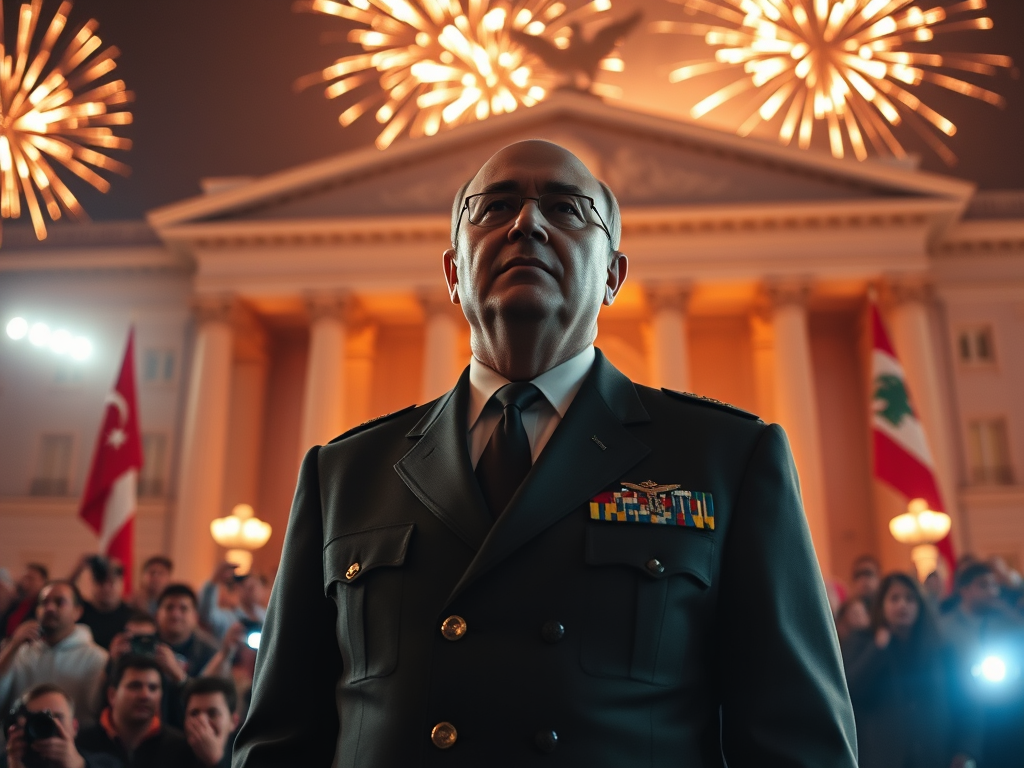

Lebanon’s divided Parliament broke through more than two years of political deadlock on Thursday, electing a new president in a critical step toward stabilizing a nation grappling with economic turmoil and the aftermath of a devastating war.
Lebanon Chooses a President After 2 Years of Gridlock

Lawmakers overwhelmingly chose Gen. Joseph Aoun, the head of Lebanon’s military, during the second round of voting. He secured 99 votes in the 128-seat Parliament, having fallen short of the required majority in the first round. This marked a significant milestone in ending over two years of weak caretaker governance.
“Today marks the beginning of a new chapter in Lebanon’s history,” General Aoun declared in his victory speech.
The election was widely seen as a pivotal moment for Lebanon, sparking celebrations in Beirut with fireworks and gunfire as the results were announced. The country has faced severe challenges in recent years, including an economic collapse and a war between Israel and Hezbollah that left large swaths of the nation in ruins.
Thursday’s vote — which at times descended into heated arguments — also highlighted changing dynamics in the region. In neighboring Syria, a fragile government is attempting to rebuild after years of civil war. Meanwhile, the fall of the Assad regime in Syria and Hezbollah’s military setbacks against Israel have weakened Iran, the group’s longtime supporter.https://wordpress.com/
Lebanon’s international allies, including the United States, have made clear that postwar financial aid depends on the election of a president. The World Bank estimates that the Israel-Hezbollah conflict, currently under a tenuous 60-day cease-fire, has caused $8.5 billion in damage and losses in Lebanon.
Since October 2022, when Michel Aoun completed his presidential term, Parliament had failed 12 times to elect a successor. Under Lebanon’s sectarian power-sharing system, the president must be a Maronite Christian.
Hezbollah, a dominant political force, had previously obstructed votes by leaving sessions, but its weakened position following the war forced compromises. The group ultimately backed General Aoun after its candidate withdrew on the eve of the election. Analysts noted that Hezbollah’s diminished political leverage necessitated concessions.
“He represents a shift in Lebanon’s power dynamics,” observed Mohanad Hage Ali, a senior fellow at the Carnegie Middle East Center in Beirut.
As president, General Aoun will consult with Parliament to appoint a Sunni Muslim prime minister, who will then form a government. With no single faction holding a majority, the process may face delays. General Aoun has pledged to begin consultations promptly.
Widely respected in Lebanon and considered to have U.S. support, General Aoun is seen as a unifying figure. He has led the armed forces since 2017, earning cross-sectarian backing as the military remains one of the nation’s few respected institutions.
“He is broadly acceptable to Lebanon’s political elite,” said Lina Khatib, an associate fellow at Chatham House. “This perception ties to the belief that the Lebanese Army acts in the national interest.”
Foreign diplomats, including representatives from the U.S., Saudi Arabia, and France, attended the election, following intense diplomatic efforts earlier in the week. Amos Hochstein, the U.S. regional envoy, met with General Aoun and urged lawmakers to resolve the political impasse.
General Aoun’s election will require a constitutional amendment, as senior civil servants must resign two years before running for office. Despite heated debates in Parliament, this step has precedent in Lebanon’s political history. Some lawmakers cast protest votes in the initial round, with one ballot mocking international influence by naming “Joseph Amos Bin Farhan,” a mix of General Aoun’s name and those of the U.S. and Saudi envoys.
Diplomats hope General Aoun’s military background will strengthen his ability to maintain influence over the army and enforce U.N. Security Council Resolution 1701, which ended the 2006 Israel-Hezbollah war. They view it as a potential framework for lasting peace after the current cease-fire.
In his victory speech, General Aoun vowed to ensure that only the Lebanese state would wield weapons, a statement that drew applause in Parliament. Israeli officials have expressed hope that the Lebanese Army will curb Hezbollah’s activities in southern Lebanon.
“I trust this decision will bring stability, a brighter future for Lebanon, and foster good relations with neighbors,” Israeli Foreign Minister Gideon Saar posted on social media.
Addressing the nation, General Aoun pledged to restore stability, combat corruption, and rebuild the destruction caused by the war. “My promise is to rebuild what Israel has destroyed,” he affirmed.


Leave a Reply