
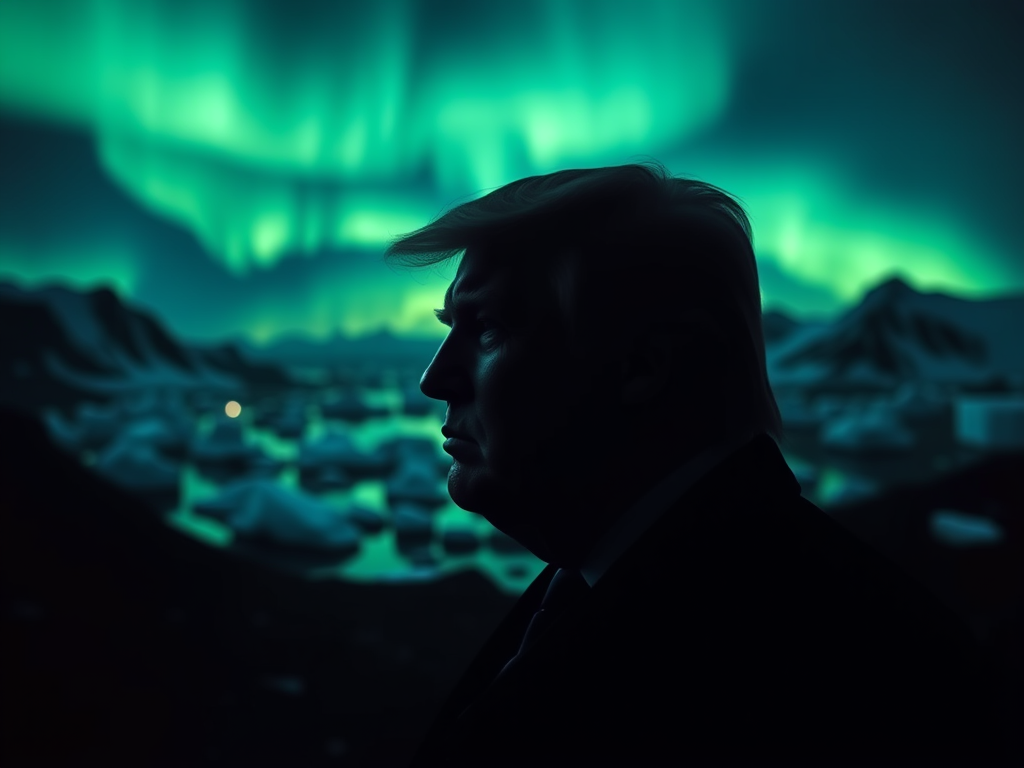

‘Make Greenland Great Again’? No Thank You, Greenlanders Say.

Christian Ulloriaq Jeppesen recalls how it all began.
In 2019, during Donald Trump’s first term as U.S. president, he proposed the idea of the United States purchasing Greenland. At the time, many in Greenland (and Denmark, which governs the territory) dismissed the idea as a joke.https://wordpress.com/
“Everyone thought, ‘Ha-ha, you can’t just buy a country, he doesn’t really mean it,’” said Jeppesen, a Greenlander and radio producer, over the phone. “But looking back, that was the wrong reaction. Just look at where we are now.”
Fast forward to today, and Trump has reiterated his belief that the U.S. should annex Greenland for security reasons. This has raised the same questions as before, but with a much greater sense of unease.
Is Trump simply indulging in another grandiose, impractical idea?
Or is he genuinely serious?
From his recent remarks, it seems Trump is entirely serious. Regardless of Denmark’s repeated stance that Greenland is not for sale and that its future must be decided by its people, Trump insists that Greenland’s ownership is crucial for U.S. national security.
“For the sake of global security and freedom, the United States believes the ownership and control of Greenland is absolutely necessary,” Trump posted in December, announcing his pick for the U.S. ambassador to Denmark.
In a more surprising move, during a press conference earlier this week, Trump went even further, refusing to rule out the use of military force to secure Greenland.
France and Germany, concerned by Trump’s statements, both issued strong remarks on Wednesday defending Greenland’s territorial integrity and warning against any potential military action.
German Chancellor Olaf Scholz emphasized that the inviolability of borders applies to all nations, big or small. French Foreign Minister Jean-Noël Barrot, in turn, declared that threatening another country’s sovereign borders was “obviously out of the question.”
“Do I think the United States will invade Greenland? No,” Barrot said on French radio. “But have we entered an era where the rule of the strongest is back? Yes.”
Adding to the intrigue, Trump’s son, Donald Trump Jr., made an unexpected visit to Greenland this week. He landed in Nuuk, Greenland’s capital, toured the city, including a statue of a Danish-Norwegian missionary, and was hosted by a Trump supporter from Denmark. Though he claimed his visit was personal, the president-elect tweeted about it, even stating, “MAKE GREENLAND GREAT AGAIN.”
“This is getting frightening,” Jeppesen commented.
At 836,000 square miles, Greenland is the world’s largest island, roughly a quarter the size of the U.S. It is an autonomous territory of Denmark, with a parliamentary system that governs most of its domestic affairs, though Denmark still controls defense, security, and aspects of foreign policy.
Greenland’s location, its vast mineral wealth, and its strategic importance in the Arctic make it an appealing target for Trump. The island sits near the top of the world, east of Canada and bordering the Arctic Sea, housing a large U.S. military base. It also has valuable mineral resources like cobalt, copper, and nickel.
As climate change accelerates the melting of its ice, new Arctic shipping routes and energy resources are becoming accessible, increasing the region’s importance for international trade, energy, and military interests.
Greenland’s future is now the focus of a growing debate, one that comes at a time when many Greenlanders are becoming increasingly dissatisfied with Denmark. A small population of just 56,000 people, the majority of whom are Inuit, Greenland has a culture and language distinct from Denmark’s. Like many Indigenous peoples, Greenland’s residents have long faced inequality, and their frustration with Denmark intensified in recent years, particularly after the revelation that Danish doctors had fitted thousands of Indigenous women with contraceptive devices in the 1960s and 1970s without their consent.
While Danish officials have repeatedly stated that Greenland is not for sale, they have signaled their openness to discussions with the U.S. A recent move by Denmark’s king, who altered the country’s coat of arms to feature Greenland’s polar bear and the Faroe Islands’ sheep, also highlighted the sensitivity surrounding Greenland’s identity.
This uncertainty about Greenland’s future has many questioning Trump’s motivations.

“Is this just a distraction?” asked Ulrik Pram Gad, a senior researcher at the Danish Institute for International Studies. “Or is it a form of threat-based diplomacy?”
For many Greenlanders, like Aviaaja Sandgren, a nurse in Qaqortoq, becoming part of the U.S. is not an appealing option.
“We would lose many benefits,” she explained over the phone. “Here, we have free education, free healthcare, and everything is provided for. That’s not the case in the U.S.”
Greenland was a colony of Denmark from the 1700s until the mid-20th century, during which Indigenous culture was heavily suppressed. In World War II, the U.S. established military bases in Greenland to prevent Nazi occupation after Germany invaded Denmark, and after the war, the U.S. offered to buy Greenland, though Denmark rejected the proposal.

Greenland was formally incorporated into Denmark in 1953, with substantial Danish support for its economic and infrastructure development. In 1979, Greenland gained home rule over domestic affairs, and in 2009, it was granted even greater autonomy, including the right to hold a referendum on independence, though this has not yet happened. Analysts believe the island’s continued dependence on Denmark for services and subsidies has kept it from pursuing full independence.
Aaja Chemnitz, a Greenlandic representative in Denmark’s Parliament, worries that Trump’s proposals might inadvertently fuel Greenland’s independence movement for his own geopolitical interests. “We risk being a pawn in a game between Denmark and the U.S.,” she said.
Chemnitz, who lived in New York while working for the United Nations, added that Greenland benefits from Denmark’s welfare system and would fare worse if it were to join the U.S.
“I’ve seen the American system,” she said. “It’s harmful to equality.”
Jeppesen, the radio producer, argued that Trump might be misreading Greenland’s sense of independence. Greenland is not merely a piece of land—it’s a nation, a community, a place of pride.
“There’s a tremendous sense of pride in being one of only 56,000 people,” Jeppesen said. “Greenland is amazing, it’s beautiful, it’s the most wonderful country in the world.”
“And it is a country fighting for independence,” he continued. “It’s not a property you can buy.”


Leave a Reply