
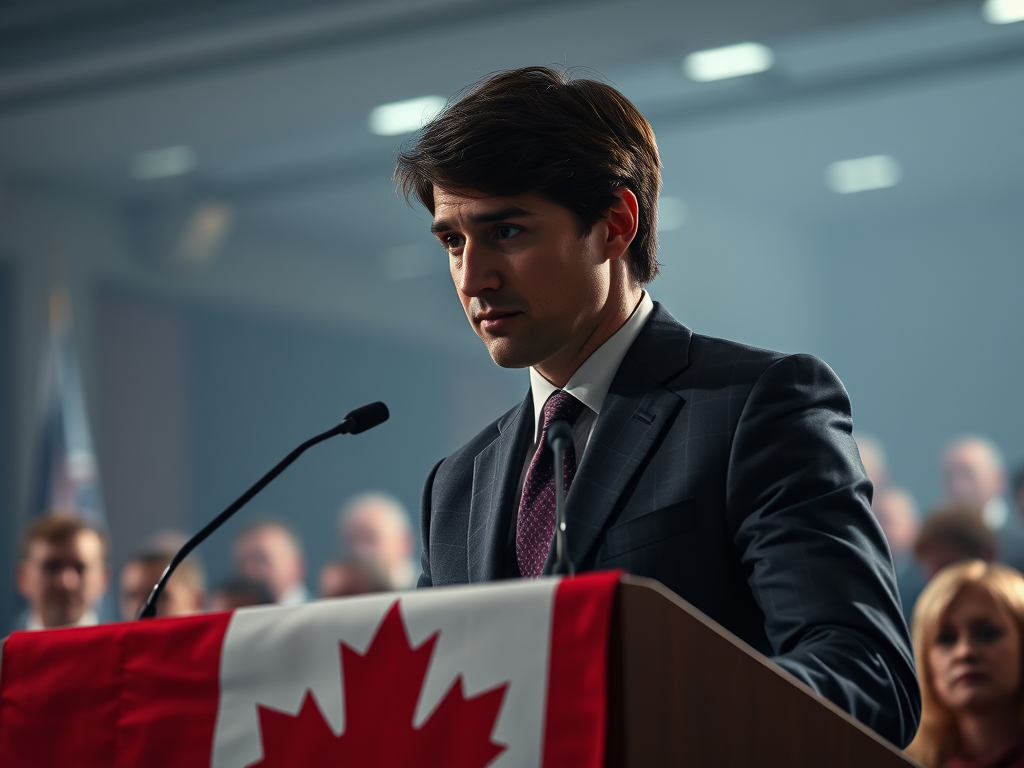

Justin Trudeau’s Trying to Save His Party. Is He Hurting Canada?

On Monday, Justin Trudeau’s announcement that he would step down marked the final move in a political game for Canada’s deeply unpopular prime minister, whose leadership had been steering his party towards a national defeat.https://wordpress.com/
His decision to step aside offers the Liberal Party an opportunity to reinvent itself in the absence of his leadership. However, it also leaves Canada in a vulnerable position, particularly as it faces the incoming President-elect, Donald J. Trump, who has threatened tariffs that could severely damage the Canadian economy.
It seems that Mr. Trudeau is prepared to take this risk.
By suspending Parliament until March 24 to allow his party’s members to elect a new leader—a process that will include campaigning—Mr. Trudeau has delayed a general election, which is expected to follow. While holding a leadership election before a national vote is common in parliamentary systems like Canada’s, suspending Parliament for this purpose is relatively rare. This move helps Mr. Trudeau avoid the collapse of his minority government and gives the Liberals time to choose a new leader without the burden of his declining poll numbers.
However, it also means that in just two weeks, when Mr. Trump resumes his role in the Oval Office, Canada will be led by a prime minister who has lost much of his mandate, weakening the country’s position in critical negotiations with its closest neighbor.
“With the prime minister stepping down, it will be difficult for him to negotiate meaningfully with the U.S.,” said Xavier Delgado, a senior associate at the Canada Institute of the Wilson Center. “It also doesn’t signal unity within Canada. This is not a great time for the country to be in this situation.”
Opponents of Mr. Trudeau have called for an immediate general election, which would enable a new government, potentially under Conservative leader Pierre Poilievre—whose party is currently leading in the polls—to swiftly take charge of Canada’s response to Mr. Trump.
The U.S. president-elect has repeatedly threatened to impose tariffs on Canadian goods, which could lead to a recession in Canada and destabilize the North American trade agreement. Mr. Trump has even suggested that Canada should become part of the United States, joking that it should become the “51st state.” He reiterated this message on social media following Mr. Trudeau’s resignation announcement, claiming that if Canada merged with the U.S., there would be no tariffs.

On Tuesday, Mr. Trump suggested at a news conference that he might resort to “economic force” to incorporate Canada, underscoring the stakes for the country.
When Mr. Trudeau first became leader of the Liberal Party, it was in disarray, having finished third in the 2011 national elections for the first time in its history. Since then, Mr. Trudeau has been credited with reviving the party and leading it back into government in 2015.
“The Liberal Party has been, for more than a decade, essentially Justin Trudeau’s party,” said Shachi Kurl, president of the Angus Reid Institute. “This has made it difficult for both the party to move on from him and for Mr. Trudeau to relinquish control.”
Yet, after weeks of internal pressure, Mr. Trudeau acknowledged on Monday that it was time to step aside. He explained that stepping down would help to reduce the internal conflict and allow the party to move forward. However, until the new leader is chosen, he will remain both prime minister and leader of the party.

The party’s election process, which will take several weeks, will give candidates the opportunity to present themselves to the public not as Trudeau’s associates but as individuals vying for leadership.
“I think the Liberals have finally accepted that there is no longer a future for him, but there is absolutely a future for someone else,” said Kurl.
However, with the Conservative Party leading by 25 percentage points in recent polls, the path that Mr. Trudeau leaves for his successor will be challenging.
“Sixty or 90 days aren’t enough to reinvent a party after 10 years in power,” Kurl added. “How many more tricks are there up their sleeve?”
For many Canadians, Mr. Trudeau’s resignation is seen as a necessary condition for considering voting for the Liberals again. Early polling suggests that many Canadians felt relieved by the announcement and view his departure as an opportunity for the Liberals to rebuild their relationship with the public.
“There is a sense of relief and optimism about the prime minister stepping down,” said David Coletto, head of Abacus Data. “This could provide an opportunity for the Liberals to reconnect with Canadians, but it’s not guaranteed.”

Although Mr. Trudeau’s departure could improve the Liberal Party’s prospects, analysts argue that Canada will be at a disadvantage with no clear leader during critical negotiations with the incoming U.S. administration.
“As the U.S. president-elect begins to implement his agenda, Canada will be trying to figure out who’s in charge,” said Delgado of the Wilson Center. “Canada would be stronger in negotiations with the U.S. if it could present a unified front behind a clear leader.”
Some, however, are less concerned about the immediate fallout, suggesting that Canada’s interactions with the Trump administration will unfold over a longer period.
Gerald Butts, a former top adviser to Mr. Trudeau, said that no leader could immediately secure a deal with Mr. Trump. “Nothing catastrophic will happen in the next three months,” Butts noted. “We’re looking at four years of Trump, and three months is just a small part of the story.”




Leave a Reply