
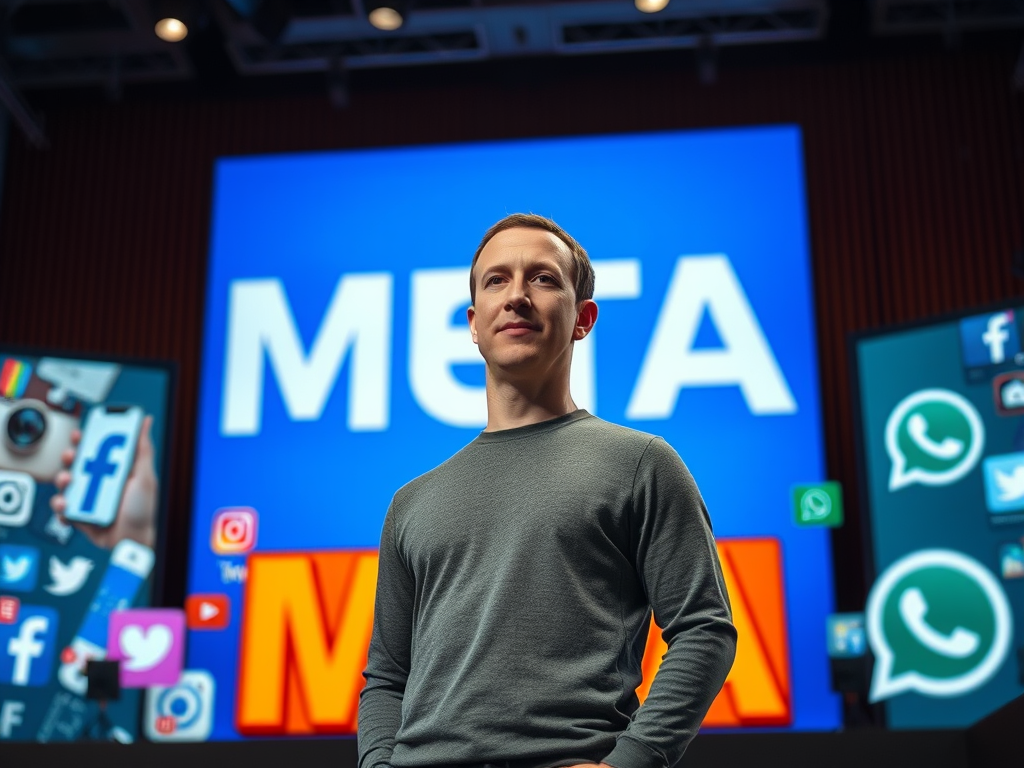

Meta to End Fact-Checking Program in Shift Ahead of Trump Term

On Tuesday, Meta announced it would be discontinuing its long-standing fact-checking program, a move that marks a significant shift in its approach to controlling misinformation across its social media platforms. The policy, which was initially introduced to curb the spread of false information, has now been re-evaluated as the company aligns itself with a more open stance on free speech, especially in light of the impending Trump administration.https://wordpress.com/
Meta, the parent company of Facebook, Instagram, and WhatsApp, revealed that it would allow more freedom of expression and depend more on users to flag or correct false content. The company intends to take a more tailored approach to political content and expressed regret over diverging from its core values in the past decade.
“It’s time to return to our roots of free expression,” said Mark Zuckerberg, Meta’s CEO, in a video announcing the policy changes. He acknowledged that the company’s fact-checking system had become too flawed and restrictive, leading to “too many mistakes and too much censorship.”

Zuckerberg admitted that the decision would result in more harmful content appearing on the platform. “This is a trade-off,” he said. “We will catch less harmful material, but we will also prevent fewer innocent users from having their posts or accounts unfairly removed.”
The decision comes after the political shift brought about by Donald Trump’s 2016 election victory, with Meta working to rebuild its relationship with the president-elect. Trump had previously accused social media companies of censoring conservative voices. In response to this, Meta has made several strategic moves to gain favor with Trump’s administration, including Zuckerberg’s visit to Mar-a-Lago, donations to Trump’s inauguration, and the promotion of Joel Kaplan, a senior executive with close ties to the Republican Party, to a top policy position.

Additionally, Meta announced that it would adopt a program similar to Twitter’s “Community Notes,” which relies on users to flag misleading or false content. Zuckerberg also confirmed that Meta would relocate its U.S. trust and safety operations to Texas, citing a desire to operate in a region less concerned with the perceived bias of its teams.
While Meta’s announcement received praise from some conservative allies, including Senator Rand Paul, others, like Senator Marsha Blackburn, criticized the move as a tactic to avoid regulation. Internally, Meta employees expressed mixed reactions, with some applauding the decision as a return to the company’s founding principles, while others decried it as a betrayal of the hard work put into content moderation.
Misinformation researchers expressed concern about the potential consequences of the policy change. Nicole Gill, Executive Director of Accountable Tech, warned that the decision would likely lead to a resurgence of hate speech, disinformation, and conspiracy theories, echoing the harmful content that fueled the January 6 Capitol riot.
Meta’s fact-checking policy was established in 2016 after Facebook came under fire for the spread of misinformation during the U.S. presidential election. Since then, the company has invested billions of dollars and thousands of employees to combat false content. However, Zuckerberg has increasingly become frustrated with the lack of recognition for these efforts and the diminishing impact of content moderation.

Zuckerberg’s views on content moderation have evolved over time, including his public frustration with the Biden administration’s requests to censor COVID-19-related content. By 2022, Meta began to reduce its content moderation teams as part of broader corporate cost-cutting measures.
The changes announced this week also include lifting restrictions on topics such as immigration and gender identity, which Zuckerberg claimed were no longer aligned with mainstream discourse. Meta plans to introduce more personalized political content based on users’ preferences, signaling a move toward more customized social media experiences.
Zuckerberg’s personal transformation has also influenced these decisions. In recent years, he has grown closer to figures like UFC President Dana White, whose right-leaning views have shaped Zuckerberg’s perspectives. This shift comes as Zuckerberg grows weary of the ongoing attacks on his company and the increasing scrutiny from policymakers.
Ultimately, Meta’s policy reversal represents a move towards greater openness, in line with the incoming Trump administration’s more lenient stance on free expression, signaling a new chapter in the company’s approach to content moderation.


Leave a Reply