

Can BAM Be a Trailblazer Again Through A.I.?

“A journalist finds himself in the woods.” These words were spoken by Marc Da Costa, a digital artist with a Ph.D. in anthropology, as he operated an AI-driven video installation at the ONX Studio, a cutting-edge media lab located within the Olympic Tower in Midtown Manhattan. Da Costa was conversing with the AI system powering the installation. The subject? Me.https://wordpress.com/
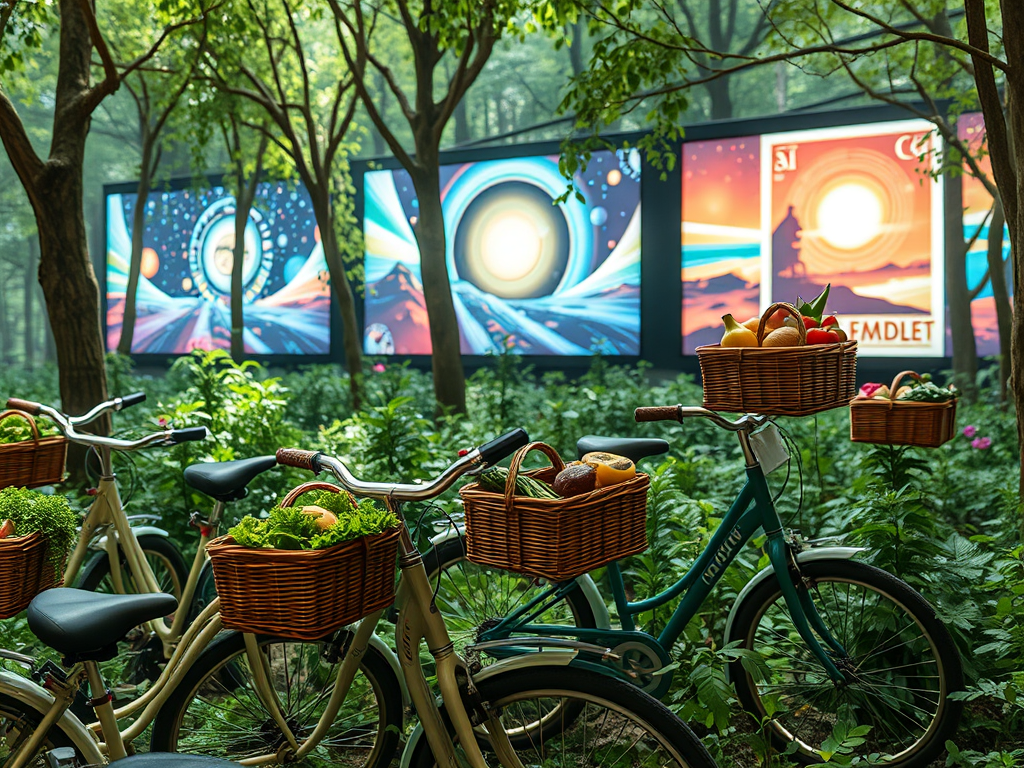
“A vast fleet of food delivery bikes appears,” Da Costa continued, weaving an absurd narrative that the AI would soon visualize on the screen. “The skies part, revealing a galactic, benevolent being wielding a scepter. Frank and this cosmic entity meet the delivery drivers and enjoy a meal together beneath the forest canopy…”

Moments later, the story materialized on three massive video screens surrounding us, rendered in a delightfully vintage style reminiscent of early 20th-century travel posters. Each bike in the imaginary fleet carried a wicker basket brimming with food, and the digital forest—though entirely synthetic—felt lush and inviting. A soothing, posh voice, akin to an Oxbridge-educated narrator, recounted the whimsical tale.

Da Costa was presenting The Golden Key, one of four digital video installations showcased in a black box theater at the Brooklyn Academy of Music’s Fisher Building. Together, these installations form Techne, the final act of BAM’s Next Wave Festival, a program aimed at offering cutting-edge art after the organization scaled back its activities and cut 13% of its staff in 2023.


Running until January 19, Techne serves as a festival within a festival, curated and primarily funded by Onassis ONX, a digital culture initiative of the Onassis Foundation. ONX provides state-of-the-art studio facilities to artists free of charge, making this innovative work possible.
The series began with The Vivid Unknown, an AI-driven reinterpretation by John Fitzgerald and Godfrey Reggio of Reggio’s 1982 film Koyaanisqatsi. Following this, The Golden Key takes inspiration from a Brothers Grimm tale, a short story that encouraged readers to craft their own ending over 200 years ago. It will be succeeded by Voices, an exploration of the spiritual realm by Athens-based video artist Margarita Athanasiou, and Secret Garden, a compilation of success stories from Black women curated by Brooklyn-based artist Stephanie Dinkins. With the exception of Voices, each installation invites interaction, either through audience responses or, in the case of The Golden Key, direct input via computer kiosks in the theater space.

Some of the most compelling works in Techne use AI to critique technology itself. Fitzgerald describes it as “a machine that’s out of control.” Similar to Koyaanisqatsi—a Hopi term roughly translating to “life out of balance”—The Vivid Unknown presents a wordless tapestry of sound and visuals that underscore humanity’s estrangement from nature. Unlike the original film, however, the AI version features no real photography or Philip Glass’s iconic music. Instead, the visuals and audio are generated entirely by software trained on the original film and score.

Fitzgerald first encountered Koyaanisqatsi in 2001 while studying anthropology at Brown University. The experience inspired him to switch to film studies, where he became fascinated with immersive storytelling. Years later, he met Reggio in Santa Fe, New Mexico, sparking the collaboration that led to The Vivid Unknown.
The Techne installations made their way to BAM through Karen Brooks Hopkins, a former president of the organization and now a board member of the Onassis Foundation’s U.S. branch. She helped secure BAM as a public venue for showcasing ONX’s experimental works.
Unlike popular immersive art experiences—such as Van Gogh-themed lightshows—Hopkins sees Techne as an effort to integrate digital media into the performing arts. By doing so, it aims to attract today’s adventurous audience much like BAM did in the 1980s with experimental performances.

BAM itself is still recovering from the pandemic, which led to significant drops in attendance and funding. The organization has also undergone leadership changes, with Gina Duncan becoming president in 2022 and Amy Cassello stepping into the artistic director role just six months ago.
While The Golden Key may seem like an entertaining digital toy, Da Costa views it as something deeper. “It’s an encounter with a future where machines tell us stories,” he explained during a preview at ONX Studio. After training their AI on an extensive folklore database, Da Costa and co-creator Matthew Niederhauser programmed it to create simulated myths—stories that have traditionally helped civilizations understand themselves.
But what happens if AI systems start fabricating meaningless or even harmful narratives on an industrial scale? Da Costa highlighted the risks of unchecked technological control, noting the economic and political interests that could drive these tools. Niederhauser echoed the sentiment, emphasizing the importance of artists engaging with technology to foster critical thinking.
As Techne demonstrates, this is a pivotal moment for art and technology to converge—not only to entertain but also to challenge our perceptions and question the implications of our increasingly AI-driven world.

Leave a Reply