
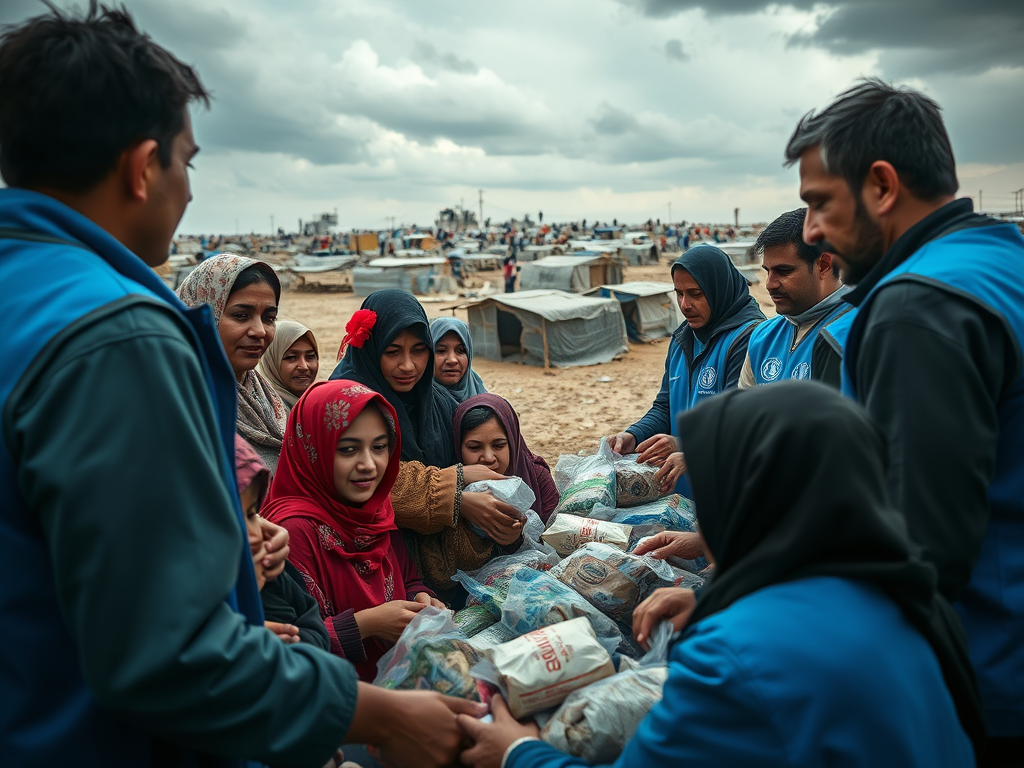

Israeli Threat to Banish Aid Agency Looms Over Gaza

For Palestinians, the United Nations Relief and Works Agency (UNRWA) is an essential lifeline, delivering critical food, water, and medical supplies to countless Gazans who have endured more than a year of conflict.https://wordpress.com/
However, for the Israeli government, the agency is seen as a dangerous entity that shields Hamas, the militant Palestinian group responsible for the 2023 surprise attack on Israel. Recently, Israeli lawmakers have moved to shut down UNRWA by passing two bills, which are expected to come into effect this month.
If these new laws are enforced, United Nations officials have warned that no organization will be able to take over UNRWA’s vital operations, and its humanitarian work in Gaza could cease at a time when experts are warning of an impending famine in the region.
In response, U.N. officials are preparing for the potential shutdown of UNRWA operations in both Gaza and the Israeli-occupied West Bank.
“It would have a massive impact on an already dire situation,” said Jamie McGoldrick, who oversaw U.N. humanitarian operations in Gaza and the West Bank until April. “If Israel’s goal is to remove any ability for us to save lives, you have to question what their intentions are and what they hope to achieve.”
UNRWA, the primary U.N. agency assisting Palestinians, is distinct from other U.N. bodies. With a workforce of 30,000—predominantly Palestinian staff—UNRWA provides schools, medical care, job training, food distribution, and even waste collection to over six million Palestinians across Gaza, Jordan, Lebanon, Syria, and the West Bank.
Since the onset of the conflict in Gaza, UNRWA has become a cornerstone of the international aid effort. With 5,000 employees still working on the ground, the agency oversees aid distribution, shelters, medical clinics, and food programs, in addition to clearing trash, human waste, and supplying fuel to power essential services like hospitals and water wells.
“The world has abandoned us. We have nothing but the aid from UNRWA to survive,” said Sami Abu Darweesh, 30, a resident of a refugee camp in southern Gaza managed by UNRWA. “If that stops, what will we do?”
The relationship between Israel and UNRWA has been strained for decades, but it fractured in 2023 after Israel accused 18 agency employees of participating in the October 7 Hamas-led attack on Israel. Israel has also claimed that Hamas uses UNRWA schools to hide fighters.
A U.N. investigation found that nine employees were involved in the attack on Israel, and they were dismissed. U.N. officials largely reject Israel’s allegations, stating that the Israeli government has not shared much substantial evidence.

A New York Times investigation of Hamas records revealed that at least 24 Hamas and Islamic Jihad members, a smaller Palestinian militant group, were employed at UNRWA schools.
In late October, Israel’s Parliament passed legislation to ban UNRWA activities in Israeli-controlled areas. This ban is expected to take effect within 90 days, this month.
There are still many uncertainties about how the law will impact operations outside of Israeli territory, particularly in Gaza and the West Bank, as the Israeli government has not fully clarified its stance on enforcement.
Sharren Haskel, Israel’s deputy foreign minister, did not provide specifics when asked about the government’s approach to UNRWA in the Palestinian territories. She only suggested that Palestinian authorities should manage UNRWA operations in the West Bank and accused the agency of harboring terrorists in Gaza.
U.N. officials say they are preparing to suspend operations in both Gaza and the West Bank because the new laws would make it impossible for Israeli officials to interact with UNRWA, a vital part of coordinating humanitarian aid. UNRWA claims it must coordinate with Israel’s military for every delivery of aid and for movement across Gaza and parts of the West Bank.

“If we can’t share that information with Israeli authorities on a daily basis,” said Louise Wateridge, a senior UNRWA official in Gaza, “we put our staff’s lives in danger.” She added that more than 250 UNRWA workers had been killed in the ongoing Gaza conflict.
The Israeli lawmakers behind the legislation hope that the law will effectively force UNRWA out of Gaza and the West Bank. Some have indicated that the 90-day period is meant to allow other aid organizations to step in and fill the gap left by UNRWA.
“We’ve given the government 90 days, and the whole world 90 days,” said Yuli Edelstein, the chairman of the parliamentary committee that drafted the bills. “Those who truly care about the population should bring in the organizations that will help.”
In recent months, Israel has distanced itself from cooperating with UNRWA, according to agency officials. UNRWA has reported that Israel’s military has blocked the agency from using crossings into northern Gaza, an area subject to heavy Israeli attacks. Additionally, UNRWA’s aid deliveries have been looted in southern Gaza, forcing the agency to stop shipments at a key border crossing since early December.
The situation has become increasingly dire for the people of Gaza. Enas al-Hila, 31, a mother of three who fled her home in central Gaza, now lives in a camp managed by UNRWA. She depends on the agency for food, dried milk, and diapers, but has recently had to purchase these basic items from resellers at exorbitant prices.
“UNRWA has always been our only hope for jobs, food, flour,” she said. “It’s the lifeline for us and our children, just as it was for our parents and grandparents.”
Founded in 1949, UNRWA was created to assist the approximately 750,000 Palestinians displaced by the 1948 war surrounding Israel’s establishment. Many Israelis view the agency as perpetuating the conflict because it allows generations of Palestinians to inherit refugee status. Some also accuse UNRWA of indoctrinating Palestinian youth to hate Israel, though the United Nations denies these claims.

Since the laws banning UNRWA passed, the Israeli government has maintained a steady stream of criticism toward the agency, suggesting that other aid groups are ready to take its place.
The United States, a major donor to UNRWA, has pressured Israel to allow the agency to continue operating. However, the U.S. suspended funding in January after Israel’s accusations. In October, U.S. officials warned that banning UNRWA would “devastate the Gaza humanitarian response at this critical moment.”
Before the conflict, UNRWA operated 288 schools that educated 300,000 students in Gaza—nearly half of the territory’s school-age children—and its 22 medical clinics saw 2.6 million patient visits annually. Now, as the war continues, it remains central to the aid response in Gaza, where it has become woven into the fabric of daily life.

Yasser Abu al-Assal, 39, recalls how his grandparents used to say, “You have God with you and the UNRWA coupon.” His family had always relied on the agency for education, healthcare, and food. “Now, even that promise feels like it’s slipping away,” he said.
UNRWA also plays a vital role in the West Bank, serving 900,000 Palestinians. In the Qalandiya refugee camp, UNRWA provides schools, job training, medical services, and waste collection, all free of charge. The camp, with a population of 16,500, is one of the areas most likely to be affected by the new laws.
Without UNRWA, residents like Jamila Lafi, 40, who relies on the agency’s education and healthcare services for her three children, fear they will have nowhere else to turn. “Without UNRWA, I don’t know how we’d survive,” she said.



Leave a Reply