
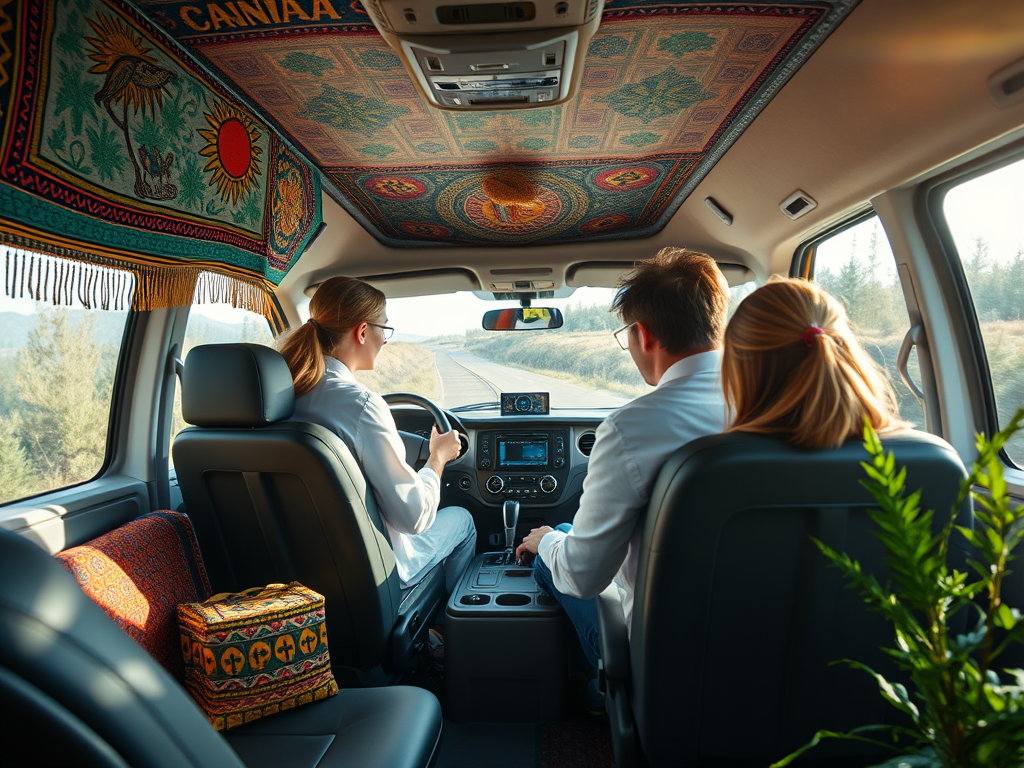

In Colorado, the birthplace of America’s experiment with legal recreational marijuana over a decade ago, federal scientists are paying regular cannabis users to consume marijuana as part of an innovative research effort.https://wordpress.com/
This unique study, conducted in vans decorated with hippie tapestries and using a modern car simulator, addresses a critical issue in road safety: the lack of reliable tools to detect cannabis-impaired driving, which has become more pressing as marijuana use grows nationwide.

Unlike alcohol, cannabis impairment is much harder to measure accurately. Law enforcement officers often require a warrant to obtain blood samples from suspected impaired drivers, and even when tests are conducted, they cannot reliably determine whether marijuana was consumed hours or days before an incident. As a result, the connection between cannabis use and road safety remains unclear.

State laws on cannabis-impaired driving vary widely, creating confusion for both police and motorists. “We’re kind of painting the plane as we fly it when it comes to cannabis liberalization,” said Jake Nelson, director of traffic safety advocacy at AAA, an organization opposing recreational marijuana legalization. He added that public health and safety often take a back seat in discussions about marijuana policy.
National data on marijuana’s impact on road safety is limited, though studies suggest that cannabis use can impair a driver’s ability to react quickly and judge distances. To fill this gap, scientists in Colorado are working on two studies. One aims to develop portable breathalyzers capable of detecting recent marijuana use. The other involves observing stoned drivers in a car simulator to assess how cannabis affects motor skills and reflexes in both regular and occasional users.
“There isn’t much data here,” noted Tara M. Lovestead, a chemical engineer at the National Institute of Standards and Technology, which oversees the research. Policymakers need such data to create practical and enforceable regulations.

The widespread accessibility of marijuana has compounded these challenges. Today, 39 states allow medical use, and 24 have legalized recreational use. A 2023-2024 Gallup survey showed that 15% of American adults use marijuana, more than double the rate in 2013. Additionally, a significant number of drivers admit to using cannabis before driving. A 2019 AAA survey found that 14.8 million motorists had driven within an hour of using marijuana, and a Virginia study revealed that 22% of drivers admitted to driving stoned occasionally or more frequently.
Legislation across the U.S. reflects a patchwork approach. Some states have adopted zero-tolerance THC laws, while others use a blood THC limit akin to drunk-driving regulations. However, experts warn that these alcohol-based frameworks are ill-suited for cannabis. Unlike alcohol, cannabis affects users differently depending on how it is consumed, with smoked marijuana taking effect quickly and wearing off sooner than edibles, which have a delayed and longer-lasting impact.

Statistics from Colorado and Washington—the first states to legalize recreational marijuana—show inconsistent trends regarding fatal crashes involving drivers with marijuana in their systems. THC can linger in the bloodstream long after its psychoactive effects fade, further complicating efforts to establish clear links between cannabis use and impaired driving.
Pam Fischer of the Governors Highway Safety Association highlighted that many states have focused on tax revenue from marijuana sales without adequately addressing potential risks to road safety. Meanwhile, personal stories like that of Mary Kazmark, whose daughter was killed in a crash involving a driver who had used marijuana hours earlier, underscore the human toll of the issue. Kazmark lamented the lack of reliable methods to measure cannabis impairment, saying, “If they had that in place, more people would think twice before lighting up.”
Challenges in prosecuting cannabis-related impaired driving cases are also evident. Sacramento prosecutor Greg Hayes noted the difficulty of proving impairment and combating societal attitudes that dismiss the risks of driving under the influence of marijuana. These challenges are compounded when jurors themselves may have used cannabis before serving.
In Nevada, Jeff Krajnak’s experience illustrates the limitations of existing laws. Following a fatal car crash, Krajnak faced charges despite passing a field sobriety test and claiming he last used marijuana nearly 19 hours before the incident. Blood tests showed THC levels above the legal limit, but Krajnak argued that such thresholds fail to account for the nuances of cannabis impairment.
Experts like Ashley Brooks-Russell, a public health professor running the federally funded driving simulator study, emphasize that cannabis and alcohol impair drivers in different ways. Cannabis users often drive more cautiously, while drunk drivers tend to be aggressive. Brooks-Russell advocates for tailored policies rather than relying on frameworks designed for alcohol.
“There’s a lot of wishful thinking that it should be like alcohol,” she said. “But it’s not.”




Leave a Reply