
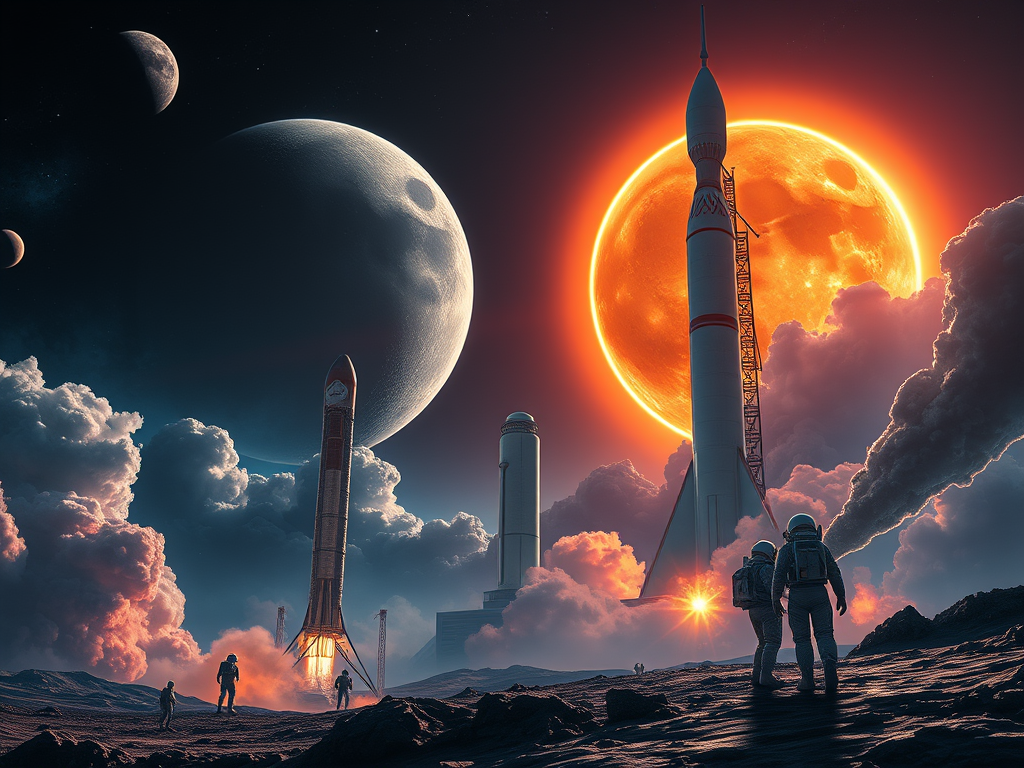

Big Rockets, a Big Telescope and Big Changes in Space Await in 2025

Our species labeled its latest 366-day voyage around the sun as “2024,” packing it with extraordinary astronomical and spaceflight milestones.https://wordpress.com/
A solar eclipse traversed North America. Two robotic landers made mostly successful arrivals on the moon. The most powerful rocket booster ever constructed was dramatically caught by mechanical arms dubbed “chopsticks.” A mission to explore Europa, Jupiter’s icy ocean moon, began. Private astronauts even embarked on a daring spacewalk.

As we set our sights on another solar orbit, aptly named “2025,” the question remains: will this year measure up? That’s for you to decide as you witness the anticipated wonders on launchpads and in the night sky.
For a front-row seat to these events and more, don’t forget to check The Times Space and Astronomy calendar regularly.

Jeff Bezos Joins the Race
Elon Musk’s SpaceX has long been the dominant force in space exploration. However, Jeff Bezos, founder of Amazon, may soon challenge Musk’s leadership with his space company, Blue Origin.
Blue Origin’s powerful New Glenn rocket, designed for reusability like SpaceX’s Falcon 9, is expected to take its maiden flight in 2025. It could launch U.S. military satellites, NASA missions, and even lunar landers, signaling a competitive leap forward.

Additionally, Bezos’s company is set to bolster Amazon’s Project Kuiper, which aims to rival SpaceX’s Starlink by deploying a vast network of internet satellites. Blue Origin will also collaborate with other companies such as United Launch Alliance and Arianespace to achieve this goal.
A New Dawn for Astronomy

In Chile, atop a mountain, the Vera C. Rubin Observatory nears completion and may capture its first cosmic images as early as July 4. Previously known as the Large Synoptic Survey Telescope, this observatory is poised to revolutionize our understanding of the universe with its cutting-edge digital camera.
Named after Vera Rubin, whose work confirmed the existence of dark matter, the observatory will create a time-lapse view of the Southern sky. These observations promise to deepen our knowledge of dark matter and dark energy, unveil the Milky Way’s origins, and identify potentially hazardous celestial objects.

Lunar Exploration and Political Shifts
Under the Trump administration, the U.S. space policy pivoted toward lunar exploration—a direction the Biden administration maintained. With Donald Trump poised to return to office, there’s speculation about potential shifts, including scrapping NASA’s costly rocket project or prioritizing human missions to Mars, aligning with Musk’s ambitions.
Meanwhile, robotic lunar missions are set to continue. Early 2025 could see launches from Firefly Aerospace and Japan’s Ispace on a shared SpaceX rocket. Later, Intuitive Machines may deploy its second lander, Athena, carrying NASA instruments to search for lunar ice.
Farewell to Voyagers
The Voyager 1 and Voyager 2 spacecraft, launched in 1977, have spent decades inspiring awe. Having explored the outer planets and ventured into interstellar space, their signals are now faltering as their power dwindles. Though nearing their journeys’ end, their legacy endures, highlighted by the iconic “Pale Blue Dot” image of Earth.
India’s Space Ambitions
India’s space program is advancing human spaceflight, with astronaut Shubhanshu Shukla set to join a spring mission to the I.S.S. via Axiom Space. Domestically, India’s Gaganyaan project is preparing for an uncrewed orbital test, aiming for its first crewed mission by 2026.
New Rockets and Milestones
SpaceX continues to push boundaries with Starship, the most powerful rocket to date, aiming for 25 launches in 2025. Other innovations include Rocket Lab’s reusable Neutron rocket and Sierra Space’s Dream Chaser spaceplane, both of which are slated for debut missions this year.




Leave a Reply