

Trump Weighs In on Immigrant Visa Debate but Offers Little Clarity

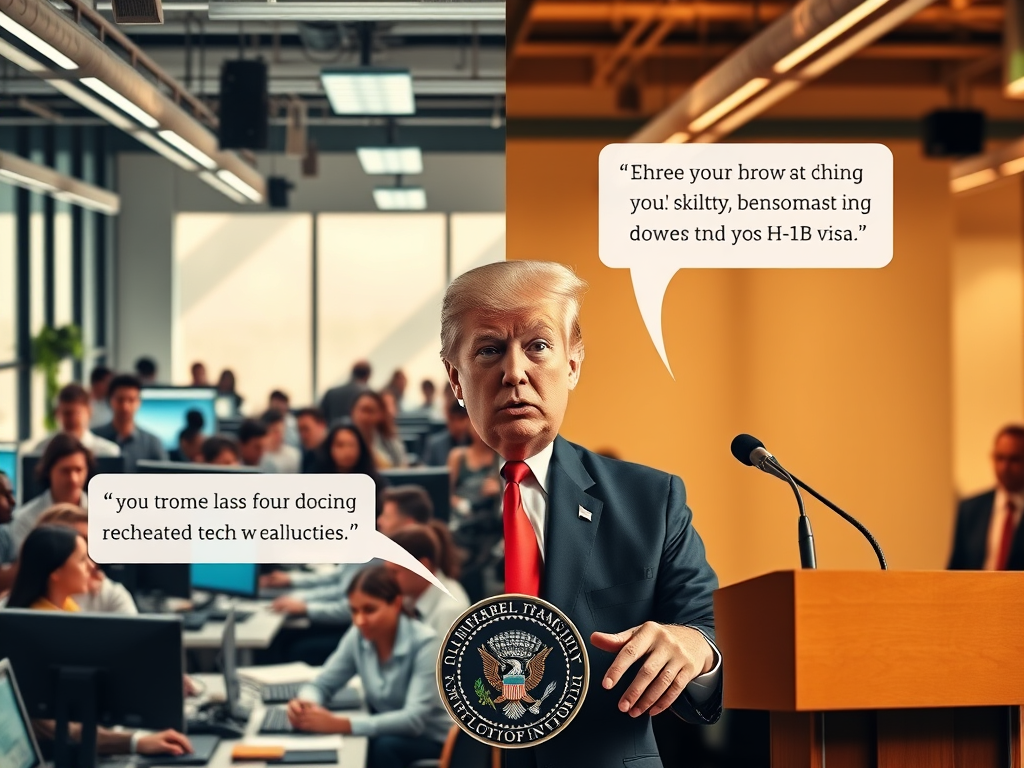
On Saturday, President-elect Donald J. Trump appeared to address a divisive discussion among his supporters regarding the role of skilled immigrant workers in the U.S. economy. He acknowledged that he had made significant use of work visas for skilled employees in the past and expressed support for the program.https://wordpress.com/
“I have many H-1B visas on my properties,” Trump stated in an interview with The New York Post. “I’ve always believed in H-1B. It’s an excellent program, and I’ve utilized it extensively.”
While Trump’s remarks were warmly received by the tech industry as a sign of his endorsement, they have created some confusion. Data suggests that his companies have only limited experience with the H-1B visa program, which allows skilled professionals, such as software engineers, to work in the U.S. for up to three years, with a possible extension to six years.
Instead, Trump’s businesses have frequently relied on the H-2B visa program, designed for unskilled workers like gardeners and housekeepers, and the H-2A program for agricultural laborers. These visas typically allow workers to stay for up to 10 months. Over the past two decades, federal data shows that Trump’s companies have been approved to employ more than 1,000 workers under the H-2 programs.
Trump’s transition team did not respond to multiple inquiries seeking clarification about which visa program he was referring to during the interview. However, in response to an earlier query on his stance on work visas, the team provided a 2020 speech text in which Trump emphasized the contributions of American workers to the nation’s growth, stating, “Americans must never lose sight of this miraculous story.” While campaigning in 2016, Trump criticized the H-1B program, labeling it “very bad for workers” and suggesting it should be eliminated.
Despite these conflicting signals, the tech industry celebrated Trump’s recent remarks. Elon Musk, the world’s richest man and an outspoken proponent of H-1B visas, joined the conversation. Ian Miles Cheong, a prominent social media influencer, shared a post on X (formerly Twitter), claiming, “Donald Trump backs Elon Musk on H-1B visas.” Musk, a naturalized U.S. citizen who once held an H-1B visa himself, replied simply, “Indeed.”
Musk has often defended H-1B visas, arguing that they address a persistent shortage of highly skilled engineers in the U.S. “There is a permanent shortage of excellent engineering talent,” he posted on X on Christmas Day. Musk’s companies, including Tesla, have benefited significantly from the program, with Tesla obtaining 724 H-1B visas this year alone.
The issue of work visas has created a sharp divide among Trump’s supporters. Many of his followers advocate for stricter immigration controls and oppose programs like H-1B, which they see as a threat to American jobs and sovereignty. On the other hand, Silicon Valley backers of Trump argue that the visas are essential for maintaining competitiveness in the tech industry.
The debate intensified last week, with right-wing activist Laura Loomer taking to social media to criticize the visas, calling them a national security risk. Her outspokenness resulted in the loss of her verified status on X, cutting off potential income from her large following.
Meanwhile, Musk responded to critics with a controversial comment defending H-1B visas as vital to the success of companies like Tesla and SpaceX. Trump adviser Stephen K. Bannon, who opposes both H-1B and H-2 programs, weighed in by criticizing Musk’s stance. Bannon argued that such visas depress wages for American workers while benefiting billionaires, stating, “This is war. I’m glad we’re having this debate now before Trump takes office.”
Both H-1B and H-2 visa programs are managed by the Department of Labor, with differing regulations. The H-1B program has an annual cap of 65,000 visas, while the H-2B program for non-agricultural unskilled labor is capped at 66,000. The H-2A program for agricultural workers has no cap but is limited to specific industries.
From 2003 to 2017, Trump’s businesses obtained over 1,000 H-2 visas for jobs such as cooks, housekeepers, and waitstaff at properties like Mar-a-Lago in Florida. Federal records also indicate that his companies have applied for a limited number of H-1B visas since 2019, primarily for quality control managers, though many applications were later withdrawn.
Most recently, in 2022, Trump Media & Technology Group sought an H-1B visa for a “product data analyst” role with a $65,000 salary. It remains unclear whether the position was filled. Trump’s Virginia winery also posted openings for 31 foreign vineyard workers under the H-2A program, offering $15.81 per hour.

Leave a Reply