
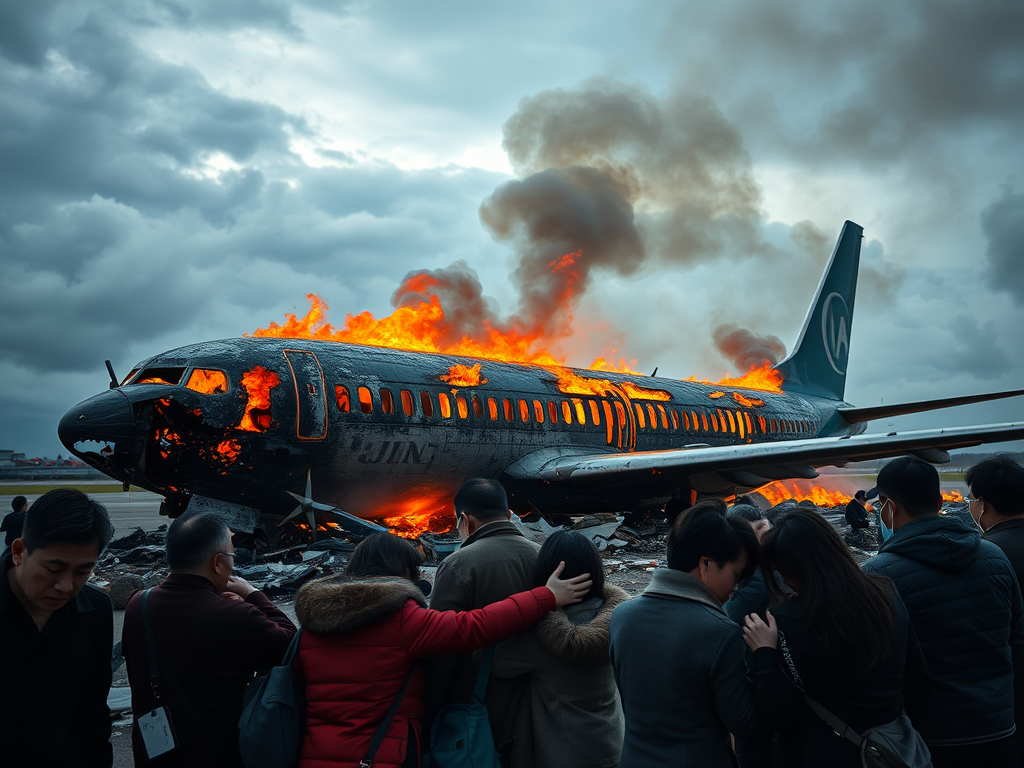
A passenger plane carrying 181 people veered off the runway at high speed, crashing into a wall and bursting into flames.
Anger and Agony in South Korea After Tragic Jeju Air Crash: South Korea’s Deadliest Aviation Disaster Crash-Lands, Killing 179

Two crew members were pulled alive from the tail section of the burning wreckage, but throughout Sunday, devastating updates reached the anxious families gathered at Muan International Airport in southwestern South Korea.https://wordpress.com/
By Sunday night, authorities confirmed that all 179 other individuals onboard had perished, marking the Jeju Air crash as South Korea’s deadliest aviation disaster in nearly 30 years and the worst to occur on its soil.

Globally, the crash was the most catastrophic since Lion Air Flight 610 plunged into the Java Sea in 2018, killing all 189 onboard, according to the International Civil Aviation Organization, a UN agency.
Investigators are probing the incident to determine the cause, focusing on the reported landing gear malfunction and the possibility of bird strikes.
As speculation about the crash’s cause grew, hundreds of relatives of the passengers endured an agonizing wait at Muan airport. Cries of despair echoed through the terminal on Sunday afternoon. A young woman held an older woman who wept over her son, while others embraced in shared grief.

By evening, only 65 victims had been identified through fingerprints and other methods, with some bodies so severely damaged that even their gender could not immediately be determined. Among the identified were a 23-year-old flight attendant and a 78-year-old male passenger.
Jang Gu-ho, 68, sat in the arrivals hall next to his tearful wife, having rushed from Mokpo after hearing that five family members—his wife’s sister, niece, nephew-in-law, and two grandchildren—were on the flight. “We’re in shock,” he said stoically.
Meanwhile, officials worked behind closed doors to identify remains retrieved from the crash site. Names of confirmed victims were periodically posted in the arrivals hall, prompting frantic crowds to check the lists.
This tragedy shook South Korea at a time of political turmoil following President Yoon Suk Yeol’s controversial martial law declaration and subsequent impeachment. Acting President Choi Sang-mok, the Deputy Prime Minister, faced his first major challenge as he hurried to oversee the response.

South Korea had not seen such a major aviation disaster since the 1997 Korean Air crash in Guam, which claimed 229 lives. Jeju Air, founded in 2005, had no prior fatal incidents until this crash. The airline’s CEO, Kim E-bae, publicly apologized, stating that the exact cause of the accident remained unclear.
The ill-fated Jeju Air Flight 7C2216, a Boeing 737-800, departed from Bangkok with 175 passengers and six crew members, mostly South Koreans, along with two Thai nationals. Trouble began as the jet attempted to land in Muan.
Footage showed the aircraft skimming the runway on its belly before slamming into a barrier and erupting in flames. Witnesses described a loud explosion, and photos captured thick black smoke billowing from the crash site.
The plane disintegrated upon impact, leaving only the tail section identifiable. The two surviving crew members were rescued from this portion of the aircraft, said Lee Jeong-hyeon, the official leading search and rescue operations.

Investigators are piecing together the moments leading up to the crash. Shortly before landing, airport staff warned the pilots about potential bird strikes. Witnesses reported hearing explosion-like noises, and television footage showed brief flames trailing from one of the engines.
The pilots issued a mayday call after the warning, aborting their initial landing attempt. The disaster occurred during their second attempt from the opposite direction, a maneuver approved by air traffic control.
Bird strikes in the muddy tidal flats near Muan, a common resting place for migratory birds, are under scrutiny. Experts believe the engines may have ingested birds, potentially damaging the hydraulic system and preventing the deployment of the landing gear.

Additional analysis suggested the wing flaps were not activated, which likely caused the plane to land at excessive speed. Investigators warn that determining the exact cause could take years.
At the airport, anguished families demanded information. As officials announced identified victims, some relatives sobbed while others voiced frustration over the slow flow of updates. Many provided DNA samples to aid in identification.
Temporary tents were set up for grieving families, and cars lined the roads leading to the terminal. Despite hours of waiting, Mr. Jang and his wife remained at the airport, bracing for a long, sorrowful night. “This is going to take a while,” he said.



Leave a Reply