
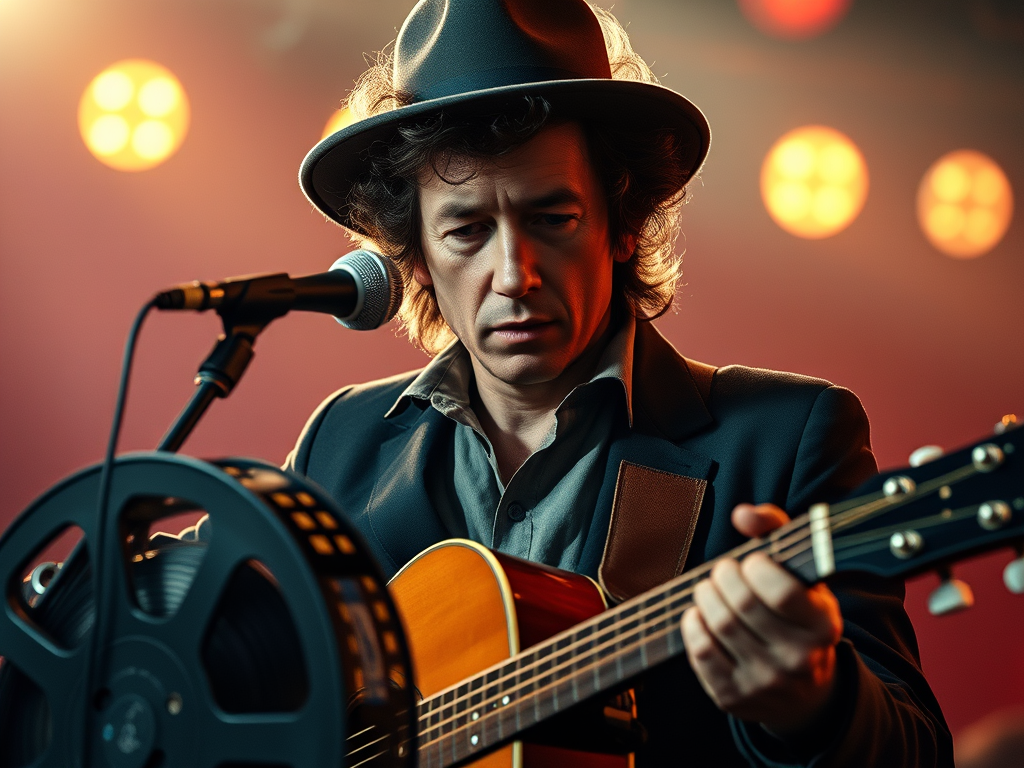

Dylan’s Path from Stage to Screen
Bob Dylan on Film: A Guide to the Movies’ True Shapeshifter

For decades, the transition from concert stages to Hollywood has been a well-traveled route. Legends like Elvis, The Beatles, Madonna, and Taylor Swift have embraced the journey. Yet, Bob Dylan’s cinematic presence remains uniquely captivating. He’s not just a singer; he’s a storyteller, a documentary subject, a commercial figure, and even a mysterious character wielding a sharp knife. Spanning seven decades, Dylan has been omnipresent, though never predictable.
Dylan’s identity itself seems a role he’s perpetually performing. Born Robert Zimmerman, he began as a folk singer championing protest songs, only to shatter expectations by going electric—a moment so iconic it inspired numerous films. His ever-evolving nature defines him: whenever Dylan becomes predictable, he reinvents himself.
Dylan, the Shape-Shifting Artist

Watching films about Dylan often reveals his trickster-like essence, blurring authenticity and identity. The upcoming biopic A Complete Unknown, starring Timothée Chalamet, portrays Dylan as a quintessential postmodern artist. It highlights his emergence in an era when absolute truths and rigid artistic norms were being dismantled. In a world of flux, why shouldn’t an artist embrace change?
Dylan’s Early Days on Film

Dylan’s early career coincided with advancements in documentary filmmaking, enabling directors to capture candid moments. Films like Murray Lerner’s Festival chronicled counterculture movements, with Dylan’s controversial 1965 Newport Folk Festival performance—where he “went electric”—as a pivotal moment.https://wordpress.com/
Another landmark was D.A. Pennebaker’s 1967 documentary Dont Look Back, which followed Dylan on his 1965 UK tour. Showcasing his confrontational charisma and wit, the film has earned its place as an essential piece of American cinematic history.

Dylan also experimented with directing, as seen in Eat the Document (1972), which he edited following his recovery from a motorcycle accident. While never widely released, its footage has influenced later Dylan films, including Martin Scorsese’s documentaries.
Dylan as an Actor and Filmmaker

In the 1970s, Dylan transitioned to acting and film scoring. He contributed the Grammy-nominated soundtrack for Pat Garrett and Billy the Kid (1973) and portrayed a mysterious character aptly named Alias. This marked the beginning of his involvement in experimental films like Renaldo and Clara (1978), a blend of truth and fiction featuring Dylan and collaborators like Joan Baez.
However, his film career hit a rough patch with Hearts of Fire (1987) and the dystopian Masked and Anonymous (2003), co-written by Dylan under the pseudonym Sergei Petrov. Despite their shortcomings, these films reflect Dylan’s continued fascination with challenging conventions.

Revisiting Dylan’s Legacy
The 21st century brought renewed appreciation for Dylan’s archival footage. Scorsese’s No Direction Home (2005) delves into Dylan’s formative years, while films like The Other Side of the Mirror (2007) and 65 Revisited (2007) offer fresh perspectives on his Newport and UK tours.
Dylan’s enigmatic persona also extended to commercials, from Victoria’s Secret campaigns to Chrysler ads, further solidifying his cultural ubiquity while defying expectations.

Dylan as a Cinematic Mystery
In recent years, portrayals of Dylan have shifted from celebrating his legacy to exploring his enigmatic essence. Filmmakers now treat him as a lens through which to examine stardom and artistic identity in modern culture. The intrigue lies not in uncovering who Dylan is but in embracing the mystery of who he might become.




Leave a Reply